
REVIEW · OLD TOWN WALKING TOURS
Private 3-hour Poznan Old Town Tour
Poznan rewards curious walkers. This private three-hour tour pairs Cathedral Island with the Old Town, so you get both the city’s early Polish roots and its lively medieval center. I like the one-group format, which lets you ask questions as you go, and I like the clear route from Ostrów Tumski to Plac Wolności. The main drawback is that optional admissions, including the Croissant Museum, are not included in the $110.01 price.
The five available ratings are all five stars, with particular praise for guide Joanna. Her guests describe her as helpful, easy to talk with, and generous with historical detail. Still, three hours passes quickly, and this is mainly a walking introduction rather than a full museum tour or a slow food experience.
In This Review
- Key points at a glance
- Why Poznan makes a good three-hour walking tour
- Starting on Ostrów Tumski, the island at Poland’s roots
- Reading the Old Market Square and Renaissance Town Hall
- Meeting the famous billy goats at Poznan Town Hall
- Seeing the Baroque Fara Church
- Saving room for a St. Martin croissant
- What the private format adds
- Timing, walking, and practical planning
- Who will get the most from this tour
- Should you book the Poznan Old Town Tour?
- FAQ
- How long is the private Poznan Old Town Tour?
- What language is the tour offered in?
- Where does the tour begin?
- Where does the tour end?
- Is the tour private?
- Are admission fees included?
- Can I cancel for a full refund?
Key points at a glance
- Start at Poland’s possible birthplace: Begin on Ostrów Tumski, the island linked with the country’s earliest rulers and oldest cathedral.
- See Poznan’s famous billy goats: The Renaissance Town Hall is the city symbol, with mechanical goats appearing at noon.
- Finish near local food and city-center sights: The route ends at Plac Wolności, close to the Croissant Museum and several major buildings.
- Private attention from an English-speaking guide: Only your group takes part, and Joanna receives especially strong praise for her clear explanations.
- Three hours covers a lot: Expect a brisk overview of five major stops, with limited time for interior visits and independent wandering.
- Admissions are mostly extra or optional: The guide is included, but entry fees are not, so budget separately if you want to visit the Croissant Museum.
Why Poznan makes a good three-hour walking tour
Poznan is one of Poland’s oldest major cities, and its story reaches back roughly 1,000 years. It is also a modern economic, commercial, scientific, and cultural center in western Poland, so you get more than a postcard Old Town here.
The city is tied to the origins of the Polish state. It also has a strong food identity, its own local dialect, an important trade-fair complex, and the regional St. Martin croissant. That mix gives the tour a useful balance: medieval politics, religious art, architecture, local customs, and something sweet to eat at the end.
I see this experience as a good first look at Poznan. You will not have time to study every museum collection or linger in every church, but you can learn how the city fits together. The route also follows part of the Royal-Imperial Route, linking Cathedral Island with the Old Town and central Poznan.
The price is $110.01 per person. That is not a budget walk, but the private format changes the calculation. You are paying for a dedicated English-speaking guide, not simply for a place in a large group. Group discounts may improve the value for families or friends traveling together, though the exact discount is not specified.
More old town walking tours in Poznań:
- Old Town Poznan: Guided Walking Tour in English
★ 4.6 · 78 reviews - Poznan Old Town and Top Attractions Private Walking Tour
★ 4.8 · 24 reviews - Old Town Poznan Walking Tour
★ 4.0 · 16 reviews
Starting on Ostrów Tumski, the island at Poland’s roots
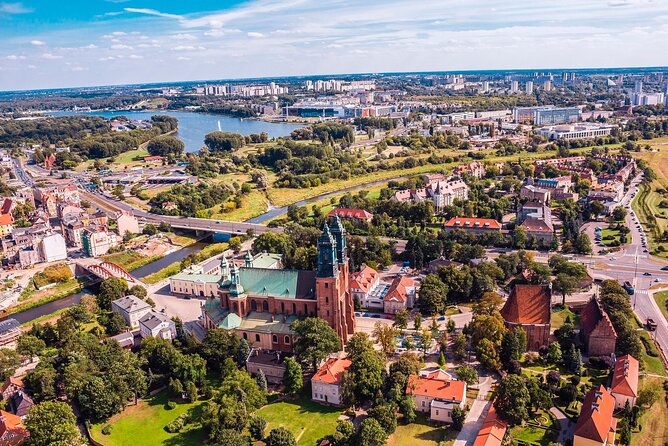
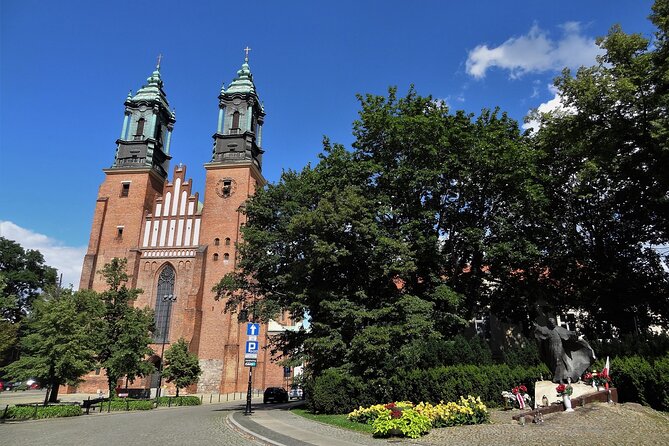
The tour begins at the Basilica Cathedral of Saints Peter and Paul on Ostrów Tumski, or Cathedral Island. The meeting address is Ostrów Tumski 17, 61-001 Poznan, and the end point is the Arkadia Building at Plac Wolności 11.
This island sits between the Warta River and its tributary, the Cybina. A fortified settlement existed here by at least the ninth century, and some accounts connect it with the birth of the Polish state. That makes it a strong place to begin, since the oldest part of Poznan is not merely an attractive opening stop. It frames the whole city’s story.
The cathedral is the oldest in Poland. Its vaults contain remnants of tombs thought to be connected with Mieszko I and his son, Boleslaus the Brave, two figures central to early Polish history. The tour information does not promise a paid interior visit, so you should treat the cathedral as a major exterior and historical stop unless your guide confirms otherwise.
You will spend about 30 minutes here, with no admission ticket listed for this part. That is enough time for an introduction and some orientation, but not enough for a slow examination of every chapel, tomb, or religious artwork.
One of the most interesting features of this area is Porta Posnania Interactive Heritage Centre. Its dramatic white building is reached by a footbridge across the river and has won architectural competitions. It is part of the Royal-Imperial Route and offers a modern setting for the city’s early story.
The center is not listed as an included admission, so do not assume you will enter during the tour. Even from outside, its modern design creates a sharp contrast with the cathedral and older buildings nearby. I like that contrast because it shows Poznan as a living city rather than a preserved medieval set.
Reading the Old Market Square and Renaissance Town Hall
From Cathedral Island, the route continues toward the Old Town. The central point is the Old Market Square, which occupies the area of the former walled medieval city.
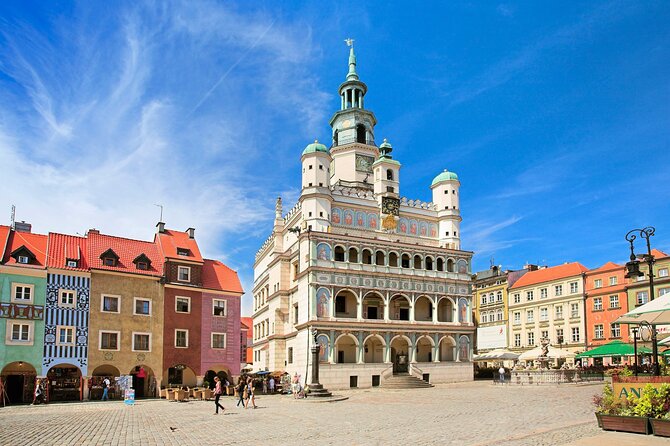
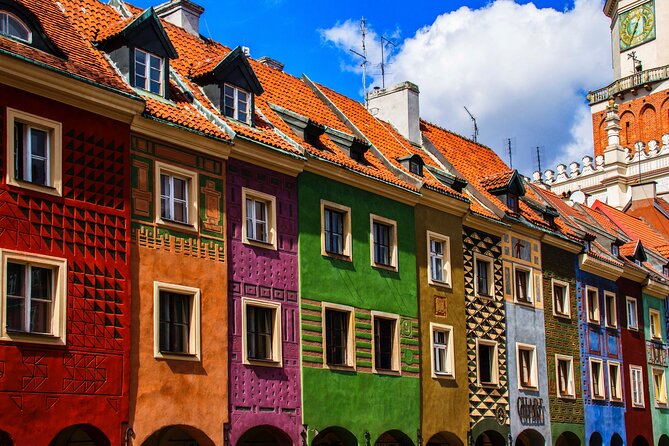
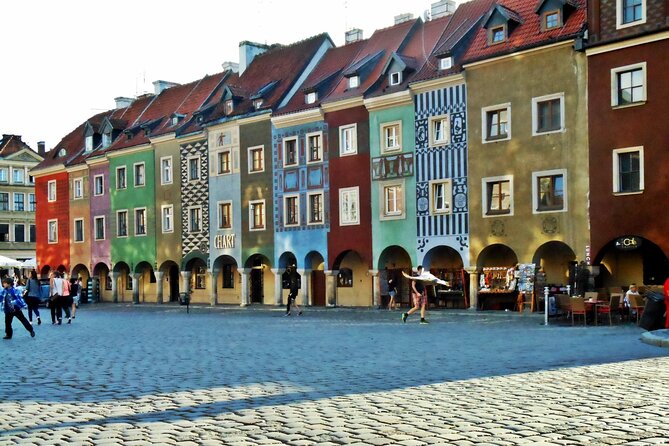
The square is surrounded by historic houses and anchored by Poznan’s famous Town Hall. Founded in 1253, the Old Town reflects the city’s medieval importance, while the Town Hall’s Renaissance design points to a later period of wealth and civic confidence.
The tour allows about 45 minutes for the Old Town area. That time includes more than the square itself. You will pass streets, churches, Przemysl Hill, the reconstructed Royal Castle, Freedom Square, and several nineteenth-century buildings.
The Royal Castle sits at the western end of the Old Town on Przemysl Hill. It was recently reconstructed, and its tower offers a broad view over the center. The information provided does not confirm tower admission during the tour, so consider it a possible extra rather than part of the standard experience.
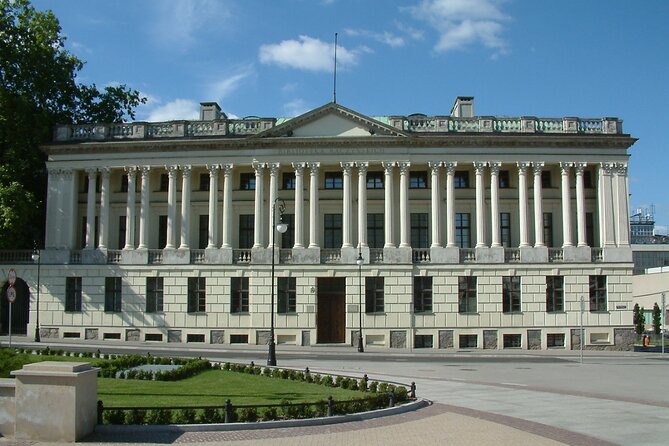
At Freedom Square, you can see the National Museum, the Raczynski Library, and the Bazar Hotel. These buildings help explain Poznan’s nineteenth-century civic character, and they also give you a sense of how the city expanded beyond its medieval walls.
I especially like the route’s variety here. You are not left circling one square while hearing the same sort of fact repeated. You move from medieval planning to Renaissance civic design, Baroque religion, reconstructed royal architecture, and nineteenth-century public buildings.
The tradeoff is pace. Forty-five minutes is enough for a guided overview, photographs, and orientation, but you will need a separate visit if you want to explore the National Museum, Royal Castle, or other interiors in detail.
Meeting the famous billy goats at Poznan Town Hall
The Town Hall receives its own 15-minute stop, and that is sensible. This building is the visual symbol of Poznan and deserves more than a quick mention while crossing the square.
Its three-story arcade loggia is the main exterior feature to watch for. The building is often described as one of Poland’s finest Renaissance secular structures, and its decoration is unusually detailed for a civic building.
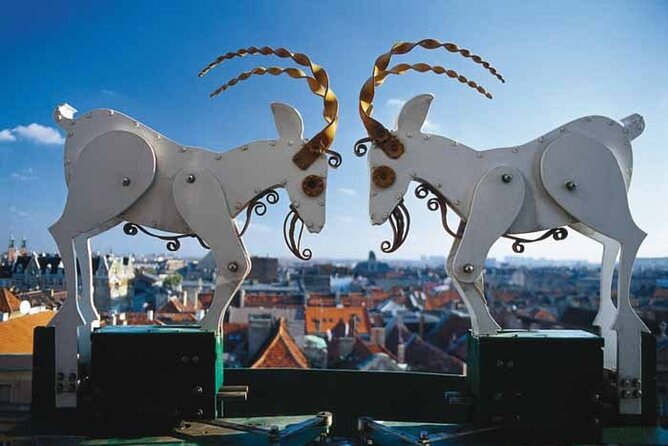
The best-known attraction is the pair of billy goats on the tower. They butt heads at noon each day. If your tour is timed for that moment, you can see one of Poznan’s most popular small traditions. If not, the guide can still explain why the goats became linked with the city.
The Town Hall houses the Museum of the History of the City of Poznan. Inside, the Grand Hall, also called the Revival Hall, has a ceiling decorated with polychromed sculptures. The imagery includes crests, biblical symbols, mythological scenes, planets, and exotic animals.
The listing marks this stop as free admission, but the short time allocation suggests that the focus is likely on the building and its story rather than an extended museum visit. If you care most about interiors, ask your guide how much time is available before planning a return visit.
A few more Poznań trips worth weighing up
- 3-Hour Guided Cycling Tour of Warsaw
★ 4.9 · 624 reviews - Warsaw Old Town 1.5-Hour or Full 3-Hour Segway Tour
★ 4.9 · 209 reviews - Warsaw: 3-Hour Panoramic City Bus Tour with Pickup
★ 4.5 · 169 reviews - Krakow: 3-Hour Small Group Tour on E-Bike
★ 4.8 · 135 reviews
Seeing the Baroque Fara Church
The Parish Church of St. Stanislaus, usually called Fara Church, is one of the tour’s strongest architectural stops. It is a major example of Baroque design and began as a Jesuit temple.
Construction took place in stages from 1651 into the middle of the eighteenth century. Building the church required the removal of selected sections of the city walls and the filling of the moat, which gives you a practical sense of how much space and civic effort the project required.
You have about 20 minutes here. That is short, but the church’s interior makes an impression quickly. It has three naves, galleries over the side naves, and heavy columns in the main nave.
Look toward the main altar and entrance portal, designed by Pompeo Ferrari. The church is packed with sculpture, painting, molding, and other decoration. Instead of feeling like a collection of separate details, these elements work together to create the theatrical effect Baroque churches are known for.
The changing light is part of the appeal. The interior can seem slightly misty or submerged, particularly when light filters across the ornament. You do not need a long lecture to appreciate the effect, but Joanna’s historical explanations can help connect the design to the Jesuit setting and the church’s long construction.
Because the tour is private, this is a good place to ask focused questions. You can ask about the altar, the Jesuits, or why the church required changes to the old fortifications. The available comments about Joanna repeatedly praise her for giving useful information and helping her group notice places they might otherwise have missed.
Saving room for a St. Martin croissant
The final major stop is the Croissant Museum, with about 45 minutes allotted. This is where the tour shifts from civic history and architecture to food culture.
The St. Martin croissant is not simply a pastry sold under a local name. It is protected by a European Union geographical designation, and it follows a strict recipe using Danish-style pastry dough and white poppy seeds. I would make this one of your food priorities in Poznan.
The museum is located in a Renaissance tenement on the Old Market Square. Its program explains how the croissant became a symbol of the Wielkopolska region, including an animated version of the pastry’s story beneath a polychromed wooden ceiling.
Admission is not included. That matters because the $110.01 tour price covers the professional local guide, while optional entry fees are separate. If you want to visit, confirm the current admission cost and timing before booking or at the start of the walk.
The 45-minute slot gives this stop more breathing room than the Town Hall or Fara Church. Still, you should not assume it includes a full meal or a broad tasting menu. The experience centers on the museum and the local pastry.
Poznan’s food story goes beyond croissants. Look for pyra z gzikiem, a baked potato with cottage cheese dip, or Poznan-style duck served with potato dumplings, baked apple, and red cabbage. These dishes are useful choices if you want to continue the regional theme after the tour.
What the private format adds
A private tour works best when you use the guide actively. The available comments single out Joanna for being informative, helpful, and easy to talk with. One group felt she took them to places they would have missed alone, while another said her explanations made the three hours pass quickly.
Those points matter more than a long list of sights. Poznan’s Old Town is walkable, and you can photograph the Town Hall or find Fara Church without a guide. The value comes from understanding what you are seeing, noticing less obvious details, and fitting the buildings into the city’s wider story.
The private setup also suits different interests. If you care about Polish statehood, you can spend more time on Ostrów Tumski. If architecture matters most, you can ask about Renaissance Town Hall details and Baroque Fara Church. If food is your priority, you can use the Croissant Museum stop to focus on local traditions.
The limitation is that a private tour is only as useful as the conversation you create. Go in with two or three questions. Ask where to return for a longer museum visit, where to try regional food, or how to hear more local history after the walk.
Timing, walking, and practical planning
The tour lasts about three hours and is offered in English. It begins at the cathedral and ends at Plac Wolności, so it is not a loop back to the starting point. That is helpful if you are planning to continue into central Poznan after the tour.
The route includes several outdoor sections, city streets, a riverside setting, and historic interiors. Wear shoes suited to walking and allow a little flexibility around the stated times, since transitions between stops are part of the experience.
The meeting point is near public transportation. Confirmation arrives at booking, and the activity is described as suitable for most people. Since the tour is private, only your own group participates.
The cancellation rule is generous if your plans are firm: you can cancel for a full refund up to 24 hours before the start time. Changes or cancellations made less than 24 hours before the local start time are not accepted for a refund.
Who will get the most from this tour
I would choose this experience if you have only a short stay in Poznan and want a clear introduction without joining a large group. It is also a good match for couples, families, and friends who value the ability to ask questions and move at a group-specific pace.
History-focused visitors will appreciate Ostrów Tumski, the cathedral, the early rulers, and the Royal-Imperial Route. Architecture fans get an efficient sequence of Gothic, Renaissance, Baroque, and nineteenth-century landmarks.
Food-minded visitors should like the Croissant Museum, but they should budget for admission and leave room for a separate meal. The tour introduces the regional pastry and other local dishes, but it is not described as a complete tasting tour.
I would be more cautious if your main goal is extensive museum time. The route visits or passes major cultural sites, but three hours is designed for broad coverage. You will need additional time for the Town Hall museum, Royal Castle tower, Porta Posnania, or the National Museum if you want to go inside.
Should you book the Poznan Old Town Tour?
Book it if you want a private, English-language introduction to Poznan that connects the city’s origins with its central square, churches, royal past, and food traditions. The praise for Joanna is unusually consistent, and her ability to explain details appears to be the experience’s strongest asset.
The $110.01 per-person price makes the most sense for a small group that can use the private format and any available group discount. Remember that optional admissions are extra, especially at the Croissant Museum.
Skip it if you prefer exploring alone at a slow pace or if you want several hours inside museums. For a first orientation, though, this route is well chosen. It gives you the city’s main story, a few memorable sights, and a practical starting point for exploring Poznan on your own.
FAQ
How long is the private Poznan Old Town Tour?
The tour lasts approximately three hours.
What language is the tour offered in?
The tour is offered in English.
Where does the tour begin?
It begins at the Basilica Cathedral of Saints Peter and Paul, Ostrów Tumski 17, 61-001 Poznan, Poland.
Where does the tour end?
The tour ends at the Arkadia Building at Plac Wolności 11, 61-738 Poznan, Poland.
Is the tour private?
Yes. Only your group participates in the activity.
Are admission fees included?
No. Entry or admission fees are optional and not included. The Croissant Museum specifically lists admission as not included.
Can I cancel for a full refund?
Yes. You can cancel at least 24 hours before the experience start time for a full refund. Cancellations or changes made less than 24 hours before the local start time are not accepted for a refund.
Just added around Poznań
- Poznan Old Town and Croissant Museum Private Walking Tour★ 5.0 · 3 reviews
- Poznan Private Vodka Tasting Tour★ 5.0 · 3 reviews
- Poznan: Private Polish Beer Tasting Tour★ 4.6 · 3 reviews
- Discover Poznan: Walk, Take a tram and have a traditional snack★ 5.0 · 4 reviews
- Palace, Castle and Ancient Oaks – Rogalin and Kórnik guided tour from Poznan★ 5.0 · 4 reviews
- Poznan: City and Brewery Private Walking Tour with Beer★ 4.6 · 5 reviews
- Poznan: Private Jewish Heritage Tour★ 5.0 · 5 reviews
- Poznan private tailor made tour with a local guide-driver★ 5.0 · 6 reviews
Old Town Walking Tours, compared.




Bike Tour of Old Town, Jewish Quarter and the Ghetto
Read our review →

Sightseeing EcoCruise around the Old Town of Gdansk
Read our review →
Browse the lists this tour appears in