
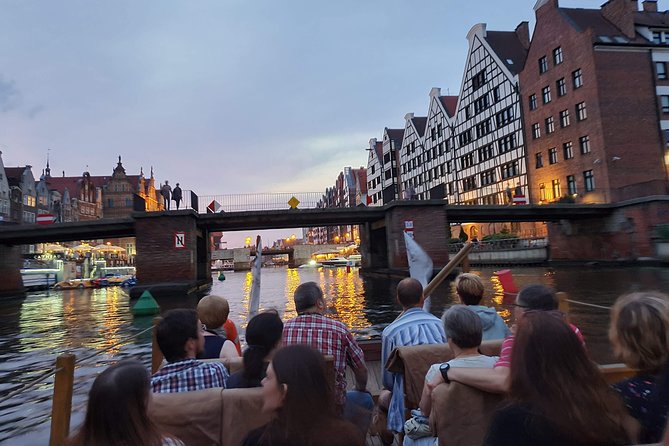
REVIEW · CRUISES & BOAT TOURS
Gdansk Guided City Cruise on Historical Polish Boat
Try Gdansk from the river first. This one-hour cruise gives you a clear view of the city’s water gates, medieval waterfront, shipyard, and rebuilt granaries from a small Polish boat modeled on traditional river craft. I like the intimate 12-seat design, which can slip close to places larger sightseeing boats cannot reach, and I like the guides’ lively storytelling. Simon, Damian, and another guide called Bron were singled out for being funny, clear, and well informed.
The main drawback is simple: the boat is open to the weather. Blankets help on cool days, but rain, wind, fog, or a long wait at a lock can change the mood. The meeting point at Dokowa 1 is also near the former Imperial Shipyard and takes extra time to reach on foot, with signs that may not be easy to spot.
In This Review
- Key Things to Know Before You Go
- Starting Beside the Former Imperial Shipyard
- Following the Motlawa Toward Main City
- Ołowianka Island and Its Changing Purpose
- Granary Island and the Story of Trade
- What the Small Boat Feels Like
- The Guides Make the Difference
- Is $21.92 Good Value?
- Who Will Enjoy This Cruise Most?
- Should You Book the Gdansk Historical Boat Cruise?
- FAQ
- Where does the Gdansk boat cruise begin?
- Where does the cruise end?
- How long does the cruise last?
- How many people can fit on the boat?
- What landmarks can I see from the boat?
- Is the cruise suitable in cool weather?
- What happens if the weather is poor?
Key Things to Know Before You Go
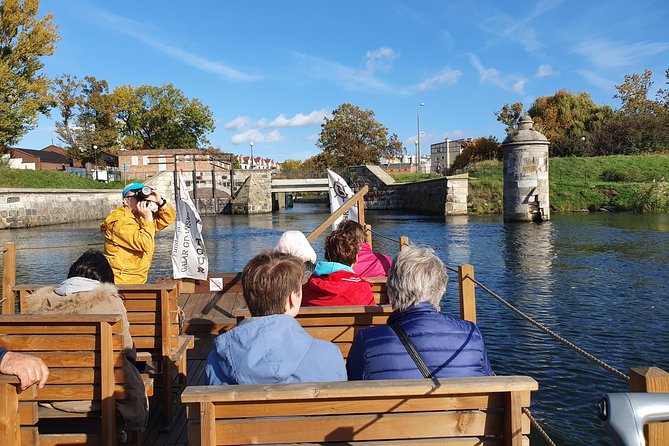
- A 12-seat historical boat: The compact Polish riverboat reaches narrow waterfront areas that larger vessels may miss.
- A 70-minute city overview: You see the shipyard, Main City waterfront, Ołowianka Island, and Granary Island in one outing.
- Live commentary matters: The guides add history, jokes, and explanations about both old Gdansk and its modern port.
- A useful first look at Gdansk: The cruise helps you understand how the river, gates, islands, trade, and shipbuilding shaped the city.
- Blankets are supplied: They are useful in cooler weather, but they do not turn an open boat into a rainy-day activity.
- Good value at $21.92: For roughly an hour of sightseeing and guiding, the price is modest, especially if this is your first time in Gdansk.
Starting Beside the Former Imperial Shipyard
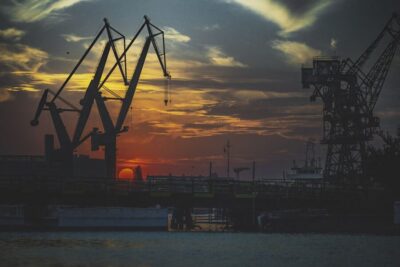
The cruise begins at Dokowa 1, in the post-shipyard area near the former Imperial Shipyard. This is not the postcard version of Gdansk. It is an industrial setting, with shipbuilding activity, cranes, specialist vessels, yachts, and the working character of a port city.
I like this starting point because it gives the cruise a wider frame. Gdansk is not only a collection of handsome streets and historic facades. Its identity also comes from shipbuilding, trade, canals, and the Baltic waterfront. Beginning here lets you see the older city and the working port as parts of the same story.
Give yourself extra time to find the dock if you are walking. The meeting point can feel out of the way, and the route is not always clearly marked. One practical account described needing help from a nearby bar owner for the final stretch. A phone map helps, but I would avoid arriving at the last minute.
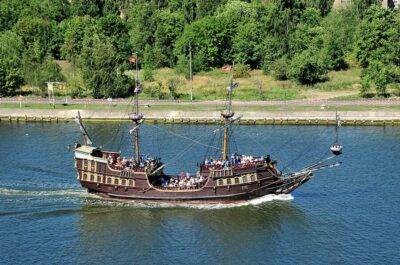
The activity uses small historical-style boats with engines and modern comforts. They are replicas of boats once used by people on Polish rivers, rather than antique working craft. That gives you the look and feel of an older water journey without giving up the basics of a powered sightseeing boat.
The boat has room for 12 people, creating a much more personal setting than a large river cruiser. The overall activity can accommodate up to 48 people, so several boats may operate around the same time. Life jackets are available, and blankets are provided when the temperature drops.
More Boat Tours in Gdańsk
- Gdansk: City Cruise on Historical Polish Boat
★ 4.8 · 2,913 reviews - Gdańsk: Sunset Cruise on a Historic Polish Boat
★ 4.9 · 977 reviews - Gdansk: Guided Round-Trip Cruise to Westerplatte
★ 4.3 · 865 reviews
Following the Motlawa Toward Main City
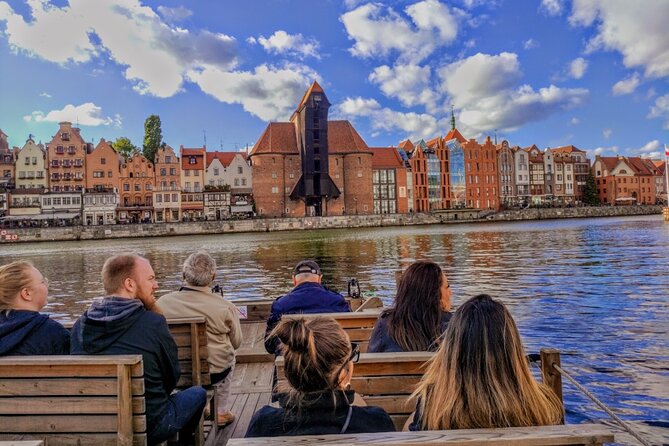
Once underway, the route follows the long Motlawa River Embankment toward central Gdansk. From the water, the city’s famous waterfront buildings appear in a different order and at a different scale. You are not simply checking off landmarks. You are seeing why the river was so important to the city’s growth.
The guide points out remains of the Teutonic Castle wall, including the Swan Tower. You also pass several water gates that once controlled movement between the river and the city. These gates are easier to understand from the water because you can see their position along the embankment instead of viewing each one as an isolated monument.
The famous 15th-century Crane is the major landmark on this stretch. Its enormous wooden lifting structure once handled cargo and served the practical needs of a port. From a street, you see its striking facade. From the boat, you get a better sense of its relationship with the river, where the loading and unloading actually took place.
The route also includes St. Mary’s Gate, described as the most beautiful of the water gates, and the Green Gate, the oldest gate on this part of the waterfront. The guide connects these buildings with Gdansk’s past and present, so you get more than a string of names.
This is where the live commentary earns its keep. Several guides, including Simon and Damian, were praised for mixing facts with humor. That tone suits a short cruise. You receive enough context to make the buildings memorable, without sitting through a formal lecture.
One small caution: a guide may speak excellent English yet still be hard to follow at times if the boat engine, wind, or pronunciation gets in the way. One account found the narrator occasionally mumbled. If you miss a sentence, do not hesitate to ask a question when the boat is quiet.
Ołowianka Island and Its Changing Purpose
The boat continues around Ołowianka Island, an important stop because it shows how the waterfront has changed over time. The island’s use was once practical and industrial. Today it is home to cultural and maritime institutions.
You can see the Polish Baltic Philharmonic, the Royal Granary, the National Maritime Museum, and Stonemason’s Bridge. The combination is telling. Gdansk’s waterfront is not frozen in the medieval past. Old storage buildings and transport routes now sit beside cultural venues and museums.
I find this part especially useful if you plan to explore Gdansk on foot later. From the boat, you get a quick map of the islands and bridges. You also see how close these places are to the Main City, even though the river makes them feel separate.
The small boat helps here. Its size allows closer views and a quieter ride than you might get on a large vessel. It also makes the outing feel more like a local river trip than a standard harbor circuit.
Still, keep your expectations realistic. This is a sightseeing loop, not a stop-and-explore tour. You pass the landmarks and hear about them, but the activity ends back at the original meeting point. If you want to visit the Maritime Museum or Philharmonic, plan a separate visit.
Granary Island and the Story of Trade
Granary Island is another key section of the route. The Green Bridge links it with the main part of the old city, and its name tells you what once happened here. Storehouses held goods brought through the port and prepared them for trade.
The boat gives you a broad view of the island’s past and present. You see remains of older granaries, including the Blue Lamb, described as the best-preserved example. You also see modern versions of the island’s historic buildings, rebuilt after the Second World War.
That contrast is one of the strongest reasons to take the cruise. Gdansk’s waterfront contains old structures, wartime losses, reconstruction, and new development side by side. A walk can show you the details of one street. The river shows you the full pattern.
The guides explain how the islands and gates fit into the city’s trade network and Hansa roots. You do not need a detailed background in Polish history to follow along. The hour gives you a practical introduction, then you can return to the places that interest you most.
The loop around the island also creates changing views of the city. Buildings that look familiar from the embankment take on a new shape from the river. The waterline reveals backs, side walls, bridges, and loading areas that are easy to miss while walking.
More History Tours in Gdańsk
- Gdańsk City Sights & History Guided Walking Tour in English
★ 4.8 · 876 reviews - Historic City Center Tour Gdansk in German
★ 4.6 · 455 reviews - Gdansk Legends & Cocktails Tour: Historic Tales and Tasting
★ 5.0 · 11 reviews - Boat Tour in Gdańsk – Explore the Historic Motława River
★ 5.0 · 8 reviews
What the Small Boat Feels Like
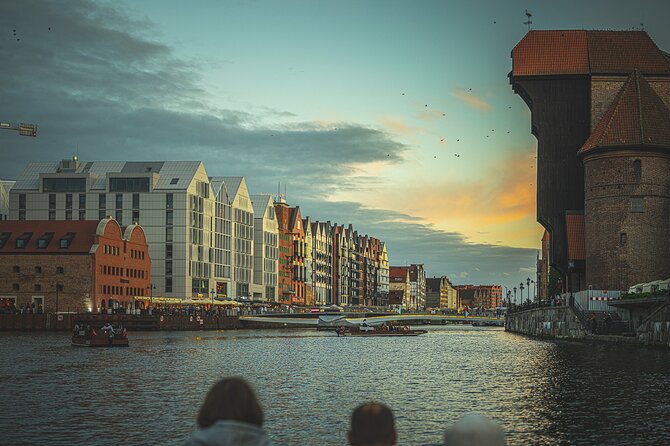
The boat is open, compact, and built for sightseeing rather than speed. On a calm, dry day, that is a major advantage. You get fresh air, unobstructed views, and a close look at the waterfront without windows reflecting the sky.
The ride is generally smooth, and the short duration works well. At about 1 hour and 10 minutes, the cruise is long enough to cover the main route but short enough to fit into a busy day of sightseeing. You can take it early to get your bearings, in the middle of the day as a break from walking, or later when you want a quieter activity.
Blankets are supplied for cooler periods, and umbrellas may be available on some boats. Those details matter in Gdansk, where a sunny start can still feel cool on the water. They are helpful extras, but I would still dress for outdoor conditions.
Weather is the key variable. Fog can make the journey atmospheric, though it may reduce the views. Rain and strong wind are more serious problems because the boat is open. The operator requires good weather and may cancel for poor conditions, offering another date or a full refund.
There is also the possibility of a delay at a lock gate. One cruise spent about 20 minutes waiting, but the pause became part of the entertainment. I would not count on every trip running exactly to the minute. If you have a train, timed museum entry, or dinner reservation immediately afterward, leave a buffer.
Seasickness is listed as a consideration. The route is on the river, not a long open-sea voyage, but anyone prone to motion sickness should think about the small boat and outdoor conditions before booking.
The Guides Make the Difference
The route is good, but the guide can determine whether the hour feels special or merely pleasant. The strongest accounts praised the guides for being funny, approachable, and able to explain the city’s past and present in plain English.
Simon received particular praise for bringing the story to life. Damian was also noted for sharing interesting details about the area. Another guide, remembered as Bron from Boat 4, was described as entertaining and well informed.
That mix of humor and history is valuable on a short outing. A guide who only recites dates can lose you quickly. Here, the commentary appears designed to hold your attention while showing how the shipyard, medieval gates, trading islands, and present-day waterfront connect.
You also have a chance to ask questions. The boats are small enough that the guide is not speaking to a distant crowd. If you want to understand a building, bridge, or part of the shipyard, ask while you are passing it.
The English delivery is usually strong, but clarity can vary by guide and conditions. Wind, engine noise, and occasional mumbling may make some details difficult to catch. Sitting where you can hear the commentary is worth more than simply choosing the best photo position.
Is $21.92 Good Value?
At $21.92 per person, I consider this a strong-value introduction to Gdansk. You get about 70 minutes on the water, a historical-style boat, a guided route, and views that would be difficult to arrange on foot.
The value is highest if this is your first day in the city. The cruise gives you a mental map of the Motlawa, the water gates, Ołowianka Island, Granary Island, and the shipyard. Afterward, you can walk back to the places that caught your attention.
It is also useful for repeat visitors. One person taking the cruise on a second visit felt the city looked new because the guide added details missed on land. That is the point of this experience. It is not meant to replace Gdansk’s museums and streets. It adds another angle.
You are paying for interpretation as much as transport. A basic boat ride might show you the same water, but the guide explains why the Crane was built, why the gates mattered, and how the islands changed. That makes the modest fare easier to justify.
The price is less attractive if you dislike open boats, have limited tolerance for cool or wet weather, or want a fast, tightly timed attraction. In those cases, the weather risk and possible lock delay may outweigh the benefits.
Who Will Enjoy This Cruise Most?
I would recommend it to first-time visitors who want an easy introduction before tackling Gdansk’s history on foot. It suits couples, families, and small groups who prefer a relaxed outing with some humor rather than a formal walking lecture.
It is also a good choice for anyone interested in ports, ships, trade, or urban rebuilding. The route covers both the old city and the working shipyard, giving you a fuller picture than a tour limited to the Main City streets.
You should think twice if you need a fully enclosed boat or guaranteed shelter. The open design is part of the appeal, but it is also the main weakness. Bring suitable clothing and do not assume a blanket will solve every weather problem.
The cruise is accessible to most participants, is near public transportation, and allows service animals. A mobile ticket is provided, and confirmation arrives when you book. Cancellation is free up to 24 hours before the local start time. Within 24 hours, refunds are not available unless the operator cancels because of poor weather.
Should You Book the Gdansk Historical Boat Cruise?
Yes, if you want a friendly, affordable first look at Gdansk from the water. The route covers the city’s most useful waterfront landmarks, while the small boat gets close enough to make the views feel personal. The guides add the humor and local context that turn a simple ride into a worthwhile city introduction.
Choose a dry day, arrive early at the shipyard meeting point, and allow time to find the dock. If you do that, this 70-minute cruise offers an excellent balance of price, history, scenery, and relaxation.
FAQ
Where does the Gdansk boat cruise begin?
The cruise begins at Dokowa 1, 80-863 Gdańsk, Poland, in the post-shipyard area near the former Imperial Shipyard.
Where does the cruise end?
The activity ends back at the meeting point.
How long does the cruise last?
The cruise lasts approximately 1 hour and 10 minutes.
How many people can fit on the boat?
The historical boat has 12 seats. The overall activity has a maximum capacity of 48 participants.
What landmarks can I see from the boat?
The route includes the former Imperial Shipyard area, the Motlawa River Embankment, the Teutonic Castle wall remains, Swan Tower, several water gates, the 15th-century Crane, St. Mary’s Gate, Green Gate, Ołowianka Island, and Granary Island.
Is the cruise suitable in cool weather?
Blankets are provided during cooler periods. The boat is open, so rain and wind can make the experience less comfortable.
What happens if the weather is poor?
The experience requires good weather. If the operator cancels because of poor conditions, you can choose another date or receive a full refund.
Just added around Gdańsk
- Gdańsk: Boat Cruise from Gdańsk Old Town to Sopot Marina★ 4.4 · 3 reviews
- Stutthof Concentration Camp and Museum of WWII: Private Tour★ 4.7 · 3 reviews
- Gdansk: Bubble Football with Hotel Transfers★ 5.0 · 3 reviews
- Gdansk: Oliwa Zoo with Tickets and Roundtrip Transportation★ 5.0 · 3 reviews
- Segway Tour Gdańsk: Shipyard Tour – 1,5-Hour of Magic!★ 5.0 · 3 reviews
- Gdansk: Escape Room Adventure★ 4.0 · 3 reviews
- Gdańsk : Catamaran River Cruise (group)★ 4.3 · 3 reviews
- Artus Court and Gdansk Old Town Private Tour with Tickets★ 4.7 · 3 reviews
Cruises & Boat Tours, compared.

Traditional Galar Cruise on The Vistula River
Read our review →
Browse the lists this tour appears in