
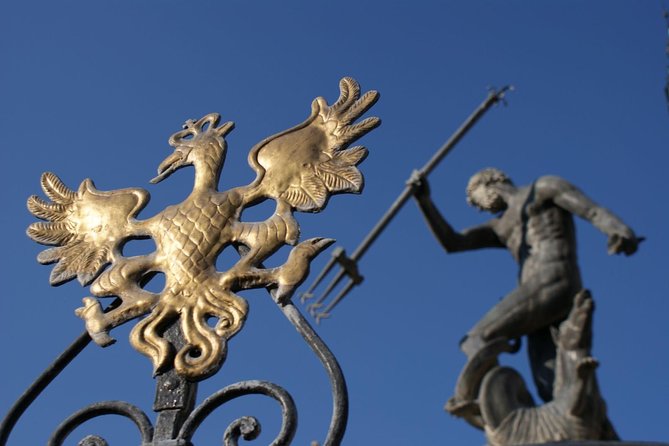
REVIEW · OLD TOWN WALKING TOURS
Private Walking Tour of Gdansk Old Town
Gdansk reveals itself one street at a time. This private walk links the city’s grand gates, brick churches, royal route, maritime symbols, and riverfront in about two hours, giving you a clear first look without a large group slowing things down. I like the private format, especially for families or groups who want to ask questions freely, and I like the route’s focus on places that buses simply cannot reach. The main thing to consider is the brisk schedule: eight major stops in roughly 120 minutes leaves limited time for extended museum visits, shopping, or long pauses.
The tour begins at Highland Gate and returns there, which makes the route easy to fit into a day in Gdansk. The price is $159.70 for a group of up to 15, so the value improves sharply when shared by several people. You should also expect a fair amount of walking outdoors, and a moderate level of fitness is recommended.
In This Review
- Key points at a glance
- Starting at Highland Gate
- Golden Gate and Great Armoury: a strong architectural opening
- The Royal Way and St. Mary’s Church
- Neptune’s Fountain and Artus Manor
- Main Town Hall: civic power in brick and stone
- The Crane and Gdansk’s working port
- Motlawa River Embankment and the final stretch
- What the private format adds
- Price, timing, and who gets the best value
- Practical fit for different visitors
- Should you book this Gdansk walking tour?
- FAQ
- Where does the tour start?
- Where does the tour finish?
- How long does the walking tour last?
- How much does the private tour cost?
- Is the tour offered in English?
- Is this a private activity?
- Can I cancel for a full refund?
Key points at a glance
- Eight central stops in two hours: The route covers the Golden Gate, Great Armoury, Royal Way, St. Mary’s Church, Neptune’s Fountain, Main Town Hall, the Crane, and the Motlawa embankment.
- A genuinely private outing: Only your group takes part, so the guide can adjust the pace and answer your questions without managing strangers.
- Strong architectural focus: Dutch Renaissance details, Gothic brickwork, allegorical sculpture, city halls, gates, and old port buildings all appear on the route.
- A useful introduction for cruise visitors: The compact route works well when you have only part of a day in Gdansk.
- Guides add personality: Named guides praised for this tour include Martin, Olga Libura, Michael Maj, Agnieszka Syroka, and Basia Lasota.
- A group price rather than a per-person fare: At $159.70 for up to 15 people, a full group pays about $10.65 each.
Starting at Highland Gate
Your meeting point is Highland Gate, at Wały Jagiellońskie 2A. This is a fitting place to begin because it introduces the ceremonial side of Gdansk before the route moves toward churches, civic buildings, and the port.
The tour is conducted in English and uses a mobile ticket. Confirmation is issued at booking, and the activity finishes back at the same meeting point. That return matters if you have a train, ship transfer, restaurant booking, or another timed activity later in the day.
Because the tour is on foot, wear shoes that can handle city paving and bring a weather layer. The information provided does not promise indoor time at every stop, so plan for an outdoor city walk rather than a museum tour. Children must be accompanied by an adult.
More Old Town Walking Tours in Gdańsk
- Gdańsk: Sightseeing EcoCruise around the Old Town of Gdansk
★ 4.6 · 719 reviews - Gdańsk: Old Town Private Walking Tour with Legends and Facts
★ 4.9 · 245 reviews - Gdansk Old Town 2-Hour Walking Tour
★ 4.5 · 94 reviews
Golden Gate and Great Armoury: a strong architectural opening
The first stop is the Golden Gate, also called Langgasser Tor or Goldenes Tor. You get about 10 minutes here, enough to inspect the gate’s formal design and hear why it mattered to the city.
The building was designed by Abraham van den Block and built by Hans Strakowski. Its inscriptions and allegorical sculptures express the civic ideals expected of Gdansk and its residents. That gives the guide more to work with than a simple photo stop: you can look at the decoration as a statement about how the city wanted to present itself.
Next comes the Great Armoury, also scheduled for 10 minutes. This is one of the finest Dutch Renaissance buildings in Poland and forms an impressive end point to Piwna Street near the Coal Market area. Its value on a walking tour is visual and urban. You see how one showy building helps shape an entire street rather than viewing it as an isolated monument.
Both stops are listed with free admission. The schedule suggests that the guide will explain the buildings from the outside or keep the visit brief. If you want a long interior visit, this tour may not provide enough time.
The Royal Way and St. Mary’s Church
The Royal Way receives about 20 minutes, making it one of the central sections of the walk. Polish kings traditionally used this route during visits to Gdansk, and its grand scale makes more sense once you know that it was built for ceremony and display.
This is where a private guide can be especially useful. Instead of simply walking down an attractive street, you can connect the buildings and public spaces to the city’s relationship with Polish rulers. The route also provides a natural transition from the Golden Gate toward the main civic and religious sights.
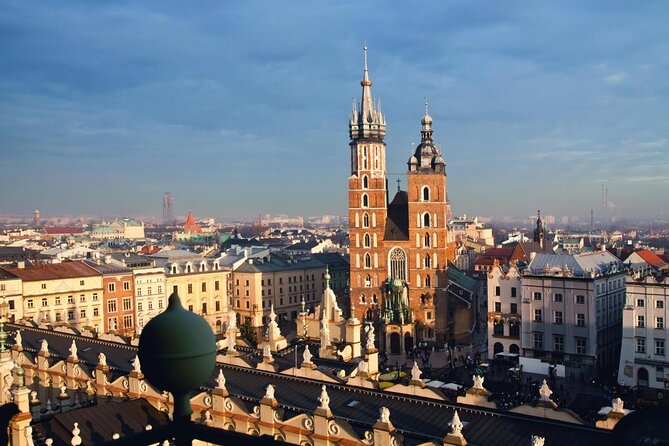
St. Mary’s Church follows, with 15 minutes set aside. St. Mary’s Basilica is widely described as the largest brick church in the world. Its interior includes 37 windows, more than 300 tombstones, and 31 chapels, with room for up to 25,000 people.
That scale is hard to grasp from a quick glance outside. If the tour enters the church, the short time means you will need to focus on the main points rather than inspect every chapel. The basilica also carries modern political significance: during martial law from 1981 to 1983, members of the Solidarity movement sought refuge there. That detail connects the monumental building to recent Polish history.
Neptune’s Fountain and Artus Manor
The 15-minute stop at Neptune’s Fountain brings you to the Long Market, one of Gdansk’s most representative public spaces. The fountain sits in front of Artus Manor, giving you two important landmarks in one view.
The project was initiated by Mayor Bartłomiej Schachmann and the city council in 1633. Neptune fits the setting well, since Gdansk’s prosperity was tied to trade and its position as a port. Your guide can use the fountain to explain the city’s public image, its commercial ambitions, and its connection to the sea.
This is also one of the busiest-looking parts of the route in terms of landmark density. The fountain, Artus Manor, nearby façades, and the Royal Way all compete for your attention. I would keep your camera away for a moment and listen first. The historical explanation will help you see more in the surrounding details.
The schedule allows enough time for an explanation and photographs, but not necessarily a relaxed café stop or a full interior visit. The private setup gives you a better chance to ask for a short pause if your group needs one, but the walk still has several more stops to cover.
More Walking Tours in Gdańsk
- Gdańsk City Sights & History Guided Walking Tour in English
★ 4.8 · 876 reviews - Main Town Gdańsk Walking Tour
★ 5.0 · 644 reviews - Discover Gdansk Walking Tour
★ 5.0 · 495 reviews - Gdańsk Old Town Private Walking Tour with Legends and Facts
★ 5.0 · 65 reviews
Main Town Hall: civic power in brick and stone
The Main City Hall, identified as the Museum of Gdansk, gets another 15 minutes. It was the seat of city authorities and includes architectural references to different cultural influences. Its shape and key decorative elements have been compared with the Hanseatic House in Bruges.
This stop helps explain why Gdansk can feel different from other Polish cities. Its architecture reflects trade, municipal power, and connections across northern Europe. The guide’s job here is not only to name the building, but to show how its design reflects the city’s place in the Hanseatic world.
The stop is listed with free admission, but the two-hour format still makes this more of an orientation visit than a full museum experience. If the museum is a major priority for you, ask the operator before booking how much interior access is included. The supplied details identify the building as the Main Town Hall Museum, but they do not promise a dedicated museum visit.
The Crane and Gdansk’s working port
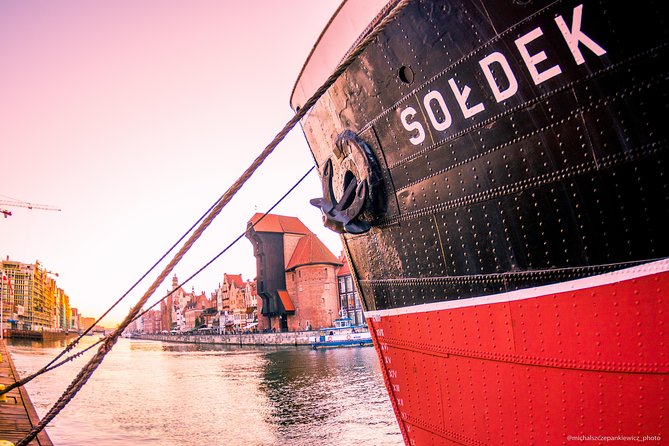
The Crane is one of Gdansk’s best-known symbols and the clearest reminder that this was a working port, not just a handsome historic center. The former port crane is scheduled for 15 minutes.
Its meaning becomes stronger once you reach the riverfront. The Crane represents the practical side of Gdansk’s maritime past: lifting, loading, and moving goods. It is not merely an ornate object beside the water. It points to the labor and trade that helped make the city important.
The route’s maritime focus also gives the tour some balance. You are not spending the whole morning looking at royal façades and church towers. You also see the machinery and waterfront spaces connected to commerce.
A short visit is enough to understand the Crane’s role and take in its shape from the outside. It is unlikely to satisfy someone who wants a detailed museum session, but it works well as part of a first walk through the city.
Motlawa River Embankment and the final stretch
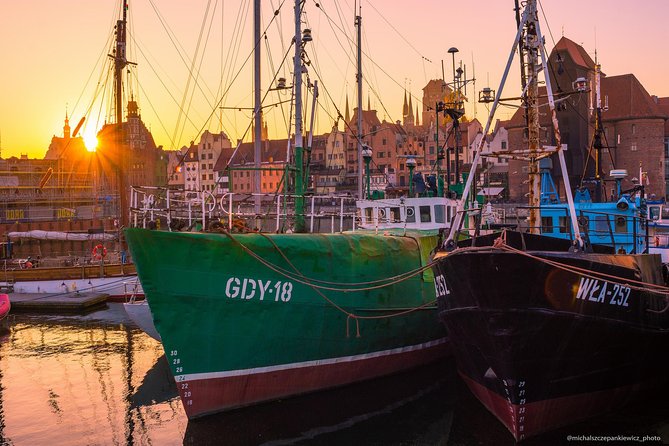
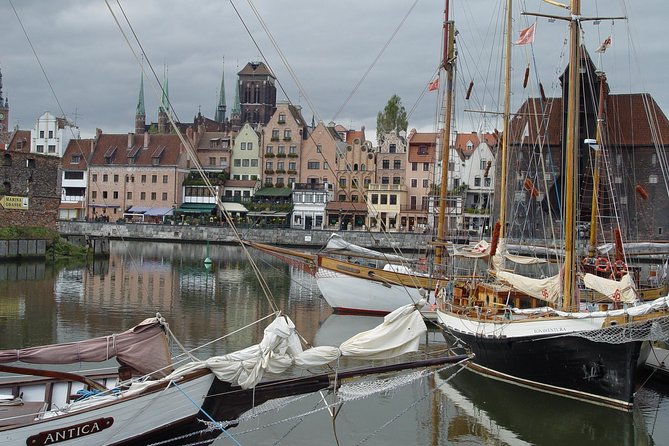
The final listed stop is the Motlawa River Embankment, known as Dlugie Pobrzeze. You get about 20 minutes along the historic harbor, which gives the walk a natural finish.
The port once handled as many as 300 ships in a day during the period described for the site. That figure helps you picture the waterfront as a major commercial center rather than a quiet promenade. The river also changes the mood of the tour after the formal streets and monumental buildings inland.
I like ending here because the Crane, water, old harbor, and merchant city all come together. You can look back at the route and see how the religious, civic, royal, and commercial parts of Gdansk fit together.
The walk then returns to Highland Gate. Since the route is compact but full, you should keep track of the time if you have a fixed departure. The stated duration is approximately two hours, and the stop timings add up to that full period.
What the private format adds
The biggest advantage is control. Your group alone participates, so you can ask about a building, request a slower pace, or spend less time on a subject that does not interest you. That matters in Gdansk, where several sights can look similar at first glance until someone points out the differences in style, purpose, and period.
The guides associated with this experience have different strengths. Martin was praised for clear explanations of important buildings and streets. Olga Libura was described as warm, humorous, and effective for a short visit from a cruise ship. Michael Maj was noted for speaking several languages, including English, Mandarin, Norwegian, and Russian, and for explaining history, dates, and local recommendations in great detail.
Agnieszka Syroka received particular praise for making Polish and Eastern European history easy to follow. Her explanation of brick-making proved useful later for identifying architectural details in other cities. Basia Lasota also led a well-received outing for students.
Guide assignment can vary, so you should not book expecting one particular person unless the operator confirms it. Still, these comments suggest that the guide quality is a major part of the experience, especially for visitors who want context rather than a simple list of dates.
Price, timing, and who gets the best value
The cost is $159.70 for up to 15 people. For two people, that is about $79.85 each. For a group of five, it works out to about $31.94 per person. With 10 people, the cost falls to about $15.97 each, and a full group of 15 pays about $10.65 per person.
That makes the tour most attractive for families, friends, student groups, or cruise companions who can share the fixed fee. For a solo visitor or couple, a shared group walk could be cheaper, but it would not provide the same privacy or control.
The two-hour length is another value point. You can cover the essential center without giving up an entire day, and you return to the starting point. It suits a first morning in Gdansk, a short city break, or a port call when you want a structured introduction.
The tradeoff is depth. Eight stops in two hours means the tour prioritizes coverage and explanation over long visits. You will see the city’s main symbols, but you may need another visit for extended time inside St. Mary’s Church, the Main Town Hall Museum, or the Crane.
Practical fit for different visitors
This walk suits you best if you want:
- A private guide for your own group
- A clear introduction to Gdansk’s central sights
- History explained in plain language
- A route that stays outdoors and avoids vehicle transfers
- A compact experience during a short visit
- Local suggestions along the way
It is also a good choice for people who walked around Gdansk once already but felt they missed the meaning behind the buildings. One useful account described walking past many details before a guide pointed them out. That is exactly where a guided route earns its fee.
You should think twice if you dislike walking, need frequent long breaks, or want to spend most of your time inside museums. The tour requires moderate physical fitness, and the schedule leaves little room for a slow, unstructured wander.
The experience is offered in English. Children are welcome with an adult, but the fixed two-hour route may be less suitable for very young children who struggle with city walking.
Should you book this Gdansk walking tour?
I would book it if you have limited time, are visiting with a group, or want the city’s main sights explained in a logical order. The Royal Way, St. Mary’s Church, Neptune’s Fountain, Main Town Hall, Crane, and Motlawa waterfront give you a strong first picture of Gdansk, while the private format lets you set the tone.
I would skip it only if you already know the center well and want long museum visits instead. For everyone else, especially cruise visitors and first-time guests, the $159.70 group price can be good value when divided among several people. Bring comfortable shoes, keep the schedule in mind, and treat this as a well-paced introduction rather than a complete study of every landmark.
FAQ
Where does the tour start?
The tour starts at Highland Gate, Wały Jagiellońskie 2A, 80-887 Gdańsk, Poland.
Where does the tour finish?
The activity ends back at the Highland Gate meeting point.
How long does the walking tour last?
The tour lasts approximately two hours.
How much does the private tour cost?
The price is $159.70 per group, with up to 15 people allowed in the group.
Is the tour offered in English?
Yes. The tour is offered in English.
Is this a private activity?
Yes. Only your group participates in the activity.
Can I cancel for a full refund?
Yes. You can cancel at least 24 hours before the experience start time for a full refund. Cancellations or changes made less than 24 hours before the start time are not accepted for a refund.
Just added around Gdańsk
- Gdańsk: Boat Cruise from Gdańsk Old Town to Sopot Marina★ 4.4 · 3 reviews
- Stutthof Concentration Camp and Museum of WWII: Private Tour★ 4.7 · 3 reviews
- Gdansk: Bubble Football with Hotel Transfers★ 5.0 · 3 reviews
- Gdansk: Oliwa Zoo with Tickets and Roundtrip Transportation★ 5.0 · 3 reviews
- Segway Tour Gdańsk: Shipyard Tour – 1,5-Hour of Magic!★ 5.0 · 3 reviews
- Gdansk: Escape Room Adventure★ 4.0 · 3 reviews
- Gdańsk : Catamaran River Cruise (group)★ 4.3 · 3 reviews
- Artus Court and Gdansk Old Town Private Tour with Tickets★ 4.7 · 3 reviews
Old Town Walking Tours, compared.




Bike Tour of Old Town, Jewish Quarter and the Ghetto
Read our review →

Sightseeing EcoCruise around the Old Town of Gdansk
Read our review →
Browse the lists this tour appears in