
REVIEW · WARSAW TOURS
Discover the Dark Side of Warsaw in Praga District by Retro Bus
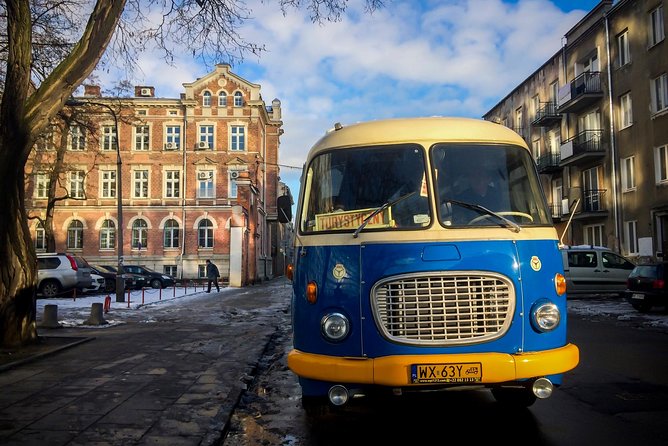
Praga tells Warsaw’s untidy, fascinating story. This retro-bus tour crosses the Vistula to streets that escaped much of the wartime destruction, mixing prewar courtyards, murals, old factories, and Communist-era memories. I like the ride itself, which turns transport into part of the sightseeing, and the stop at E.Wedel for hot chocolate is a welcome treat.
I also like the way the tour goes beyond Warsaw’s postcard center, reaching Brzeska, Stalowa, Kamionek, and the area nicknamed the Praga Bermuda Triangle. The main drawback is pace: two and a half hours covers a lot, so some stops feel brief. You should also confirm the start time, as the information gives both 10:30am and 11:00am.
In This Review
- Key points to know before you book
- Why Praga deserves a separate tour
- Meeting the retro bus at the Palace of Culture
- E.Wedel: a sweet start with historical weight
- Kamionek and the changing face of Praga
- Warsaw East station and the city’s longest building
- The Basilica of the Sacred Heart of Jesus
- Koneser and the old vodka factory
- Brzeska, Stalowa, and murals on the street
- Różycki’s Bazaar and the old black market
- The Praga Bermuda Triangle and prewar courtyards
- New Praga and a film connection to The Pianist
- The return across the Vistula
- The guides are the strongest part
- Group size, comfort, and weather
- Is $42.34 good value?
- Who should book this Praga tour?
- Final verdict: book it for the stories, not the polish
- FAQ
- Where does the Praga retro-bus tour start?
- What time does the tour begin?
- How long does the tour last?
- Where does the tour end?
- Is the tour offered in English?
- What is included in the price?
- Is hotel pickup included?
- Does the tour operate in bad weather?
- Can I cancel for a full refund?
Key points to know before you book
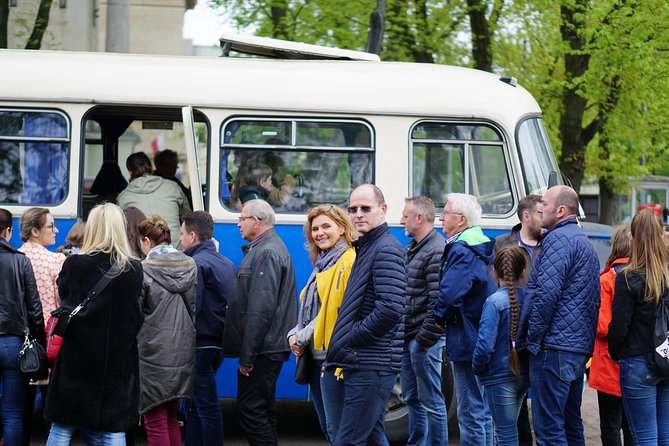
- A 1980s bus is part of the attraction: You are not simply riding between sights. The old coach adds a playful, slightly rough-edged feel to the outing.
- E.Wedel hot chocolate is included: You receive a cup at the 19th-century chocolate factory, with stories about the company and its Warsaw role.
- Praga is shown as a district in transition: Expect old courtyards, murals, former industrial sites, hip cafes, and buildings with plenty of wear.
- The tour connects history with films: You visit streets used for The Pianist and hear about places linked to The Zookeeper’s Wife.
- Guides make a major difference: Guides including Konrad, Marcin, Paweł, and Conrad have been praised for humor, clear English, and lively storytelling.
- The atmosphere can vary: A small group may create a better experience, while a large or noisy group can make the bus ride and short stops less comfortable.
Why Praga deserves a separate tour
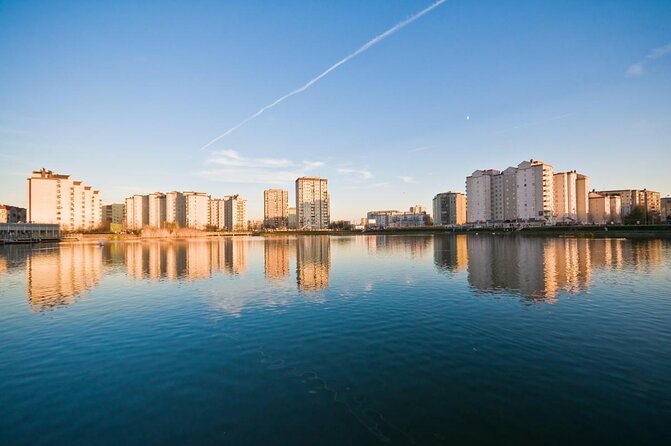
Warsaw’s central sights tell only part of the city’s story. The Palace of Culture and Science, Royal Castle, rebuilt Old Town, and broad postwar streets show a city that was almost destroyed and then reconstructed. Praga offers a different view.
Across the Vistula, parts of the district kept more of their prewar street pattern and older buildings. That does not make Praga a preserved museum quarter. You will see a working district, areas being renewed, walls covered with art, former industrial compounds, and courtyards that still feel separate from the polished center.
The tour’s dark side label is more theatrical than sinister. You are not being led through a horror show. The phrase points to Praga’s old reputation, its rougher past, black-market stories, vodka production, poverty, and long period outside the usual sightseeing route.
I appreciate that distinction. If you expect shocking crime stories at every corner, this may seem mild. If you want a grounded look at how Warsaw lived through war, Communism, and redevelopment, the title makes more sense.
A few more Warsaw trips worth weighing up
- Warsaw: Chopin Concert in the Old Town
★ 4.8 · 2,287 reviews - Warsaw: Traditional Galar Cruise on The Vistula River
★ 4.6 · 1,640 reviews - Warsaw: Old Town Highlights Walking Tour in English
★ 4.7 · 1,516 reviews
Meeting the retro bus at the Palace of Culture
The meeting point is outside the Palace of Culture and Science, near the Warsaw Tourist Information Office at pl. Defilad 1. The palace itself is hard to miss. Built as a gift from Joseph Stalin, it remains one of Warsaw’s most debated landmarks and a useful place to meet.
The tour begins with a short orientation around central Warsaw before crossing the Vistula. Along the way, the guide covers several quick subjects: the date palm in the city center, wartime objects hidden in the basement of the National Museum, the football stadium built for UEFA Euro 2012, and the view toward the Royal Castle.
You also hear about the Warsaw Nike monument, dedicated to those who died during World War II, and the main street widened after the war. These are short passing points rather than full visits, but they help connect Praga to the wider city.
The departure time needs checking. One part of the details says 10:30am, while the meeting information says 11:00am. I would rely on the confirmation sent after booking and arrive early. The tour ends back at the same point.
E.Wedel: a sweet start with historical weight
The first main stop is E.Wedel, a chocolate factory with 19th-century roots. A cup of hot chocolate is included, and this is more than a quick sugar break. The guide uses the factory to explain how chocolate production became part of Warsaw’s commercial and social life.
I like this stop because it gives the tour a human scale. Warsaw’s history can become a procession of battles, borders, ruined buildings, and political decisions. A warm drink and a story about an enduring local company make the past easier to connect with.
The hot chocolate is served even in warm weather, so do not expect a cold drink option to be part of the included refreshment. One useful tip is to bring your own water, especially on a hot day. The bus may not have modern cooling, and there may not be a convenient drink purchase during the route.
You receive roughly 20 minutes here. That is enough for the drink and explanation, but not a long factory visit.
Kamionek and the changing face of Praga
The route continues into Kamionek, an area described through its transformation from an old industrial and working neighborhood into a place with newer bars and cafes. This is one of the tour’s best themes: Praga is not frozen in the past.
You see how old buildings and new uses can sit side by side. The contrast matters. A former factory or worn residential block may now be surrounded by creative businesses, while the original structure still carries marks of earlier decades.
The tour does not present redevelopment as an entirely good thing. Its stories about everyday life under Communism and the changes after 1989 give you a sense of what was gained and what may be lost when a district becomes fashionable.
That said, you should keep expectations realistic. This is not a full food tour or a cafe crawl. The bars and cafes are part of the street scene, not a series of tastings.
A completely different kind of day out in Warsaw:
- Warsaw Concert: Chopin – Painted by Candlelights with Wine
★ 4.8 · 1,442 reviews - Warsaw: City Sightseeing Hop-On Hop-Off Bus Tour
★ 3.6 · 1,415 reviews - Warsaw: POLIN Museum of the History of Polish Jews Ticket
★ 4.7 · 1,142 reviews - #1 Pub Crawl Warsaw with Optional Premium 1 Hour Open Bar
★ 5.0 · 790 reviews
Warsaw East station and the city’s longest building
Several short drive-by stops add visual variety. Warsaw East railway station prompts a discussion about whether it is the city’s most beautiful station. The question is deliberately open, and the guide uses it to discuss Warsaw’s postwar appearance and changing standards of beauty.
You also see what is described as the longest building in Warsaw. These passing sights are useful if you enjoy urban details that do not usually make it into a standard city tour. They are less satisfying if you want time to get off the bus, take photographs, and study every building.
The old coach shapes the experience here. It is charming, but not polished like a modern sightseeing vehicle. One account describes the bus battery becoming cold enough that some people had to help push it. That sounds like an unusual hiccup rather than a normal part of the tour, but it tells you to expect vintage character rather than modern reliability.
The Basilica of the Sacred Heart of Jesus
The Basilica of the Sacred Heart of Jesus is one of the longer stops, at about 20 minutes. The church is presented as one of Poland’s most beautiful, giving the itinerary a change of tone after the factories, stations, and street art.
This stop will appeal to you if you enjoy architecture and religious sites. It also gives the guide room to explain how faith, public life, and Polish identity intersected during the country’s difficult 20th-century periods.
The visit is included, with no separate admission charge listed. As with several stops, the time is limited. You will see the basilica and hear the main story, but you should not expect a detailed architectural lecture or extended quiet time.
Koneser and the old vodka factory
Koneser Warsaw Vodka Factory is another 20-minute stop. The former factory is used to explain Praga’s industrial past and to ask how vodka shaped the district.
This is an effective choice because alcohol production was not a decorative side issue. A factory could affect employment, trade, local identity, and the reputation of an entire neighborhood. The guide’s job is to show those connections without turning the visit into a simple drinking story.
The stop focuses on the former factory and its history. The included drink is hot chocolate, not vodka, so do not book this expecting a tasting session. Koneser is also part of the larger story of old industrial places finding new lives.
Brzeska, Stalowa, and murals on the street
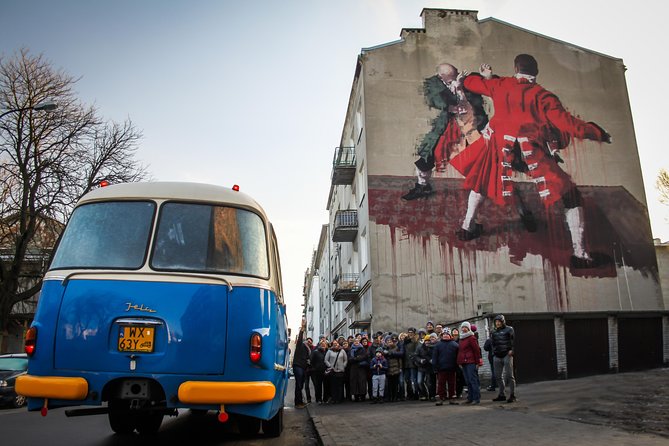
The streets of Brzeska and Stalowa bring you closer to Praga’s rougher character. You see colorful murals that refer to Polish history and political life, along with older buildings and street scenes that feel far removed from central Warsaw.
I like the use of street art here. Murals can compress a complicated national story into images you can grasp quickly. They also show that Praga’s past is not only kept in museums. It appears on walls, in courtyards, and in the way people talk about their neighborhood.
One practical limitation is time. A review from a particularly large group felt that the street art received less attention than it deserved. If murals are your main interest, this tour gives you an introduction, not a dedicated art walk.
You may also find the atmosphere less tidy than in the rebuilt center. That is the point, but it is worth saying plainly. Praga’s appeal comes partly from its rough edges.
Różycki’s Bazaar and the old black market
The route includes Różycki’s Bazaar, described as Warsaw’s longest-operating marketplace. The guide explains its past as a place where customers could obtain forged documents and other goods that were difficult to find through official channels.
This story opens a window onto life under Communism. When shops lacked supplies or the state tightly controlled paperwork, informal markets became essential. The bazaar was not simply a place to shop. It was part of an alternative economy.
You also get a chance to see what is sold there now. That small detail matters because it keeps the site connected to present-day life rather than treating it as a historical prop.
The market is another place where you should listen closely. The physical setting may not deliver a grand monument, but the stories explain why ordinary places mattered so much in Warsaw.
The Praga Bermuda Triangle and prewar courtyards
The tour’s longest stop is in Praga Polnoc, lasting about an hour. This is where you explore the area sometimes called the Praga Bermuda Triangle.
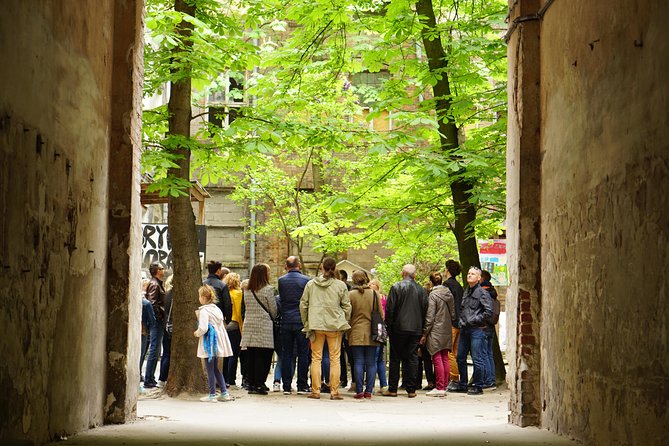
The name hints at mystery, but the real attraction is the network of courtyards, narrow passages, and prewar residential buildings. You get a better sense of how people lived in close quarters and how older parts of the district survived the war.
A courtyard can say more than a broad avenue. It shows entrances, shared space, layers of repair, and the distance between a building’s street face and its private interior. This is also one of the places where the tour’s walking sections become important. You are not only looking through a bus window.
The one-hour duration gives this section more breathing room than the quick passing points. Still, the overall route covers a large area, so the guide has to keep moving.
New Praga and a film connection to The Pianist
New Praga includes a 15-minute visit to the inner courtyard of a prewar residential house. You hear the story of the district’s founder and see how the courtyard layout works in practice.
The tour also points out a picturesque street used as a film set for Roman Polański’s The Pianist. This is not just a movie trivia stop. The film’s Warsaw scenes rely on the city’s surviving textures, and Praga’s older buildings help explain why filmmakers use the district to evoke earlier periods.
The route also brings up Warsaw Zoo, associated with The Zookeeper’s Wife. You may not enter the zoo, but the reference adds another wartime connection to the city.
Film locations can sometimes feel thin when they are treated as a quick photo stop. Here, they work best when paired with the district’s actual history. I would see the movie references as extra value, not the main reason to book.
The return across the Vistula
The return crossing offers a different view of Warsaw. You hear about the river as Poland’s major waterway and can take in the city from the moving bus.
The final views include the Royal Castle panorama and the Warsaw Nike monument. The main street enlarged after World War II also returns the story to the central city, where postwar planning replaced much of the old urban fabric.
Then the bus returns to the Palace of Culture and Science. The full outing lasts about two and a half hours, though the exact rhythm depends on traffic, group size, and how long the guide needs at each stop.
The guides are the strongest part
A good guide matters greatly on this tour because many stops are interesting only when their backstory is explained. Konrad is praised for clear English, humor, and calm handling of a difficult group member. Marcin is described as especially good at mixing facts with personal stories about life behind the Iron Curtain.
Paweł is praised as a strong storyteller, while Conrad is noted for being funny, informative, and good at answering questions. These comments point to a consistent strength: the experience depends less on polished attractions and more on the person connecting them.
The live commentary is in English. The guide may also be driving, so the clearest listening position can depend on where you sit and how noisy the bus is. One account notes that the guide managed the sound from Polish narration so the English explanation remained easy to follow.
Group size, comfort, and weather
The stated maximum is 40 people, but the information also describes one outing with about 80 people split among three buses. That suggests group size can vary, so check the current arrangements if a small group is important to you.
A smaller bus may actually improve the experience. It can make the guide easier to hear and reduce the rush at walking stops. Do not assume a small vehicle means a lesser tour.
The buses date from the 1980s. That is the charm, but it also means you should dress for the weather. The tour operates in all conditions, and accounts from hot days note that the bus does not have air conditioning. Bring water, wear comfortable shoes, and dress in layers when temperatures are uncertain.
Some people have also noticed exhaust concerns. I would not treat that as a deal breaker, but anyone sensitive to fumes should keep it in mind.
Is $42.34 good value?
At $42.34 per person, the tour costs more than a basic city bus ride but includes a professional English-speaking guide, live commentary, transport, the retro vehicle, and hot chocolate.
The value comes from access and interpretation rather than expensive admissions. Most stops have no separate admission fee, and several are street-level places you could technically visit alone. The guide saves you the work of finding them and, more importantly, explains why they matter.
I consider the price fair for visitors who want an unusual half-day outing and do not want to arrange transport across several parts of Praga. It is less compelling if you only want major monuments, formal museum visits, or a long meal.
The tour is especially useful early in a Warsaw stay. It gives you context for the city’s wartime destruction, Communist period, and current rebuilding before you explore on your own.
Who should book this Praga tour?
I would recommend it to you if you:
- Want to see a less polished side of Warsaw
- Enjoy local history told through streets and buildings
- Like unusual transport and old vehicles
- Are interested in World War II and Communist-era stories
- Want an English tour with humor and personal anecdotes
- Prefer a broad introduction to Praga rather than a single museum
I would be more cautious if you dislike vintage vehicles, need air conditioning, want a relaxed pace, or expect the words dark side to mean a very dramatic crime tour.
The experience also suits people who have already seen Warsaw’s central sights. It fills in the eastern side of the city and gives you a better sense of how Warsaw developed unevenly after the war.
Final verdict: book it for the stories, not the polish
I would book this tour if I wanted an engaging introduction to Praga and valued the guide’s storytelling more than a perfectly smooth ride. The old bus, E.Wedel hot chocolate, murals, Koneser, Różycki’s Bazaar, courtyards, and film locations create a memorable mix.
Go with realistic expectations. Praga is not a row of flawless monuments, and some stops pass quickly. But that is also why the tour works. You see a real district with scars, repairs, new businesses, old habits, and stories that do not fit neatly into Warsaw’s rebuilt center.
Confirm the departure time, bring water, dress for the weather, and hope for a manageable group. If you do, this is a good-value way to reach the other Warsaw, the one best understood from a rattling old bus and a guide who can make an ordinary courtyard matter.
FAQ
Where does the Praga retro-bus tour start?
It starts outside the Palace of Culture and Science, near the Warsaw Tourist Information Office at pl. Defilad 1, 00-901 Warszawa.
What time does the tour begin?
The meeting information gives an 11:00am start, while another part of the details says 10:30am. Check your booking confirmation and arrive early.
How long does the tour last?
The experience lasts approximately two hours and 30 minutes.
Where does the tour end?
It ends back at the original meeting point outside the Palace of Culture and Science.
Is the tour offered in English?
Yes. The tour includes English live commentary and an English-speaking guide.
What is included in the price?
The price includes a professional guide, live commentary on board, transport by a 1980s coach, and one cup of hot chocolate.
Is hotel pickup included?
No. Hotel pickup and drop-off are not included.
Does the tour operate in bad weather?
Yes. It operates in all weather conditions, so you should dress appropriately.
Can I cancel for a full refund?
Yes, if you cancel at least 24 hours before the experience start time. Cancellations made less than 24 hours in advance are not refundable.
Just added around Warsaw
- Jewish heritage in Warsaw★ 4.5 · 3 reviews
- Warsaw Outdoor Paintball with Transfers (all year round)★ 5.0 · 3 reviews
- World War II Warsaw Old Town, Military Cemetery Walking Tour★ 4.7 · 3 reviews
- Warsaw: Wolf’s Lair & Swieta Lipka Small-Group Tour + Lunch★ 5.0 · 3 reviews
- Sunset Boat Tour with Unlimited Drinks in Warsaw★ 3.5 · 3 reviews
- Majdanek – German camp from II World War – Private Tour – 1 DAY TRIP FROM WARSAW★ 5.0 · 3 reviews
- From Warsaw: Guided Tour to Wieliczka Salt Mine and Krakow★ 4.5 · 3 reviews
- Warsaw Sightseeing with NEW Mercedes Sclass !!!★ 5.0 · 3 reviews
Warsaw Tours, compared.

Traditional Galar Cruise on The Vistula River
Read our review →
Warsaw Concert: Chopin – Painted by Candlelights with Wine
Read our review →

POLIN Museum of the History of Polish Jews Ticket
Read our review →
#1 Pub Crawl Warsaw with Optional Premium 1 Hour Open Bar
Read our review →