
REVIEW · WARSAW TOURS
Jewish Warsaw
Warsaw’s Jewish story is told street by street. This three-hour private tour links surviving buildings, memorials, cemeteries, and the POLIN Museum, giving you a clear introduction to the Jewish community that once made Warsaw the largest Jewish center in Europe. I like the route’s mix of well-known sights and quieter places, especially Prozna Street and Krochmalna, where the city’s prewar character still feels close. I also like that the tour ends at POLIN, so you can continue with the museum’s audio guides after your guide leaves.
The main consideration is pace. Nine stops in about three hours means some visits are brief, and the Nozyk Synagogue and Jewish Cemetery require extra entrance fees. The tour is listed at $89.35 per person, with private transport, hotel pickup, and a guide included, but you should confirm the transport plan because public transport is also mentioned in the practical information.
In This Review
- Key points to know before booking
- Why Jewish Warsaw deserves a dedicated tour
- Grzybowski Square: the first view of prewar Jewish Warsaw
- Prozna Street and the feel of a preserved commercial street
- Nozyk Synagogue: a living place of worship
- Krochmalna and Chlodna Street: following Isaac Bashevis Singer
- Keret House: a small piece of modern Warsaw
- The Jewish Cemetery: the tour’s longest and most reflective stop
- The Ghetto Heroes Monument and Willy Brandt’s gesture
- Ending at POLIN Museum of the History of Polish Jews
- What the $89.35 price buys you
- Timing, transport, and practical planning
- Who should book Jewish Warsaw
- Should you book it?
- FAQ
- Where does the Jewish Warsaw tour start?
- Where does the tour end?
- How long does the tour last?
- Is hotel pickup available?
- Is this a private tour?
- Is the tour offered in English?
- Is admission to Nozyk Synagogue included?
- Is admission to the Jewish Cemetery included?
- Can I visit POLIN Museum after the tour?
Key points to know before booking
- The route begins at Grzybowski Square, in the center of prewar Jewish Warsaw, and ends at the POLIN Museum.
- Mary may be your guide, and a recent 10 a.m. pickup from the Golden Tulip Warsaw Centre praised her clear and thoughtful storytelling.
- Nozyk Synagogue is Warsaw’s only surviving prewar synagogue still in operation, with admission not included.
- The Jewish Cemetery receives the longest stop, about 40 minutes, and covers burial customs, famous Jewish figures, Janusz Korczak, Esperanto, and Jewish theater.
- This is a private experience, so only your own group participates.
- You can use the tour as a POLIN introduction, then stay on for the museum with its audio guides.
Why Jewish Warsaw deserves a dedicated tour
Warsaw’s Jewish past is easy to miss if you only visit the Old Town, Royal Route, and rebuilt castle. The Jewish district was largely destroyed during World War II, and much of what you see today is made up of memorials, fragments, restored structures, and streets that survived in altered form.
That makes a guide especially useful. The story is not laid out in one compact historic quarter. It is scattered across central Warsaw, and the route helps you connect ordinary streets with the people, institutions, and events that shaped them.
The tour focuses on places rather than a long lecture in a single museum room. You move from a square to a synagogue, from former residential streets to a cemetery, then to the monument commemorating the Warsaw Ghetto Uprising. It is a useful format if you want historical context but also want to see the city itself.
The private setup matters. You are not being fitted into a large group with strangers, and your own party can ask questions as the route develops. The information says most people can participate, and hotel pickup is offered. If your hotel lies far outside the center, the meeting point is arranged by email.
A few more Warsaw trips worth weighing up
- Warsaw: Chopin Concert in the Old Town
★ 4.8 · 2,287 reviews - Warsaw: Traditional Galar Cruise on The Vistula River
★ 4.6 · 1,640 reviews - Warsaw: Old Town Highlights Walking Tour in English
★ 4.7 · 1,516 reviews
Grzybowski Square: the first view of prewar Jewish Warsaw
The tour starts at Grzybowski Square, listed as Pl. Grzybowski 2. This was part of the center of Jewish Warsaw before the war, so it gives you an immediate sense of scale and location.
The 15-minute stop is short, but it sets up the rest of the morning. Your guide introduces the Jewish community that lived in Warsaw before World War II, when the city was home to the largest Jewish community in Europe.
Do not expect a fully preserved historic district here. The value is in learning how to read the modern city. Once you know what stood in this part of Warsaw, later stops become more meaningful. The square is a starting point for memory, not a complete museum exhibit.
Prozna Street and the feel of a preserved commercial street
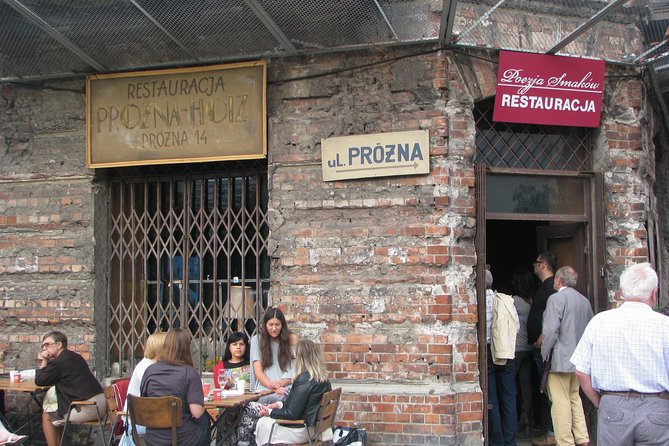
Ulica Prozna is one of the more appealing stops for anyone interested in architecture and daily life. The tour pauses for about 10 minutes on a Jewish commercial street preserved in its original form.
Your guide talks about the people who lived and worked here, including prominent families and well-known names connected with Warsaw. That social detail helps keep the story from becoming only a list of dates and wartime events.
The stop is free, but brief. You will have time to look at the street and hear its background, not to conduct a long architectural study. I like this part of the route because it focuses on ordinary urban life: shops, homes, neighbors, and the people who gave the street its purpose.
Nozyk Synagogue: a living place of worship
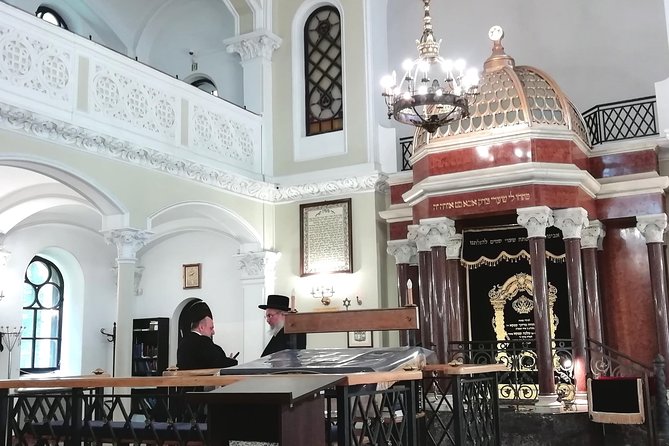
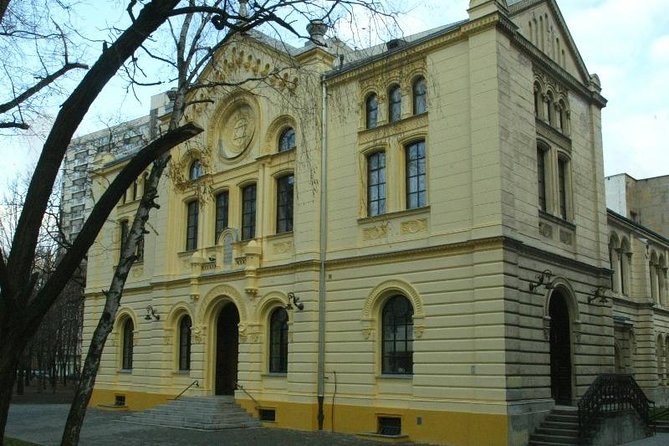
The 15-minute visit to Nozyk Synagogue is one of the tour’s most important stops. It is the only synagogue in Warsaw that survived World War II and remains in operation.
That distinction changes how you experience the building. This is not simply an old structure preserved behind glass. It is a functioning place of worship, and the visit should be approached with appropriate respect for religious use.
Admission is not included. The supplied information lists the Jewish Warsaw entrance fee as €5 per person, so carry that amount or confirm the current fee before setting out. The stop is short, and access can depend on opening arrangements, so a private tour gives you a useful chance to ask your guide how the visit fits into the day.
A completely different kind of day out in Warsaw:
- Warsaw Concert: Chopin – Painted by Candlelights with Wine
★ 4.8 · 1,442 reviews - Warsaw: City Sightseeing Hop-On Hop-Off Bus Tour
★ 3.6 · 1,415 reviews - Warsaw: POLIN Museum of the History of Polish Jews Ticket
★ 4.7 · 1,142 reviews - #1 Pub Crawl Warsaw with Optional Premium 1 Hour Open Bar
★ 5.0 · 790 reviews
Krochmalna and Chlodna Street: following Isaac Bashevis Singer
The route then moves through Krochmalna, a stop of about five minutes. The street is linked with the writing of Isaac Bashevis Singer, the Nobel Prize-winning author whose prose described Jewish Warsaw and its people.
This is a literary pause rather than a major sightseeing stop. You are being shown the streets and places behind the writing, which can add a human scale to the history. If you know Singer’s work, the reference may carry extra weight. If you do not, the guide’s explanation still gives you a sense of how the neighborhood entered literature.
Chlodna Street receives about 10 minutes. Here you look at buildings that remain in their original condition and explore Warsaw’s courtyards. The backyards matter because public monuments tell only part of the story. Residential spaces can suggest how people lived, moved, and shared the city.
Again, the tour does not promise a preserved neighborhood at every turn. Instead, it points out surviving pieces and explains their place in the larger story. That is a good reason to pay attention to the guide rather than judge each stop only by how much old architecture remains.
Keret House: a small piece of modern Warsaw
The Keret House is a striking change of subject. The tour spends about 10 minutes at what is described as the narrowest house in the world, learning about its history.
This is not a surviving prewar building. It is a modern architectural project, and its presence shows how Warsaw’s Jewish story continues to develop in the present city. The unusual shape gives the route a visual break after several historically heavy stops.
The stop is free. You should think of it as a quick architectural marker, not a full interior visit. Its appeal comes from seeing the structure in context and hearing why it was created.
The Jewish Cemetery: the tour’s longest and most reflective stop
The Jewish Cemetery receives roughly 40 minutes, making it the longest stop on the route. That extra time is welcome. A cemetery requires slower attention than a quick street corner, and the tour uses it to discuss famous rabbis, zaddiks, and Jewish families buried there.
You also learn about Jewish burial traditions. That gives the visit a cultural and religious framework, rather than treating the cemetery as a collection of names and stones.
The guide also connects the cemetery with the history of Esperanto, Janusz Korczak’s orphanage, and Jewish theater. These subjects show the range of Jewish life in Warsaw. Education, language, literature, religion, care for children, and public culture all form part of the story.
Admission is not included, and the practical information gives the Jewish Warsaw entrance fee as €5 per person. Wear sensible shoes and allow the cemetery stop the attention it deserves. The route covers a lot, but this is the point where you may want to pause, look closely, and ask questions.
For many people, this will be the emotional center of the tour. It is also the part most likely to benefit from a guide who can explain names and traditions without rushing past them.
The Ghetto Heroes Monument and Willy Brandt’s gesture
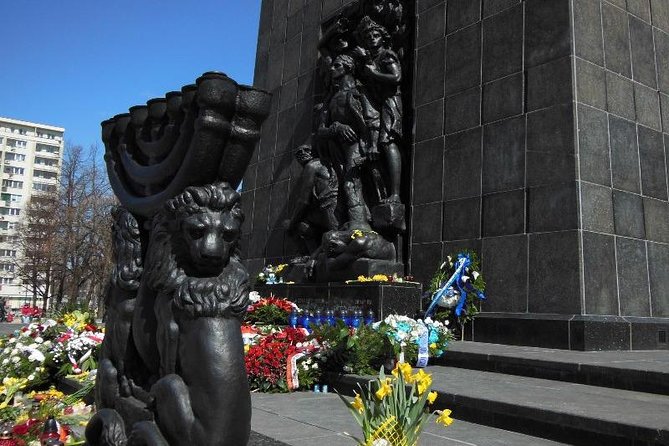
The stop at Pomnik Bohaterow Getta, the Ghetto Heroes Monument, lasts about 15 minutes. This is where the tour recalls the Warsaw Ghetto Uprising and the people who resisted Nazi persecution.
The location is also associated with Willy Brandt’s famous gesture of kneeling. That moment gave the site an additional layer of political and moral meaning, linking the monument not only with wartime history but also with Germany’s later reckoning.
The monument is free to view. The guide’s role is crucial here because the physical visit is short, while the events connected with the place are complex. You will get more from the stop if you ask questions about the uprising, the memorial’s purpose, and Brandt’s act.
Ending at POLIN Museum of the History of Polish Jews
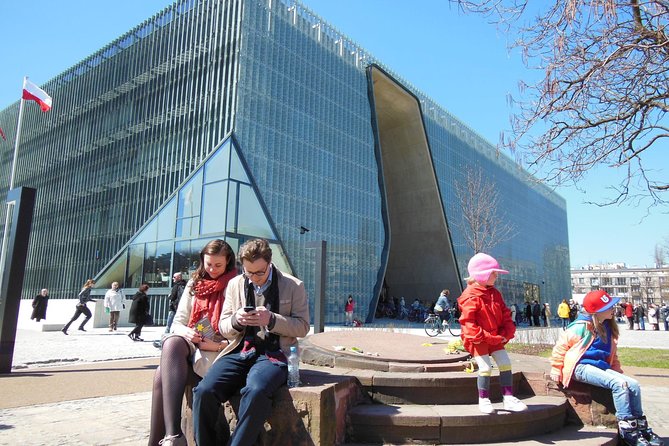
The tour ends at the POLIN Museum of the History of Polish Jews, at Mordechaja Anielewicza 6. The guide spends about 15 minutes explaining the building’s symbolism and architecture.
This is a smart place to finish. After seeing streets, religious sites, graves, and memorials, you arrive at a major institution devoted to the wider history of Polish Jews. The building itself is part of the experience, and the tour gives you an introduction before you enter.
Your tour ends outside the museum, but you can continue inside with the audio guides. This is one of the strongest practical features of the route. You are not being hurried away after the final stop, and you can decide if you want a longer museum visit.
Plan your energy accordingly. The three-hour tour gives you a strong framework, but it cannot replace a full visit to POLIN. If the museum is a priority, leave additional time in your day rather than treating the 15-minute exterior explanation as enough.
What the $89.35 price buys you
At $89.35 per person, this is not a bargain-priced walking tour. The value comes from the private format, the guide, the linked route, and the transport arrangement.
An air-conditioned vehicle is included. Hotel pickup is also offered, with the guide meeting you at reception with a PolinTours sign or waiting in the car outside your hotel entrance. If your hotel is outside the central area, the meeting place is arranged in advance.
The price does not include lunch, synagogue admission, cemetery admission, or any public transport ticket needed for the public transport-based version. The listed Jewish Warsaw entrance fee is €5 per person, so the real cost is a little higher than the headline price.
The private format can make the price reasonable for a family or small group. You are paying for a guide focused only on your party, and group discounts are available. For one person or a couple on a tight budget, the cost may be harder to justify, especially if you are comfortable researching the sites yourself.
The tour is booked, on average, 76 days in advance. That suggests you should not assume you can wait until the last day, particularly if your dates are fixed.
Timing, transport, and practical planning
The advertised duration is approximately three hours. Nine stops in that time means the schedule is active, with short visits at several locations. The cemetery gets the most time, while Krochmalna, Prozna Street, and the Keret House are quick orientation stops.
Pickup is convenient, but confirm the exact arrangement before the day. The experience information refers to an air-conditioned vehicle and also gives advice for a public transport-based tour, including buying a ticket in advance or carrying small change. That suggests the transport format may vary, so ask PolinTours which version applies to your booking.
The tour is offered in English. Confirmation normally arrives at booking, though bookings made within three days of departure may receive confirmation within 48 hours, subject to availability.
The experience requires good weather. If poor weather causes cancellation, you are offered another date or a full refund. You can cancel for a full refund up to 24 hours before the start time. Changes or cancellations inside that 24-hour window are not accepted.
Who should book Jewish Warsaw
I would recommend this tour to anyone visiting Warsaw for the first time who wants a structured introduction to Jewish Warsaw. It also suits families and small groups who value hotel pickup and the ability to ask a private guide questions.
It is a good match for readers of Isaac Bashevis Singer, people interested in Jewish religious traditions, and anyone planning to visit POLIN. The mix of streets, cemetery, synagogue, memorial, and museum makes the experience broader than a simple monument tour.
You may want something else if you prefer a slow walking tour with long stops at each site. The schedule is compact, and some locations receive only five to 15 minutes. You should also look elsewhere if your main goal is a full museum visit, since the museum itself is only introduced at the end.
Mary is specifically associated with a recent 10 a.m. pickup from the Golden Tulip Warsaw Centre, where her clear and engaging explanation earned heartfelt thanks from a family group. Guides can vary, but that detail is useful if you are able to request Mary when booking.
Should you book it?
Book Jewish Warsaw if you want the city’s Jewish past explained through real streets and places, not only through a museum display. The strongest parts are the private guiding, the 40-minute cemetery visit, Nozyk Synagogue, and the finish at POLIN.
Before paying, confirm the transport method, the €5 entrance charge, and the synagogue and cemetery access arrangements. If you have only a short time in Warsaw, this route gives you a thoughtful overview. If you have several days and prefer independent sightseeing, you might save the money and visit POLIN on your own, then explore selected sites at a slower pace.
For most people seeking a focused introduction, the price is justified by the private pickup and the guide’s ability to connect scattered places. Just keep your expectations realistic: this is a fast, serious overview, not a leisurely day in a preserved historic quarter.
FAQ
Where does the Jewish Warsaw tour start?
The tour starts at Grzybowski Square, Pl. Grzybowski 2, 00-824 Warszawa, Poland.
Where does the tour end?
It ends at the POLIN Museum of the History of Polish Jews, Mordechaja Anielewicza 6, 00-157 Warszawa, Poland.
How long does the tour last?
The experience lasts approximately three hours.
Is hotel pickup available?
Yes. The guide can meet you at your hotel reception with a PolinTours sign or wait in a car outside the hotel entrance. If your hotel is far outside the city center, the meeting point is arranged by email.
Is this a private tour?
Yes. Only your own group participates.
Is the tour offered in English?
Yes. English is listed as the available tour language.
Is admission to Nozyk Synagogue included?
No. Admission is not included. The listed Jewish Warsaw entrance fee is €5 per person.
Is admission to the Jewish Cemetery included?
No. Admission is not included. The listed Jewish Warsaw entrance fee is €5 per person.
Can I visit POLIN Museum after the tour?
Yes. The tour ends at POLIN Museum, where you can continue with the museum’s audio guides.
Just added around Warsaw
- Jewish heritage in Warsaw★ 4.5 · 3 reviews
- Warsaw Outdoor Paintball with Transfers (all year round)★ 5.0 · 3 reviews
- World War II Warsaw Old Town, Military Cemetery Walking Tour★ 4.7 · 3 reviews
- Warsaw: Wolf’s Lair & Swieta Lipka Small-Group Tour + Lunch★ 5.0 · 3 reviews
- Sunset Boat Tour with Unlimited Drinks in Warsaw★ 3.5 · 3 reviews
- Majdanek – German camp from II World War – Private Tour – 1 DAY TRIP FROM WARSAW★ 5.0 · 3 reviews
- From Warsaw: Guided Tour to Wieliczka Salt Mine and Krakow★ 4.5 · 3 reviews
- Warsaw Sightseeing with NEW Mercedes Sclass !!!★ 5.0 · 3 reviews
Warsaw Tours, compared.

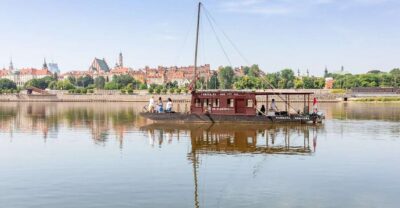
Traditional Galar Cruise on The Vistula River
Read our review →
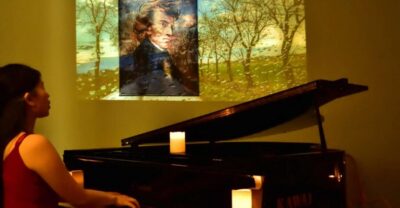
Warsaw Concert: Chopin – Painted by Candlelights with Wine
Read our review →

POLIN Museum of the History of Polish Jews Ticket
Read our review →
#1 Pub Crawl Warsaw with Optional Premium 1 Hour Open Bar
Read our review →