
REVIEW · GOLF CART TOURS
Krakow: City Sightseeing Tour Eco Electric Buggy Golf Cart
Krakow reveals itself quickly here. This 90-minute electric buggy tour links Kazimierz, Podgórze, churches, synagogues, and wartime sites without asking you to march across town. I like the easy central pickup and the chance to cover nearly two dozen sights in one outing. I also like the mix of live guiding and recorded narration, with guides such as Olivia, Natalie, Philip, and Jacob praised for clear English and thoughtful explanations.
The main catch is focus. Most of the route centers on the Jewish quarter and former ghetto, so you should not book it expecting a full Old Town or Wawel Castle tour. The ride can also feel tight when a full group is packed in, and the cobbled streets may give you a few bumps along the way.
In This Review
- Key points to know before you book
- Starting near Krakow’s old town
- What the 90-minute format really means
- Skałka and the churches of Kazimierz
- Plac Wolnica and the old town of Kazimierz
- The synagogues of the former Jewish quarter
- Crossing into Podgórze and confronting the ghetto years
- Schindler’s Factory and the old ghetto wall
- The guides make the difference
- Comfort, cold weather, and the bumpy bits
- Is $28.88 a fair price?
- Who should book this Krakow buggy tour?
- Should you book it?
- FAQ
- Where does the Krakow electric buggy tour start?
- Where does the tour finish?
- How long does the buggy tour last?
- What language is the tour offered in?
- Does the tour include pickup?
- Does the tour enter Oskar Schindler’s Factory?
- Are admission tickets included for the sights?
- What is the cancellation policy?
Key points to know before you book
- Nearly two dozen sights in 90 minutes: You get a broad first look at Kazimierz and Podgórze rather than long visits inside each place.
- A strong Jewish Krakow focus: Several synagogues, former ghetto sites, and the Schindler Factory area shape the tour.
- Warm in cold weather: Blankets and heating are available on the buggies, a real help during Krakow’s chilly months.
- Good for saving your legs: The electric cart covers ground that would take much longer on foot.
- Live guide plus audio narration: Your driver explains the route, while recorded commentary adds more detail.
- Best booked early in your stay: It gives you a useful map of the city and helps you choose which sites to revisit.
Starting near Krakow’s old town
The meeting point is the 24-hour car park at Mikołaja Zyblikiewicza 2, close to Krakow’s central old town. It is practical, but not necessarily obvious if you are approaching from an unfamiliar direction. One useful local tip is to find the wider main stretch of Westerplatte first, then look for Zyblikiewicza Street nearby. The pickup point is across from a Żabka shop.
Pickup is offered, and the activity ends back where it began. You receive confirmation when you book, and the tour is offered in English with a mobile ticket. Public transportation is nearby, and service animals are allowed.
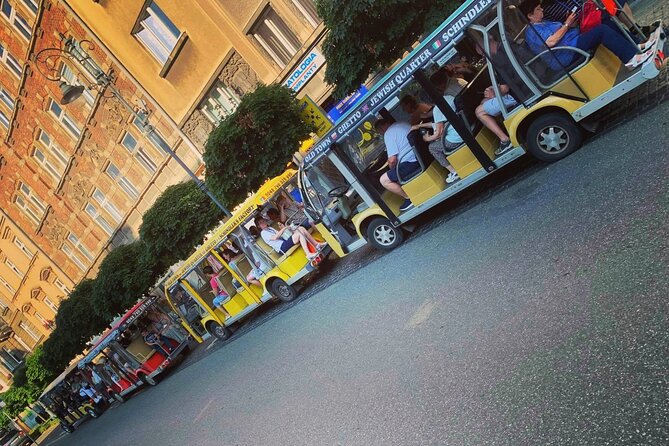
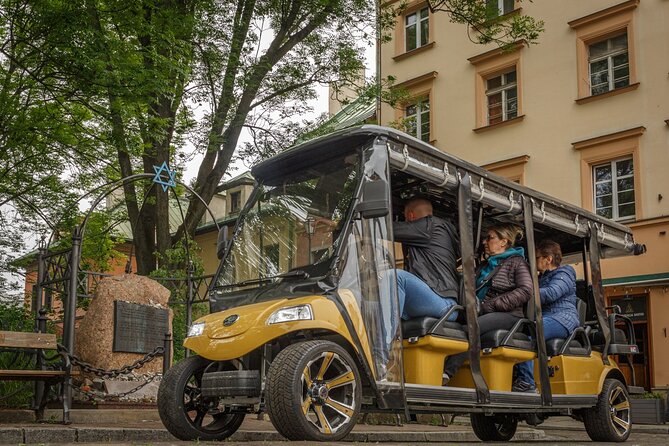
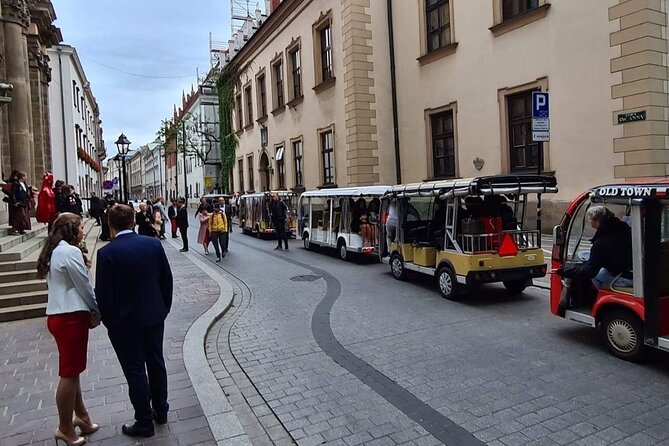
The vehicle is an eco electric buggy shaped much like a golf cart. You ride through city streets while the driver handles the route and points out what you are seeing. With a maximum capacity of 50 people for the activity, group size can vary, so it is worth arriving ready for the possibility of a busy vehicle.
More Golf Cart Tours in Kraków
- Krakow: City Sightseeing Tour by Electric Golf Cart
★ 4.5 · 3,264 reviews - Krakow: City Sightseeing Tour Eco Electric Buggy Golf Cart
★ 4.7 · 3,143 reviews - Krakow: Extended City Sightseeing Tour – Eco Buggy Golf Cart
★ 4.7 · 794 reviews
What the 90-minute format really means
This is a moving introduction, not a series of full museum visits. You stop at major points for brief looks and photographs, but the time is designed to give you a citywide outline rather than detailed interior access.
That format works well in Krakow. Kazimierz and Podgórze are close enough to connect, yet spread out enough that walking between every synagogue, square, church, and ghetto site can eat up much of a day. The buggy lets you see the pattern of the city: the former Jewish district on one side of the river, the ghetto and factory district on the other, and the Vistula corridor between them.
You may hear both a live explanation and recorded commentary. The audio guide is useful when road noise or group conversation makes the driver harder to hear. One limitation is that earphones may not always work perfectly, so do not rely on the recording alone.
Skałka and the churches of Kazimierz
The first major sight is the Church on the Rock, or Skałka, formally the Basilica of Saint Michael the Archangel and Saint Stanislaus the Bishop and Martyr. It sits above the place where Bishop Stanislaus of Szczepanów was killed in 1079 on the order of King Bolesław II the Bold.
That event changed Polish political and religious history. The king was forced into exile, while the slain bishop was later declared a saint. The site is tied to both the authority of the medieval crown and the power of the church, which makes it a strong opening to the tour.
You get about ten minutes here, and the admission ticket is free. The stop is especially useful if you want to see the church without making a separate visit. Just remember that a short stop cannot replace time inside the basilica or its surrounding monastery grounds.
The route also includes a basilica built in stages from about 1340 through the mid-15th century. It was designed as a monastery church, which explains its broad plot and nearby monastic cemetery. In 1404, King Władysław II Jagiełło gave the church to the Canons Regular of the Lateran.
This section gives the tour some balance. You are not seeing only Jewish Krakow. You are also seeing the older Christian institutions that helped shape Kazimierz.
Plac Wolnica and the old town of Kazimierz
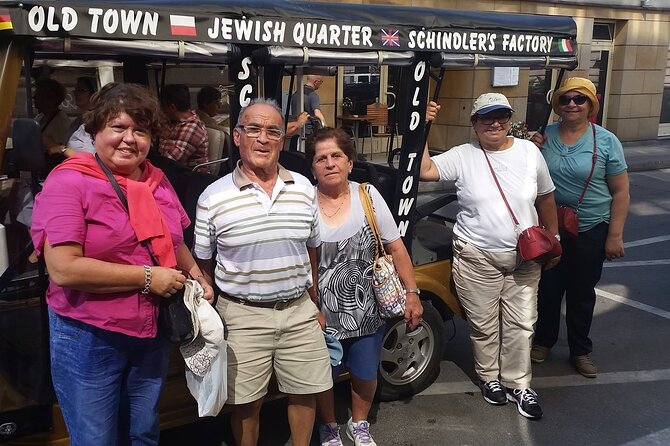
Plac Wolnica was once the main market square of Kazimierz, a city founded in 1335. In its earlier days, it was said to be as large as Krakow’s main market square, with trade, a town hall, scales, stalls, and a shearing room.
The square’s name comes from forum liberum, a Latin term linked with the right to sell meat outside the regular stalls. That detail gives you a glimpse of how medieval city government worked. Kazimierz was not simply a neighborhood of Krakow. It began as a separate city with its own administration and commercial life.
The surrounding streets changed shape during regulatory projects in 1808 and 1844. On the northern side, buildings once connected with the Jewish hospital near Kupa Synagogue line the area. From the buggy, you get the broad setting, while the guide supplies the details that are easy to miss when you walk through quickly.
A completely different kind of day out in Kraków:
- From Krakow: Auschwitz-Birkenau Guided Tour & Hotel Pickup
★ 4.5 · 33,358 reviews - From Krakow: Auschwitz-Birkenau Guided Tour & Hotel Pickup
★ 4.5 · 29,340 reviews - Krakow: Auschwitz Guided Tour with Optional Hotel Pickup
★ 4.5 · 15,280 reviews - Krakow–Zakopane: Cable Car, Chocholow Baths, Cheese & Vodka
★ 5.0 · 10,720 reviews
The synagogues of the former Jewish quarter
The largest part of the tour passes through Kazimierz’s former Jewish district. You see a remarkable concentration of synagogues, each linked to a different part of Krakow’s Jewish life.
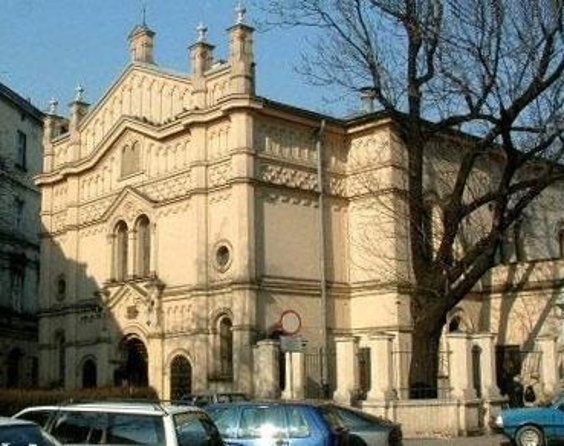
Tempel Synagogue is still used as a place of worship and also hosts concerts and cultural gatherings. Kupa Synagogue dates from the 17th century and continues to serve as a setting for religious events and cultural festivals. I like this pairing because it shows that these buildings are not only old facades. They remain tied to living traditions, even when their roles have changed.
Izaak Synagogue dates from 1644. It was funded by Izaak Jakubowicz, a banker known as Isaac the Rich, who served King Władysław IV. The building was designed by Francesco Olivieri, an architect born in Italy. That small detail reminds you that Krakow’s Jewish quarter was connected to wider European networks of money, design, and trade.
The High Synagogue is also called the Tall Synagogue. Its name refers either to its height or to the prayer room being located upstairs. It is the tallest synagogue in Krakow and an example of late Renaissance design. It is inactive today, so you should expect an exterior visit rather than a full religious site experience.
The Old Synagogue is one of the most important buildings on the route. It is the oldest synagogue building still standing in Poland and was once the main religious, social, and organizational center of Krakow’s Jewish community. Today, its importance is architectural as well as historical.
Wolf Popper Synagogue was once one of the most splendid houses of prayer in Kazimierz. Its founder, Wolf Popper, established it in the early 17th century. The building later declined, and its former women’s gallery now serves as an art gallery, while the synagogue area is used as a bookshop.
The Remah Synagogue is the smallest of Kazimierz’s historic synagogues and one of only two active synagogues in Krakow. It is named for Rabbi Moses Isserles, whose writings helped preserve Ashkenazi customs within Jewish law. That name may sound like a footnote, but it matters if you want to understand why this modest building has such weight in Jewish religious life.
The route also points out a connection to Helena Rubinstein, born to a Jewish family in Krakow. Her father ran a shop in the city, and she later became known internationally in the cosmetics business. Her family connection to philosopher Martin Buber adds another Krakow link to the wider Jewish intellectual world.
You do not tour every synagogue interior during the buggy ride. That is both its strength and its weakness. You see many sites in one sweep, but if a particular synagogue interests you, plan a return visit on foot.
Crossing into Podgórze and confronting the ghetto years
The tone shifts as the buggy moves toward Podgórze. At Ghetto Heroes Square, you are entering a place used from 1941 to 1943 for the concentration of Krakow’s Jewish population before deportations to concentration camps.
The square was once called Plac Zgody, and before that it was known as Mały Rynek. Its wartime role gives the space a difficult weight. This is not a pretty-place photo stop. It is a place where the guide’s words matter, and the best explanations connect the square to the people forced through it.
At number 18, the Eagle Pharmacy Museum recalls Tadeusz Pankiewicz. His pharmacy was the only one inside the Krakow ghetto, and he was the only Pole with permission to remain there. Before the war, the pharmacy served both Polish and Jewish residents of Podgórze. During the ghetto years, it became a place of contact, medicine, and help.
The buggy points out the museum, but admission is not part of this ride. If you want the fuller story, return independently and allow time for the museum. The tour gives you the setting; the museum gives you a closer account.
Schindler’s Factory and the old ghetto wall
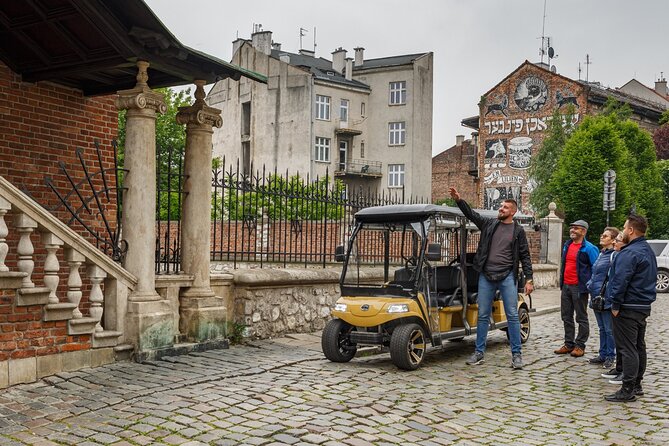
The route continues to Oskar Schindler’s Enamel Factory at Lipowa 4. The former factory now contains two museums: the Museum of Contemporary Art in Krakow in the old workshop area, and a branch of the Historical Museum of the City of Krakow in the former administrative building.
The site is widely associated with Oskar Schindler and the film Schindler’s List, but the factory also has a history before Schindler. A metal and enamel company was established there in 1937, before the wartime factory became part of Schindler’s story.
Set your expectations carefully. The buggy passes the factory area, but this tour does not provide a full museum visit. One of the most useful planning choices you can make is to schedule the factory for another time if it is high on your list. The ride helps you understand where it is and how it fits into Podgórze, but it does not replace the museum experience.
You also see a remnant of the old ghetto wall. It is a brief but powerful reminder that the ghetto was a controlled physical space, not simply an administrative label.
The final listed sight is St. Joseph’s Church on Podgórski Square, on the northern slopes of the Krzemionki foothills. Its position helps you see how the religious and residential parts of Podgórze fit together. Depending on the exact route and traffic, the amount of time spent at each point can vary.
The guides make the difference
The driver is also your guide, so the quality of the commentary shapes the entire outing. Olivia is praised for clear English, humor, good timing, and a sensitive approach to difficult subjects. Natalie is noted for careful driving, useful explanations, and even showing photographs on her phone during a wet outing.
Philip and Jacob are also described as clear and well informed, while Oskar is praised for making the history interesting. These names are useful examples, but your guide may be someone else. The important point is that the experience depends more on the individual guide than on the vehicle itself.
The best moments come when the guide links a building to a person or event instead of simply naming it. That is especially important in the Jewish quarter and around the former ghetto, where a rapid list of dates would feel flat and insensitive.
Comfort, cold weather, and the bumpy bits
The electric buggy is a practical answer to Krakow’s weather and uneven streets. Blankets and heating are available, and several outings were described as warm even in winter. That makes this a sensible choice for a cold or wet day, particularly if you want a break from walking.
The ride is not perfectly smooth. Kazimierz and Podgórze include older streets, and one part of the experience was described as a little bumpy. You should also be aware of seating space. A full cart with nine adults plus a family of three felt cramped, especially with heavy winter clothing, and some earphones did not work.
That complaint should not be ignored. If the cart feels too crowded, tell the driver at once. The operator says groups can usually be separated in such cases, but it is better to speak up early than spend the whole 90 minutes uncomfortable.
At night, some buildings are harder to see. If architecture and street detail matter to you, choose daylight. An evening ride can still be useful for orientation and atmosphere, but it is not the best choice for inspecting facades or taking clear photographs.
Is $28.88 a fair price?
At $28.88 per person, the value is strongest if you see this as a guided orientation. You are paying to cover a large area, hear context in English, rest your legs, and identify places to revisit. Walking the same route would take much longer, especially if you stop for photographs.
The price is less attractive if you expect entry to the Schindler Factory, the Eagle Pharmacy Museum, or every synagogue. Those are pass-by points on this outing, not full admissions. The free stop at Skałka helps, but the main value comes from transport and explanation.
For a first day in Krakow, I think the cost is reasonable. You get a quick mental map of Kazimierz and Podgórze, then you can spend the rest of your visit choosing which sites deserve more time.
Who should book this Krakow buggy tour?
I would choose it for a first visit, a short stay, a cold afternoon, or any day when your legs need a rest. It also suits you if you want an easy introduction to Krakow’s Jewish quarter and ghetto sites before returning to selected museums on foot.
It is a good fit for older visitors and anyone who finds long walks tiring, since most travelers can participate and the electric cart removes much of the walking between districts. Families and small groups may also appreciate the relaxed pace, provided the cart is not overfilled.
I would skip it if your main goal is Wawel Castle, the main market square, or detailed Old Town coverage. I would also skip it if you want long, quiet visits inside museums and synagogues. This is a broad city orientation with a strong Kazimierz and Podgórze focus.
Should you book it?
Book this tour if you want to get your bearings fast, see the Jewish quarter and former ghetto in one sweep, and save your legs. Choose a daylight departure when possible, and schedule Schindler’s Factory separately if you want to go inside.
Do not book it as your only Krakow sightseeing activity. The short stops and pass-by visits leave plenty for you to explore afterward. Used that way, the buggy tour offers good value, warm seats, solid local context, and a practical first look at two of Krakow’s most meaningful districts.
FAQ
Where does the Krakow electric buggy tour start?
The tour starts at the 24H Krakow old town car park, Mikołaja Zyblikiewicza 2, 31-029 Krakow, Poland.
Where does the tour finish?
The activity ends back at the same meeting point.
How long does the buggy tour last?
The tour lasts approximately 1 hour and 30 minutes.
What language is the tour offered in?
The experience is offered in English.
Does the tour include pickup?
Pickup is offered as part of the experience.
Does the tour enter Oskar Schindler’s Factory?
No. The buggy passes the factory area, but the tour does not include a museum visit inside Schindler’s Factory.
Are admission tickets included for the sights?
The listed stop at the Church on the Rock has free admission. The tour mainly provides outside visits and commentary, and it does not include full visits to every museum or synagogue.
What is the cancellation policy?
You can cancel at least 24 hours before the start time for a full refund. Cancellations or changes made less than 24 hours before the start time are not refunded or accepted.
Just added around Kraków
- Rynek Underground Museum & Wawel Castle, Cathedral – Cracow★ 5.0 · 3 reviews
- Schindler’s Factory, Ghetto and Plaszow Camp Guided Tour★ 4.7 · 3 reviews
- Nowa Huta – a guided tour of a utopian socialist city★ 5.0 · 3 reviews
- Krakow: Kazimierz by Golf Cart and Schindler’s Factory Tour★ 4.8 · 3 reviews
- Krakow: Jewish Traces Private Electric Car Tour★ 4.1 · 3 reviews
- Private Krakow City Tour by Car and Walk with private tour guide★ 5.0 · 3 reviews
- Discover the Jewish Quarter with a Bike Tour★ 5.0 · 3 reviews
- Krakow: Indoor Go-Karting (24-Minute Races)★ 4.8 · 3 reviews
Golf Cart Tours, compared.
City Sightseeing Tour Eco Electric Buggy Golf Cart
Read our review →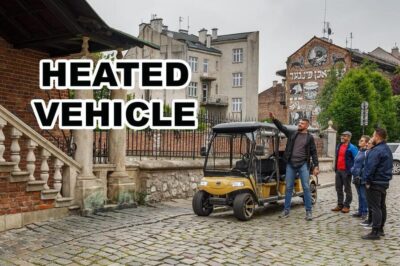
Extended City Sightseeing Tour – Eco Buggy Golf Cart
Read our review →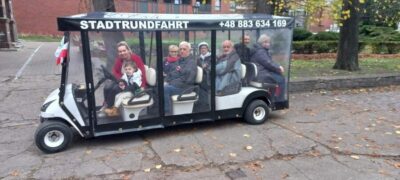
City Sightseeing Tour by Golf Cart/Buggy Guided Tour
Read our review →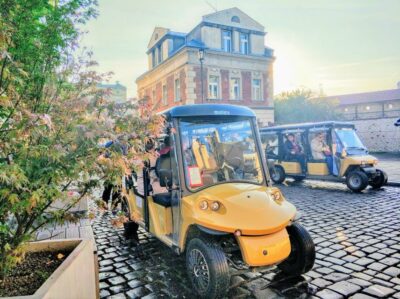
Jewish Quarter and Ghetto Electric Golf Cart Tour
Read our review →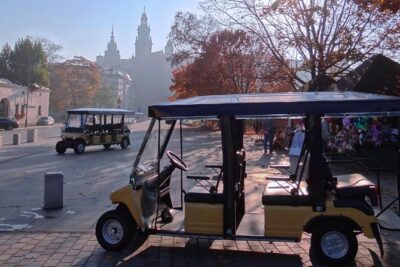
Krakow Grand City Tour by golf cart – All 3 districts
Read our review →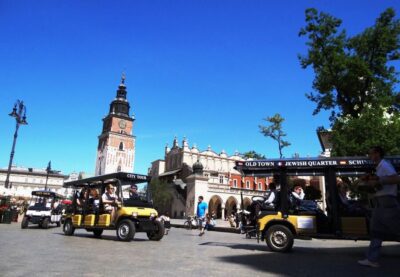
Shared or Private City Tour Sightseeing By Golf Cart
Read our review →Browse the lists this tour appears in