
REVIEW · WALKING TOURS
Life Behind the Iron Curtain Warsaw Walking Tour
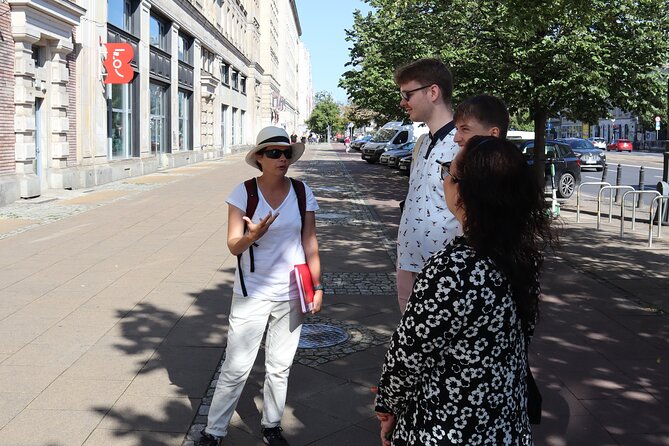
Warsaw’s communist past is hiding in plain sight. This 2.5-hour walk links ordinary streets, government buildings, railway stations, and grand socialist monuments to explain how Poland worked under the Polish People’s Republic. I like the small group limit of 10 people, which should make it easier to ask questions, and I like the guides’ use of family stories to turn politics into everyday life. The main consideration is the amount of walking, especially for anyone who has trouble covering a long city route.
The tour also gives you useful context for places you might otherwise pass without a glance. Guides such as Olivia, Oliwia, Agnieszka, and Aga have been praised for clear explanations, humor, and personal connections to the period. The 28 PLN Palace viewing terrace fee is extra, so budget for it only if you want to go upstairs after the walk.
In This Review
- Key points at a glance
- Why this tour gives Warsaw a useful second layer
- Constitution Square: a planned center for a planned society
- Marszałkowska Street and the theater of parades
- Socialist realism at the Ministry of Agriculture
- Mysia 3 and the cost of speaking freely
- The former party headquarters at Nowy Świat
- Cedet and the reality of empty shelves
- Central and Downtown stations: travel under state control
- The Palace of Culture and Science: a complicated final stop
- What the $28.57 price gets you
- Guides who make the subject personal
- Who should book it, and who should skip it
- Should you book the Life Behind the Iron Curtain tour?
- FAQ
- Where does the Life Behind the Iron Curtain tour start?
- Where does the tour end?
- How long does the walking tour last?
- What language is the tour offered in?
- How much does the tour cost?
- Is the Palace of Culture and Science viewing terrace included?
- How many people can join the tour?
- Are the stops free to enter?
- Is the tour suitable for people with walking difficulties?
- Can I cancel for a full refund?
Key points at a glance
- Starts at Constitution Square: See the planned center of postwar communist Warsaw and learn why its scale feels so grand.
- Covers daily life, not just politics: Food and household shortages, travel, censorship, and state control all form part of the story.
- Uses surviving city landmarks: Marszałkowska Street, Mysia 3, the former party headquarters, Cedet, and Central Station give the past a physical setting.
- Small groups make questions easier: No more than 10 people can join the tour.
- Ends at the Palace of Culture and Science: The final stop gives you the best chance to understand Warsaw’s most disputed building.
- Good value at $28.57: The price includes the guided walk, visual aids, a Warsaw information pack, and local recommendations.
Why this tour gives Warsaw a useful second layer
Warsaw is a city where rebuilding, political power, and modern life sit close together. You can admire a restored street one minute and then encounter a huge concrete building that carries memories of a very different Poland. Without a guide, many of these places look like ordinary city architecture.
This walk focuses on the period after the Second World War, when Poland operated as a communist state aligned with the Soviet Union. The tour does not simply point to grand buildings and attach dates. It connects architecture with control, shopping with shortages, railway stations with restricted movement, and public squares with political theater.
That approach suits me because the subject becomes human-sized. You learn not only who held power, but how the system affected buying groceries, speaking openly, traveling abroad, and finding reliable information. Several guides have also brought family experiences into the discussion, which adds a personal layer without replacing the wider historical story.
The tour is offered in English and uses visual aids. Those details matter because this subject can involve unfamiliar names, institutions, and political terms. A photograph or other visual reference can help you picture how a place looked or functioned during the communist period.
More Walking Tours in Warsaw
- Warsaw: Old Town Highlights Walking Tour in English
★ 4.7 · 1,516 reviews - Warsaw: Old Town Guided Walking Tour
★ 4.9 · 599 reviews - Half-Day Polish Food Walking Tour with Guide and Dinner
★ 4.5 · 381 reviews
Constitution Square: a planned center for a planned society
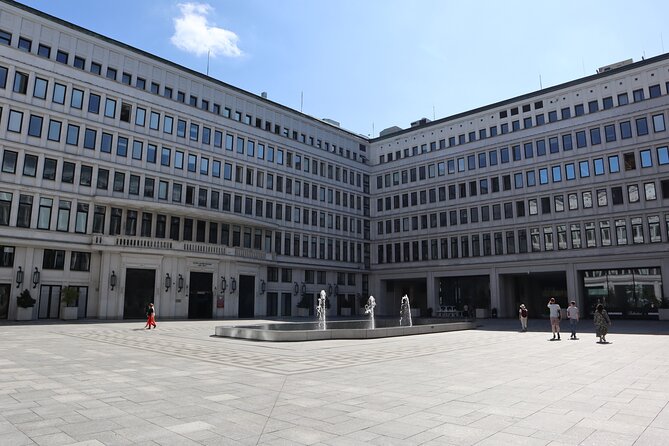
The walk begins at Plac Konstytucji, or Constitution Square. You have about 20 minutes here, and the square is an effective opening because it introduces the style and ambition of postwar communist Warsaw.
This was intended to become the new city center of the Polish People’s Republic. Its broad scale was not accidental. The square was designed for public gatherings, official ceremonies, parades, and political displays. It presents an image of order and collective power rather than the intimate feel of a traditional European square.
I would pay attention to the relationship between the open space and the surrounding buildings. The architecture helps explain socialist realism, a style that used monumental forms and grand visual messages to present the state as strong, modern, and worthy of respect. The square is not just a backdrop for photographs. It is a lesson in how a government tried to shape public space and public behavior.
This first stop also sets up an important contrast. The official image was one of confidence and progress, while daily life could be marked by shortages and uncertainty. That tension runs through the rest of the walk.
Marszałkowska Street and the theater of parades
From Constitution Square, the group continues along Marszałkowska Street for roughly 20 minutes. This wide avenue was used for marches and parades, so its size had a political purpose as well as a practical one.
A guide can show you how broad streets were built to accommodate large public events and controlled movement. You will also see one of the most recognizable places connected with the Polish People’s Republic, although the supplied details do not identify it by name. That makes this a good moment to listen closely and look around rather than rush ahead for photographs.
The walk along Marszałkowska also helps you read Warsaw as a working city instead of a collection of famous sights. The road connects the official spaces of power with shops, transport, offices, and everyday urban activity. This is where the tour begins to move from political design toward ordinary experience.
Because the group is walking through central Warsaw, you should wear sensible shoes and expect city pavement, crossings, and a steady route. The overall distance is not described in exact measurements, but the activity is not ideal for anyone who has difficulty walking long distances.
Socialist realism at the Ministry of Agriculture
The Ministry of Agriculture and Rural Development takes about 15 minutes. Its building offers a clear example of socialist realism, giving the guide a chance to explain what the style looks like and why it was used.
You can expect the discussion to focus on more than decoration. Socialist realist buildings were meant to communicate authority, discipline, and confidence. Their scale and formal appearance helped express the state’s preferred image of itself. A ministry building was also a fitting place for this message because it represented government administration and control.
This stop is useful if you are interested in architecture but do not already know how to read political design. Instead of treating the building as a photo opportunity, the guide explains how its form connects to the system that commissioned it.
There is no admission charge at this stop. You view the exterior, so the value comes from the explanation rather than from entering a museum or interior room. That is typical of this walk: Warsaw itself acts as the exhibit.
A completely different kind of day out in Warsaw:
- Warsaw: Chopin Concert in the Old Town
★ 4.8 · 2,287 reviews - Warsaw: Traditional Galar Cruise on The Vistula River
★ 4.6 · 1,640 reviews - Warsaw Concert: Chopin – Painted by Candlelights with Wine
★ 4.8 · 1,442 reviews - Warsaw: City Sightseeing Hop-On Hop-Off Bus Tour
★ 3.6 · 1,415 reviews
Mysia 3 and the cost of speaking freely
At Mysia Street, the group spends about 20 minutes discussing the Free Speech Memorial, censorship, and espionage. This is one of the more thought-provoking stops because it shifts the story from buildings and ceremonies to information.
Censorship affected what could be printed, broadcast, or publicly discussed. Espionage adds another layer, showing how a system built on secrecy and suspicion could shape people’s behavior. The memorial gives those ideas a physical point of reference.
I would expect this section to work best when the guide explains how censorship affected normal communication, not only newspapers or official publications. The personal stories associated with this period are especially useful here. The guides Olivia and Oliwia have been praised for relating the subject to family experiences, including memories passed down by parents and grandparents.
The tour’s English format is helpful at Mysia 3 because the ideas can be subtle. The walk does not appear to include an entry into a dedicated exhibition, so anyone hoping for an indoor museum display should adjust expectations. You are getting an outdoor explanation tied to the street and memorial.
The former party headquarters at Nowy Świat
The next stop is Nowy Świat 6/12, where the Banking and Finance Center occupies the building that once housed the Communist Party headquarters. The group spends about 15 minutes here.
This stop brings national power down to one address. During the Polish People’s Republic, decisions affecting the entire country were managed from this site. That makes the building a strong reminder that political control was concentrated in specific offices, not spread evenly through society.
The contrast between past and present is part of the interest. A building can continue to serve an important economic role while its political meaning changes. The guide helps you see both versions at once: the current function and the former role at the center of party authority.
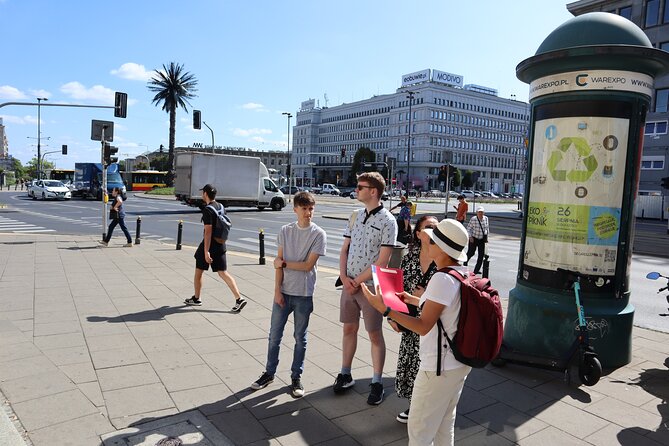
This is also a good point to ask questions. With a maximum of 10 participants, the group should feel less like a moving crowd and more like a conversation. That matters on a history walk, since the most useful details are often the small explanations about how institutions worked.
Cedet and the reality of empty shelves
The former Central Department Store Cedet gets about 15 minutes, and this may be the stop most closely tied to daily life. The tour uses the building to explain one of the hardest parts of communist-era Poland: buying ordinary goods.
The subject sounds simple, but it opens the door to a wider discussion of shortages and state-controlled supply. Shopping was not merely a matter of choosing between brands. Availability could be uncertain, and getting basic items could take time and planning. A large department store becomes a useful symbol because it suggests abundance from the outside, while the reality for shoppers could be very different.
This section should appeal to anyone who wants more than a political timeline. You learn how a system reached into kitchens, wardrobes, and family routines. The contrast between the building’s former role and its current appearance also helps you think about how quickly a city’s commercial life can change.
No entry fee is listed here. Again, the point is not shopping inside the former store but understanding the building as evidence of a former economic system.
Central and Downtown stations: travel under state control
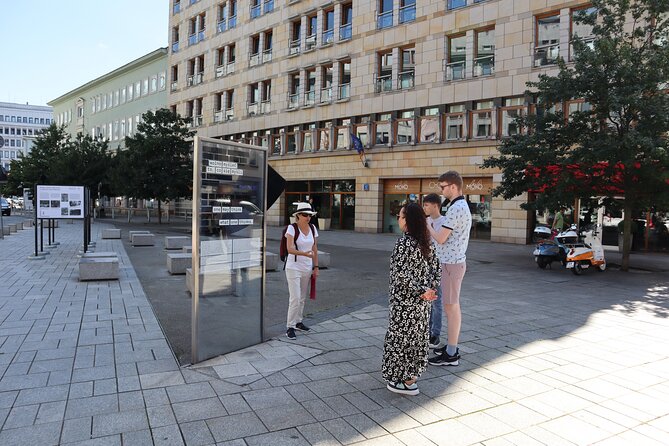
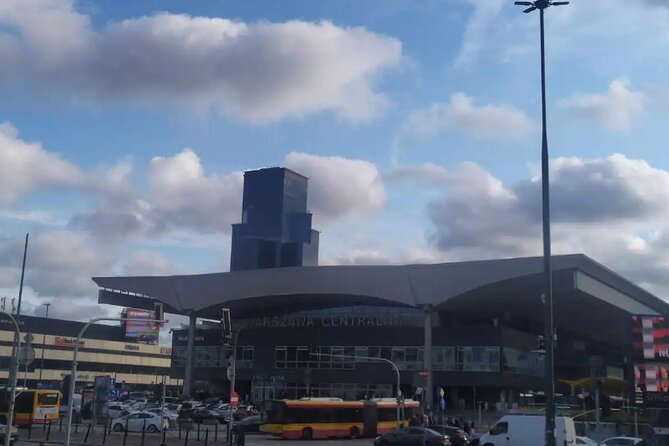
The walk then reaches Warsaw Central Railway Station and the Downtown Railway Station for about 15 minutes. The guide discusses local, regional, and international travel during the Polish People’s Republic.
Railway stations are a smart choice for this topic. They connect the capital with the rest of the country, but travel was not always as open or easy as it is today. The stop allows you to consider who could move, where people could go, and how international travel differed from domestic journeys.
You also get a chance to think about the station as a practical public building. It served commuters, families, workers, and visitors, while also reflecting the scale and priorities of the state that built it. The discussion adds social detail to the architecture.
The station stop is relatively brief, so do not expect a long transport lecture. Instead, it works as a compact part of the wider story. The tour keeps moving and avoids spending too long on any single building, which helps explain why the full route fits into about two and a half hours.
The Palace of Culture and Science: a complicated final stop
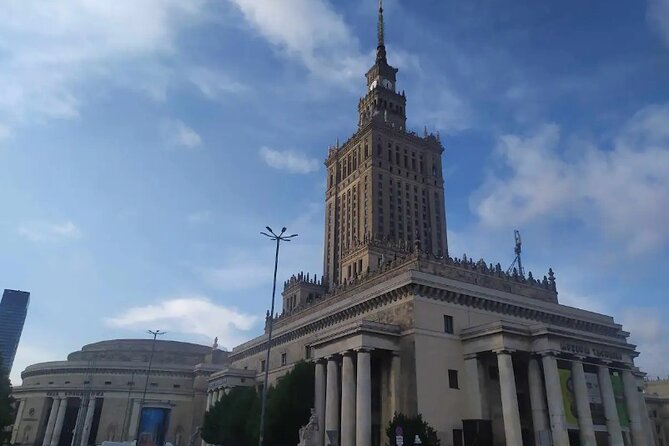
The tour finishes in front of the Palace of Culture and Science, with about 30 minutes devoted to it. This is the longest stop and a fitting end because the building is both a powerful symbol and a source of controversy.
The palace is hard to ignore. Its size and position make it one of Warsaw’s most visible reminders of the communist era. For some people, it represents Soviet influence and unwanted political pressure. For others, it has become part of the city’s identity and a familiar marker of modern Warsaw. The guide explains why the building creates such mixed feelings.
Ending outside is important to note. The standard tour does not include the viewing terrace. If you want to visit it, the additional fee is 28 PLN. The terrace is an optional extra rather than part of the guided experience, so you can decide based on your interest, budget, and schedule.
The final discussion brings earlier subjects together. Monumental architecture, government authority, public ceremonies, and changing attitudes all meet at the palace. It is a strong place to finish because you leave with a clearer sense of why Warsaw’s communist past still matters.
What the $28.57 price gets you
At $28.57 per person, this is priced as an affordable specialist walking tour rather than a major attraction package. The main value is the guide’s interpretation. You are paying to understand a group of ordinary-looking places that would be difficult to connect on your own.
The fee includes:
- A guided English-language walk lasting about 2 hours and 30 minutes
- Visual aids used during the explanations
- A Warsaw information pack sent before the tour, including frequently asked questions and useful links
- Recommendations for places to visit, eat, and drink
All listed stops are free except the optional Palace of Culture and Science viewing terrace. That keeps extra costs low. You may want to bring water and allow a little time after the tour if you plan to visit the terrace, but the provided details do not specify how long that additional visit takes.
The small group is another part of the value. A large group can make an urban history walk feel distant, especially when the guide is pointing out details on busy streets. A limit of 10 supports a more personal format and gives you a better chance to ask about family experiences, censorship, or the transition after communism.
Guides who make the subject personal
The strongest praise centers on the guides’ delivery. Olivia is repeatedly described as clear, engaging, and generous with practical recommendations. Oliwia is praised for making the subject fun while explaining how communist rule still affects people who lived through it. Agnieszka, also referred to as Aga, is noted for cheerful storytelling and strong command of the subject.
You should not assume which guide you will receive, but these comments reveal the kind of experience the tour aims to provide. The personal family accounts are especially useful. One guide was very young when her family left Warsaw during communism, yet she drew on stories from parents and grandparents to explain what life was like.
That distinction matters. You are not getting a first-person account of every event, but you are getting a guide who can connect public history with family memory. The best moments are likely to come when a building or street leads into a story about ordinary people.
Who should book it, and who should skip it
I would recommend this tour if you want to understand Warsaw beyond its headline sights. It suits first-time visitors who like context, history fans, architecture students, and anyone curious about how political systems affect ordinary routines.
It is also a good choice if you have already taken general Warsaw tours and want a more focused subject. The route gives you a different way to read central Warsaw, especially if you are interested in the years after the war and the changes that followed the fall of communist rule.
You may want to skip it if your priority is entering major museums or seeing a long list of famous attractions. This is an outdoor walking experience, and most of the value comes from explanations at buildings and public spaces. The route is also not recommended for people who have problems walking long distances.
The tour is available in English, accepts service animals, and operates near public transportation. Confirmation is provided when you book. Free cancellation is available if you cancel at least 24 hours before the start time, while later cancellations and changes are not accepted.
Should you book the Life Behind the Iron Curtain tour?
Book it if you want a human explanation of communist Warsaw, not just a parade of dates and buildings. The route is focused, the group is small, the price is fair, and the guides appear to bring warmth and family context to a difficult subject.
I especially like the way the tour moves from grand public architecture to censorship, party control, empty shops, and restricted travel. That progression shows how the system worked at both the state level and the household level.
Skip it only if you dislike walking tours or want indoor attractions throughout. For most history-minded visitors, this is a smart way to spend an afternoon in Warsaw, with the Palace terrace available as an optional add-on at the end.
FAQ
Where does the Life Behind the Iron Curtain tour start?
The tour starts at Constitution Square, Plac Konstytucji, 00-647 Warszawa, Poland.
Where does the tour end?
It ends near the Palace of Culture and Science at Emilii Plater 54, 00-901 Warszawa, Poland.
How long does the walking tour last?
The tour lasts approximately 2 hours and 30 minutes.
What language is the tour offered in?
The tour is offered in English.
How much does the tour cost?
The listed price is $28.57 per person.
Is the Palace of Culture and Science viewing terrace included?
No. Entry to the viewing terrace is not included and costs 28 PLN.
How many people can join the tour?
The tour has a maximum group size of 10 participants.
Are the stops free to enter?
All listed stops are free except the optional viewing terrace at the Palace of Culture and Science.
Is the tour suitable for people with walking difficulties?
The tour is not recommended for people who have problems walking long distances.
Can I cancel for a full refund?
Yes. You can cancel for a full refund if you cancel at least 24 hours before the experience start time. Changes or cancellations made less than 24 hours before the start are not accepted.
Just added around Warsaw
- Jewish heritage in Warsaw★ 4.5 · 3 reviews
- Warsaw Outdoor Paintball with Transfers (all year round)★ 5.0 · 3 reviews
- World War II Warsaw Old Town, Military Cemetery Walking Tour★ 4.7 · 3 reviews
- Warsaw: Wolf’s Lair & Swieta Lipka Small-Group Tour + Lunch★ 5.0 · 3 reviews
- Sunset Boat Tour with Unlimited Drinks in Warsaw★ 3.5 · 3 reviews
- Majdanek – German camp from II World War – Private Tour – 1 DAY TRIP FROM WARSAW★ 5.0 · 3 reviews
- From Warsaw: Guided Tour to Wieliczka Salt Mine and Krakow★ 4.5 · 3 reviews
- Warsaw Sightseeing with NEW Mercedes Sclass !!!★ 5.0 · 3 reviews
Walking Tours, compared.




Gdańsk City Sights & History Guided Walking Tour in English
Read our review →


Browse the lists this tour appears in