
REVIEW · OLD TOWN WALKING TOURS
Private 4h Tour in Warsaw Old Town
Warsaw’s past is written in rebuilt stone. This private four-hour walk links the city’s royal landmarks, medieval center, wartime memorials, churches, palaces, and the elegant Royal Route in one thoughtful sweep. I like the private format, since your group can focus on the questions and subjects that matter most to you. I also like the way the route treats Warsaw as more than a pretty square, bringing in the city’s destruction, reconstruction, and survival.
The main thing to consider is the pace. There are eleven stops, and most visits last only 10 to 20 minutes. You will see a great deal, but this is primarily an orientation and storytelling walk, not a series of long indoor visits. At $111.75 per person, the value is strongest for couples, families, or small groups who want a personal guide rather than a large group stroll.
In This Review
- Key points to know before booking
- Starting beneath Sigismund’s Column
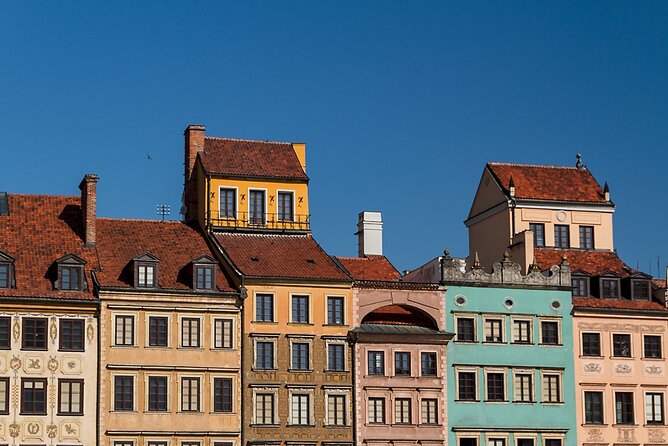
- Reading the rebuilt Old Town
- Royal Castle Gardens and the cost of rebuilding
- St. John’s Cathedral and Poland’s civic story
- The Mermaid in the Old Town Marketplace
- The Barbican, city walls, and old photographs
- Facing the Warsaw Uprising Monument
- Miodowa Street, palaces, and a royal heart
- Theatre Square and the Grand Theatre
- The Tomb of the Unknown Soldier
- Following the Royal Route to Krakowskie Przedmieście
- How the private format affects the value
- Who should book this walk?
- Should you book the Warsaw Old Town tour?
- FAQ
- How long is the private Warsaw Old Town tour?
- How much does the tour cost?
- Is the tour private?
- What language is the tour offered in?
- Where does the tour begin?
- Where does the tour end?
- Are admission tickets included?
- Can I cancel for a full refund?
Key points to know before booking
- A private route through 11 major sites: Your group travels together from Sigismund’s Column to the Royal Route, with no strangers joining you.
- Warsaw’s destruction is central to the story: The Old Town, Royal Castle, and surrounding monuments show how the city was rebuilt after near-total wartime ruin.
- Personal guiding is the tour’s biggest strength: Maria, Cesar, Carolina, and Mariola are praised for clear explanations, warmth, local insight, and useful food suggestions.
- Mostly an outdoor walking experience: Admission is free at the listed stops, but the schedule allows brief visits rather than extended museum time.
- A useful first look at central Warsaw: You cover the Old Town, Uprising Monument, Tomb of the Unknown Soldier, and Royal Route without arranging separate visits.
- The walk finishes near the Nicolas Copernicus Monument: Afterward, you can continue along Krakowskie Przedmieście on your own.
Starting beneath Sigismund’s Column
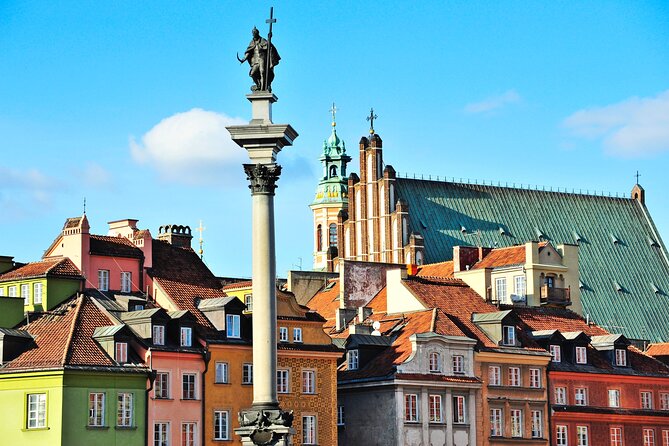
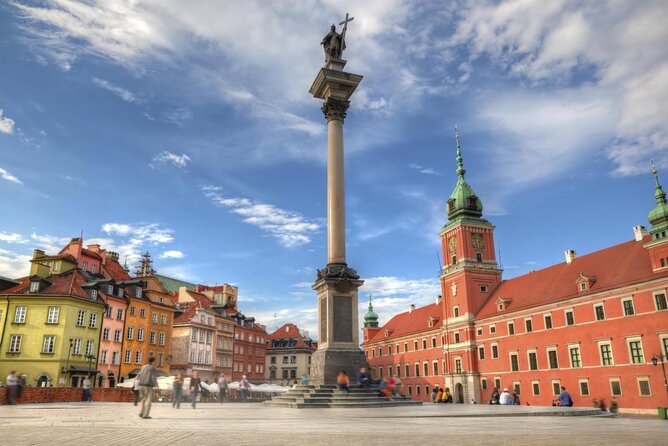
The meeting point is Sigismund’s Column on Castle Square, one of Warsaw’s clearest starting markers. The monument honors King Sigismund III Vasa, who moved Poland’s capital from Kraków to Warsaw in the late sixteenth century. The column is also a compact lesson in Warsaw’s habit of rebuilding.
This is the oldest public memorial in the city, but it has not always occupied its present setting. It was moved when the alignment of Krakowskie Przedmieście changed, then moved again after World War II as the WZ route was developed. German troops brought it down on September 2, 1944. The statue and column were reconstructed by 1949.
Your guide may point out earlier versions beside the Royal Castle walls. That small detail helps you read the square as a place altered by traffic, war, and restoration, rather than as an untouched medieval scene. Allow about 10 minutes here.
More Old Town Walking Tours in Warsaw
- Warsaw: Chopin Concert in the Old Town
★ 4.8 · 2,287 reviews - Warsaw: Old Town Highlights Walking Tour in English
★ 4.7 · 1,516 reviews - Warsaw: Old Town Guided Walking Tour
★ 4.9 · 599 reviews
Reading the rebuilt Old Town
The Old Town is the heart of the walk, and it deserves more than a quick photograph. Warsaw began here because the river location supported trade between the Baltic and the Black Sea. Merchants and craftspeople helped the settlement grow, while wooden buildings gradually gave way to masonry houses, stone walls, churches, towers, and a barbican.
Then came 1944. About 90 percent of the Old Town area was destroyed during the war. The rebuilt streets and façades are so convincing that you could easily miss the scale of what was lost. That is why a guide adds real value here. The important question is not simply how old is this building? It is how was Warsaw able to restore an entire historic center after such devastation?
The reconstruction took years and eventually earned UNESCO World Heritage recognition. You have around 45 minutes in this part of the route, the longest single stop, so expect time for context, photographs, and questions. Still, do not expect a full museum visit. The appeal is the street-level explanation of how the city’s urban center works.
Royal Castle Gardens and the cost of rebuilding
The Royal Castle Gardens offer a calmer pause beside one of Warsaw’s most important buildings. The castle became a royal residence in the sixteenth century after Masovia joined the Polish Crown. It suffered repeated damage over the centuries, then was bombed and badly burned during the opening days of World War II.
Some important artworks had been removed and hidden before the worst destruction. Other pieces were looted, and in 1944 the castle was blown up in retaliation for the Warsaw Uprising. Reconstruction did not begin until 1971, and much of the work was paid for through public generosity. The castle opened to visitors in 1984.
You spend about 15 minutes in the gardens, not inside the castle. That distinction matters if you hoped to see royal rooms or art collections. The outdoor stop is still useful because it gives you a direct view of a reconstructed national symbol and makes the city’s long rebuilding effort easier to understand.
St. John’s Cathedral and Poland’s civic story
St. John’s Cathedral is one of Warsaw’s oldest churches and a key link between religious and political life. The church witnessed important events, including the oath connected with the Constitution of May 3, regarded as Europe’s first constitution of its kind.
The crypt contains the tombs of several historical figures. A particularly notable feature is the Chapel-Mausoleum of the Primate of the Millennium. If your guide has time to point out the church’s details, listen for the connections between Poland’s religious institutions and its national identity.
The planned stop lasts 15 minutes. That is enough for an introduction, though not necessarily enough for an unhurried look at every chapel. From July through September, organ concerts take place here every Sunday at 4 PM. The tour does not include a concert, but the timing could help you plan an evening return.
A completely different kind of day out in Warsaw:
- Warsaw: Traditional Galar Cruise on The Vistula River
★ 4.6 · 1,640 reviews - Warsaw Concert: Chopin – Painted by Candlelights with Wine
★ 4.8 · 1,442 reviews - Warsaw: City Sightseeing Hop-On Hop-Off Bus Tour
★ 3.6 · 1,415 reviews - Warsaw: POLIN Museum of the History of Polish Jews Ticket
★ 4.7 · 1,142 reviews
The Mermaid in the Old Town Marketplace
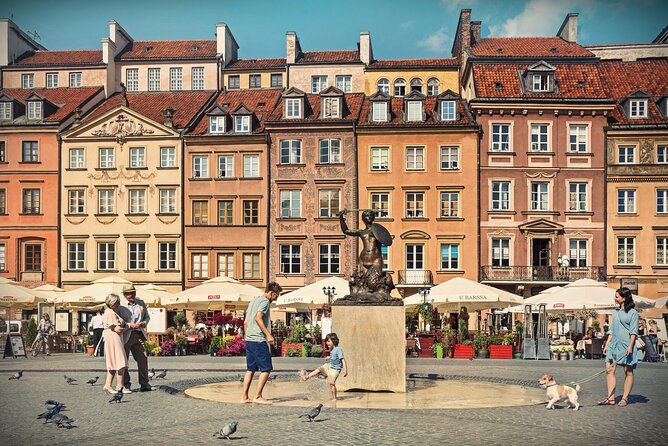
The Old Town Marketplace is the city’s social center, surrounded by restored tenement façades, cafés, restaurants, clubs, galleries, and museums. A statue of the Warsaw Mermaid, the city’s best-known symbol, occupies the central square.
The square was divided into four sections named for Enlightenment activists: Kołłątaj, Dekert, Barss, and Zakrzewski. That detail is easy to miss when you are busy admiring the colors and angles of the surrounding buildings, but it gives the square a civic dimension.
You have about 15 minutes here. I would use the time to get oriented, note places that might suit a later meal, and ask your guide for food or snack recommendations. Carolina is praised for offering practical suggestions of this kind, which can make the tour useful beyond the formal sightseeing.
The Barbican, city walls, and old photographs
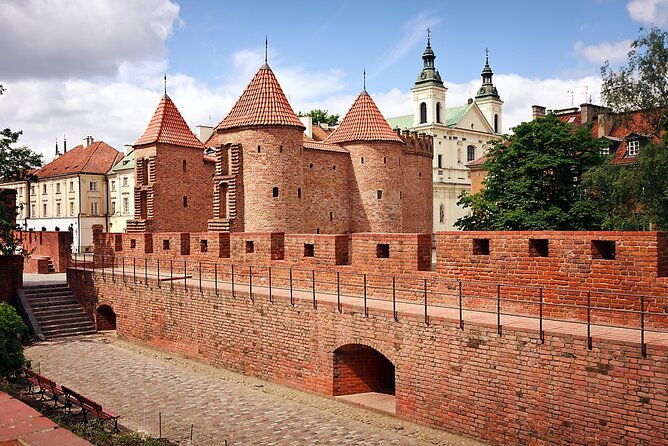
The Warsaw Barbican once formed part of the defensive system surrounding the city. Built in 1548, it belonged to roughly 4,000 feet of ramparts, towers, and fortified lines. Today, painters and musicians often add life to the passage around it.
From May through October, an exhibition inside the Barbican presents historic photographs and models of the former defenses. This is one of the few places where the contrast between old Warsaw and present-day Warsaw can become especially clear. Plans and photographs let you picture the walls before the war and understand how much of the defensive network has disappeared.
The stop lasts approximately 15 minutes. The tour does not specify admission to the exhibition, so treat the Barbican as an exterior visit unless your guide explains otherwise. If the exhibition is open and you want more time, ask if you can return later.
Facing the Warsaw Uprising Monument
The Warsaw Uprising Monument is one of the heaviest stops on the walk. It depicts insurgents in battle and recalls the 1944 uprising, which ended in defeat and the deaths of about 200,000 Polish people.
The monument is not simply a military memorial. It forces you to confront the human cost behind the city’s reconstruction. After hearing about restored façades and rebuilt palaces, you see the reason those repairs were so necessary.
Nearby, the Krasiński Palace offers a different mood. This Baroque palace, once the residence of Jan Krasiński, now houses special collections for the National Library. Its reliefs draw on antique models, and the park behind it provides room for a short pause. The tour also points out the modern Supreme Court building across the street, a useful reminder that this is a working capital, not an open-air museum.
Expect about 10 minutes here. The guide’s explanation matters more than the length of the stop.
Miodowa Street, palaces, and a royal heart
Miodowa Street is narrower and more intimate than the broad ceremonial avenues. It is lined with former aristocratic residences, religious buildings, and institutions that reveal how power and education once worked in Warsaw.
At number 24, the former Collegium Nobilium trained young members of the ruling elite. The building now houses the Academy of Theatre. Number 17 is the eighteenth-century Palace of Warsaw’s Archbishops, the residence of the Primate of Poland. Nearby are Pac Palace, now connected with the Ministry of Health, and Warsaw’s only Eastern Catholic Church.
The Capuchin Church has a particularly striking detail: the heart of King Jan III Sobieski is kept beside the right side of the altar. You may also get a view toward the Monument of Warsaw’s Heroes, often called the Monument of Nike.
This section lasts about 20 minutes. It rewards careful listening because the buildings are easy to pass without knowing what they once represented.
Theatre Square and the Grand Theatre
Theatre Square shifts the mood from medieval lanes to grand civic architecture. The Late Baroque Blank Palace borders one side, while the rebuilt Jabłonowski Palace recalls the prewar city hall. The palace was destroyed in the war and reconstructed in the 1990s, but only its façade and clock tower survive from the original design.
Walk through the gate below the tower to see nineteenth-century foundations. It is a small but telling sight, showing how Warsaw preserves fragments even when an entire building cannot be restored in full.
Across the square, the Grand Theatre houses the National Opera and National Theatre. Its opera stage is among Europe’s largest. A performance would reveal the grand interior, with chandeliers, columns, and patterned floors, but the tour itself gives you an exterior introduction. Theatre Square ends near the Petrykus Tenement House, built in 1821 and now home to restaurants and clubs.
The planned time here is 15 minutes. Keep a note of the area if you want an evening performance or meal.
The Tomb of the Unknown Soldier
The Tomb of the Unknown Soldier is a simple, solemn memorial to Polish soldiers who died fighting for the country’s freedom. It contains ashes connected with the defense of Lviv and soil from World War I battlefields, along with urns representing later battlefields where Polish troops fell.
An eternal flame burns beside the tomb, and a military honor guard changes daily at noon. If your walk reaches this point near that time, you may see the ceremony. The stop is scheduled for about 10 minutes, enough to pause and take in the setting without rushing through the memorial’s meaning.
Following the Royal Route to Krakowskie Przedmieście
The final 30 minutes follow the former Royal Route from Castle Square toward Three Crosses Square, with the tour ending on Krakowskie Przedmieście near the Nicolas Copernicus Monument. This is a fitting finish because the route connects royal residences, churches, university buildings, museums, shops, and restaurants.
Along the way, look for St. Anne’s Church and its tower view, the Polonia House, and the place where Maria Skłodowska-Curie worked at the former Museum of Industry and Trade. The Radziwiłł Palace is now the residence of Poland’s president. Warsaw University’s campus includes Kazimierzowski Palace, while Czapski Palace houses the Academy of Fine Arts.
The route continues toward Nowy Świat, an extension of Krakowskie Przedmieście lined with shops and places to eat. Your guide leaves you at the Copernicus Monument, so you can continue exploring independently. This makes the ending practical: you finish in an area suited to another walk, a café stop, or a self-guided look at the Royal Route.
How the private format affects the value
At $111.75 per person, this is not the cheapest way to see Warsaw’s Old Town. The price makes more sense when you are traveling as a small private group and want a guide who can adjust explanations to your interests. Group discounts are available, though the amount is not specified.
The tour includes a professional local guide, while the listed stops have no admission charge. That means your money mainly pays for interpretation, route planning, and the convenience of connecting eleven sites in four hours.
The strongest value comes from the historical framing. Maria is praised for making the city’s past interesting from beginning to end. Cesar is credited with explaining the details of each site clearly. Carolina is noted for her local perspective and food suggestions, while Mariola is praised for combining Polish history with links to France and for guiding with warmth and passion.
The experience is offered in English. One French-language booking was also handled by a guide who spoke French perfectly, but you should confirm language needs when booking rather than assume a particular guide.
Who should book this walk?
I would recommend it to first-time visitors who want a strong introduction to central Warsaw. It is also a good fit for anyone drawn to wartime history, urban reconstruction, churches, royal residences, and national memorials.
Families may appreciate the private setup, especially if children need occasional pauses or simpler explanations. History fans will get the most from the Old Town, Royal Castle, Uprising Monument, and Tomb of the Unknown Soldier.
You may want another option if your priority is extended time inside the Royal Castle, St. John’s Cathedral, or the Barbican exhibition. The schedule is broad rather than slow. You should also expect a substantial amount of walking and outdoor sightseeing, since the route moves through streets, squares, gardens, and monuments.
Confirmation arrives at booking, the meeting point is near public transportation, and most people can participate. Free cancellation is available up to 24 hours before the start time. Changes or cancellations inside that window are not accepted for a refund.
Should you book the Warsaw Old Town tour?
Book it if you want one private walk that explains why Warsaw looks the way it does today. The reconstructed Old Town is beautiful, but its meaning becomes much clearer when paired with the Royal Castle, Uprising Monument, memorials, and Royal Route.
Skip it if you prefer long museum visits or independent wandering with no fixed schedule. For everyone else, the tour offers a well-planned first look, strong local storytelling, and a useful finish near the city center. Its best feature is not the number of stops. It is the chance to see Warsaw as a city that remembers its losses while continuing to live fully in the present.
FAQ
How long is the private Warsaw Old Town tour?
The tour lasts approximately four hours.
How much does the tour cost?
The listed price is $111.75 per person. Group discounts are available.
Is the tour private?
Yes. Only your group participates in the activity.
What language is the tour offered in?
The tour is offered in English. A French-speaking guide has also led a French-language visit, but guide language should be confirmed when booking.
Where does the tour begin?
The tour begins at King Sigismund’s Column on Castle Square, Plac Zamkowy, 00-001 Warszawa, Poland.
Where does the tour end?
The guide leaves you at the Nicolas Copernicus Monument on Krakowskie Przedmieście, along the Royal Route. You can continue exploring independently from there.
Are admission tickets included?
The listed stops show free admission. The experience includes a professional local guide, and no separate paid entry is specified.
Can I cancel for a full refund?
Yes. You must cancel at least 24 hours before the experience start time for a full refund. Cancellations or changes made less than 24 hours before the start time are not accepted.
Just added around Warsaw
- Jewish heritage in Warsaw★ 4.5 · 3 reviews
- Warsaw Outdoor Paintball with Transfers (all year round)★ 5.0 · 3 reviews
- World War II Warsaw Old Town, Military Cemetery Walking Tour★ 4.7 · 3 reviews
- Warsaw: Wolf’s Lair & Swieta Lipka Small-Group Tour + Lunch★ 5.0 · 3 reviews
- Sunset Boat Tour with Unlimited Drinks in Warsaw★ 3.5 · 3 reviews
- Majdanek – German camp from II World War – Private Tour – 1 DAY TRIP FROM WARSAW★ 5.0 · 3 reviews
- From Warsaw: Guided Tour to Wieliczka Salt Mine and Krakow★ 4.5 · 3 reviews
- Warsaw Sightseeing with NEW Mercedes Sclass !!!★ 5.0 · 3 reviews
Old Town Walking Tours, compared.




Bike Tour of Old Town, Jewish Quarter and the Ghetto
Read our review →

Sightseeing EcoCruise around the Old Town of Gdansk
Read our review →
Browse the lists this tour appears in