
REVIEW · WALKING TOURS
Walk through the Warsaw Old and New Town: like Phoenix from the ashes
Warsaw rose from ruin. This two-hour private walk shows you how. I like the route’s strong mix of royal landmarks and wartime stories, and I like that the guide connects Chopin and Marie Curie to the city rather than treating Warsaw as a list of monuments. The main drawback is its brisk schedule, with several stops lasting only five or ten minutes.
The tour costs $72.87 per person and is offered in English, with a German-speaking guide described in the tour details. It begins at the Nicolaus Copernicus Monument and ends at the Warsaw Uprising Monument, so you cover a useful stretch of central Warsaw without paying for transport or admission to the Marie Curie Museum.
In This Review
- Key points at a glance
- Why this Warsaw walk works
- Starting at Krakowskie Przedmiescie
- Holy Cross Church and Chopin’s Warsaw
- University of Warsaw in five minutes
- Saxon kings at the Tomb of the Unknown Soldier
- The Presidential Palace and Poland’s political story
- Castle Square and Warsaw’s youngest Old Town
- St. John the Baptist and the Warsaw Uprising
- Gnojna Gora and the Vistula view
- Market Square, legends, and the Old Town streets
- Crossing into New Town and finding Marie Curie
- Ending at the Warsaw Uprising Monument
- What $72.87 buys you
- Language, timing, and practical fit
- Who should book this walk?
- Should you book the Warsaw Old and New Town walk?
- FAQ
- Where does the tour begin?
- Where does the tour end?
- How long does the experience last?
- Is this a private tour?
- What language is offered?
- Is transport included?
- Are admissions included?
- Is the tour suitable for most people?
- Can I cancel for a full refund?
Key points at a glance
- A private walk for your group only: You are not folded into a large public crowd, which gives the guide room to adjust the pace and answer questions.
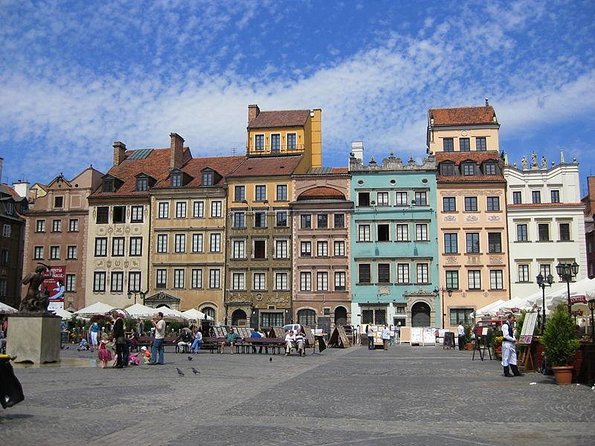
- Warsaw’s rebuilt Old Town: Castle Square and the Market Square explain how a destroyed historic center was brought back to life.
- Chopin’s heart in Holy Cross Church: A short stop links Warsaw’s famous composer to one of the city’s most important churches.
- The route moves beyond postcard sights: The Tomb of the Unknown Soldier, Presidential Palace, Warsaw Uprising Monument, and Field Cathedral add political and wartime context.
- A good central finish: Ending at the Warsaw Uprising Monument places you near a major memorial and keeps the walk focused on Warsaw’s twentieth-century story.
- Plan for walking, not sightseeing at leisure: The itinerary has many stops in two hours, so the experience works best as a first orientation.
Why this Warsaw walk works
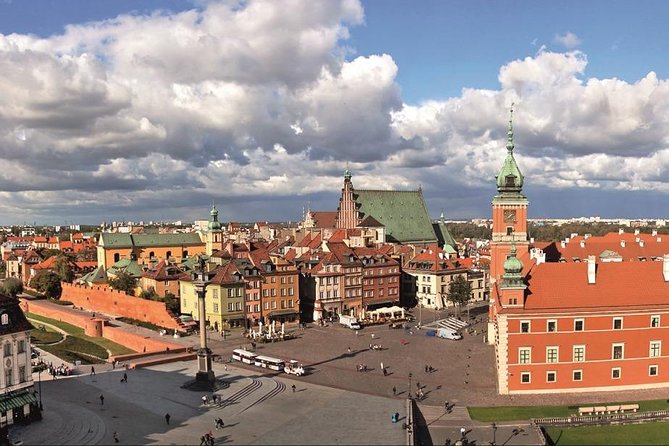
This is not simply a stroll through pretty streets. Its central idea is Warsaw’s repeated destruction and recovery, neatly captured by the title like Phoenix from the ashes. You move from the formal avenue of Krakowskie Przedmiescie through churches, government buildings, the Royal Castle area, Old Town, New Town, and finally the Warsaw Uprising Monument.
I like that the route gives equal attention to culture and politics. You hear about Frédéric Chopin and Marie Curie, then turn to Poland’s kings, its constitution, the Second World War, and the Warsaw Uprising. That range helps you understand why Warsaw can look old while also being remarkably new.
The private format matters. Only your group participates, and one booking with a single person became a one-on-one tour. That can make a real difference on a history-heavy walk, especially if you want to stop and ask about a monument instead of keeping pace with a large group.
The pace is the tradeoff. The advertised duration is about two hours, but the route includes eleven listed points, plus the movement from Old Town into New Town. Several stops receive just five or ten minutes. You will get a clear introduction rather than a long look inside every building.
More Walking Tours in Warsaw
- Warsaw: Old Town Highlights Walking Tour in English
★ 4.7 · 1,516 reviews - Warsaw: Old Town Guided Walking Tour
★ 4.9 · 599 reviews - Half-Day Polish Food Walking Tour with Guide and Dinner
★ 4.5 · 381 reviews
Starting at Krakowskie Przedmiescie
Meet the guide at the Nicolaus Copernicus Monument on Krakowskie Przedmiescie. Look for the sign marked PolinTours. This is a sensible starting point because the street leads naturally toward the historic center and places you among several major institutions from the first minutes.
The opening stop lasts about ten minutes and has no admission charge. The value here is orientation. Your guide can place the avenue, the Old Town, and the major historical personalities into one story before you start moving.
Because the meeting point is on a central street and near public transportation, it is practical for a first morning in Warsaw. The tour does not provide transport, though, so you need to arrive at the monument under your own steam. The same applies at the end: the walk finishes at Plac Krasińskich, not back at the starting point.
Holy Cross Church and Chopin’s Warsaw
Holy Cross Church receives about five minutes, but the subject is one of Warsaw’s most famous sons. The guide explains Chopin’s life and shows you the church where his heart rests.
That detail gives the stop emotional weight. You are not only looking at a church facade. You are being shown a physical link between Warsaw and a composer whose life is central to the city’s identity.
Five minutes is enough for an introduction, not for a careful examination of the whole church. If Chopin is a major reason for your visit, treat this as a starting point and ask the guide what else connects him with Warsaw. The supplied information does not promise additional Chopin sites, so do not expect a full composer-themed tour.
University of Warsaw in five minutes
The route continues to the oldest part of the University of Warsaw. This is another short stop, listed at about five minutes, so you should expect a quick explanation and exterior viewing rather than a full campus visit.
I find this kind of stop useful because it broadens the picture of Warsaw. The city is presented not only through palaces and battle memorials, but also through its intellectual life. Still, the limited time means you may need to choose your questions carefully.
A completely different kind of day out in Warsaw:
- Warsaw: Chopin Concert in the Old Town
★ 4.8 · 2,287 reviews - Warsaw: Traditional Galar Cruise on The Vistula River
★ 4.6 · 1,640 reviews - Warsaw Concert: Chopin – Painted by Candlelights with Wine
★ 4.8 · 1,442 reviews - Warsaw: City Sightseeing Hop-On Hop-Off Bus Tour
★ 3.6 · 1,415 reviews
Saxon kings at the Tomb of the Unknown Soldier
At the Tomb of the Unknown Soldier, the guide discusses the estate of the Saxon kings in Poland. The stop lasts around ten minutes and is free to visit.
This section helps connect present-day Warsaw with its royal past. The tomb itself also shifts the mood from courtly history to national remembrance. You get two strands of the city’s story in one place: the power of the monarchy and the sacrifices remembered by modern Poland.
The tour’s strength is this kind of pairing. Instead of isolating each sight, it moves between eras so you can see how Warsaw’s public spaces have carried different meanings over time.
The Presidential Palace and Poland’s political story
The Presidential Palace receives another ten-minute stop. You admire the seat of the Polish President while hearing about its unusual history.
The description does not promise entry, and admissions are not included in the tour, so expect to view the building from outside. That is common for a city walk, but it is worth knowing if you want interior visits.
This stop gives the route a present-day anchor. The Royal Castle represents earlier rulers, while the Presidential Palace points to modern government. Together, they make the walk more than a collection of attractive facades.
Castle Square and Warsaw’s youngest Old Town
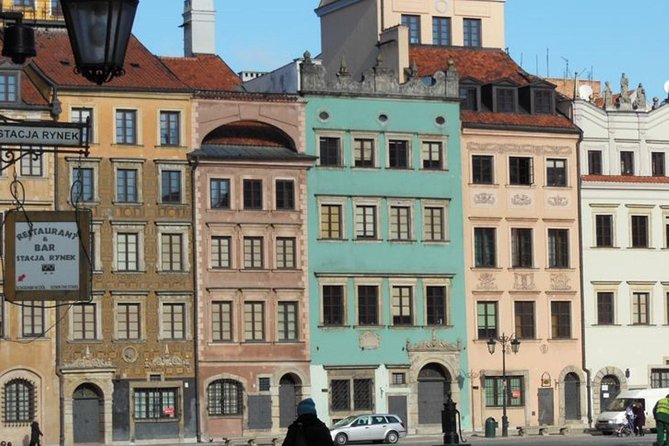
Castle Square is the main historical hinge of the tour. Here you enter Warsaw’s Old Town, a UNESCO World Heritage Site described in the tour as the youngest Old Town in the world.
The reason is central to the experience: Warsaw’s Old Town was reconstructed after the city’s wartime destruction. The guide explains how the rebuilding was financed, the part played by a Venetian painter, and the role of the Royal Castle. You also hear about the first democratic constitution in Europe.
That is a lot for roughly fifteen minutes. You will gain the basic story, but you will not have time to study every building or wander off for photographs without falling behind. If you want the best results, listen closely during the explanation, then return later for a slower visit.
The reconstruction story is especially valuable because the Old Town’s polished appearance can mislead you. It looks ancient, but much of what you see is the result of determined rebuilding. The tour asks you to look past the pretty square and consider the choices, money, and historical evidence behind it.
St. John the Baptist and the Warsaw Uprising
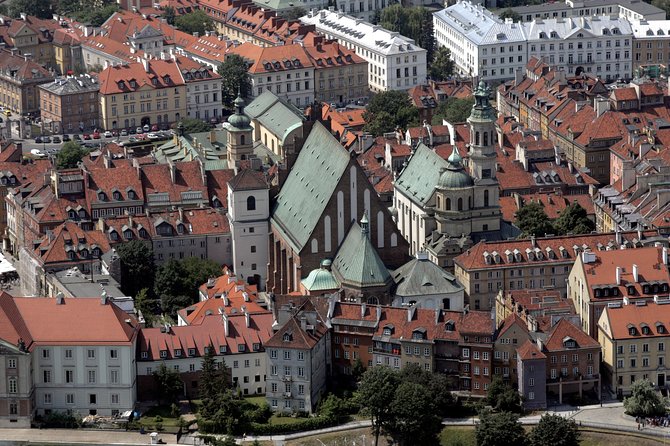
The Archcathedral Basilica of St. John the Baptist brings the Second World War into sharper focus. The guide explains that the war front ran through the church and discusses the Polish struggle during the Warsaw Uprising, along with the role of the Russian army.
This is one of the more serious stops, and the ten-minute slot is unlikely to cover every part of such a complicated subject. Still, it gives you a framework for understanding why Warsaw’s rebuilt streets carry such strong national meaning.
The route does not smooth over difficult history. That is a strength. You are asked to consider destruction, resistance, and the actions of outside forces, not just admire the reconstruction.
Gnojna Gora and the Vistula view
At Gnojna Gora, you look toward the Vistula. The stop lasts about five minutes.
This is the tour’s brief visual pause. After churches, palaces, and war memorials, the river view gives you a sense of Warsaw’s physical setting. Do not expect a long scenic break or a separate river excursion. It is a short viewpoint stop within the larger historical walk.
Market Square, legends, and the Old Town streets
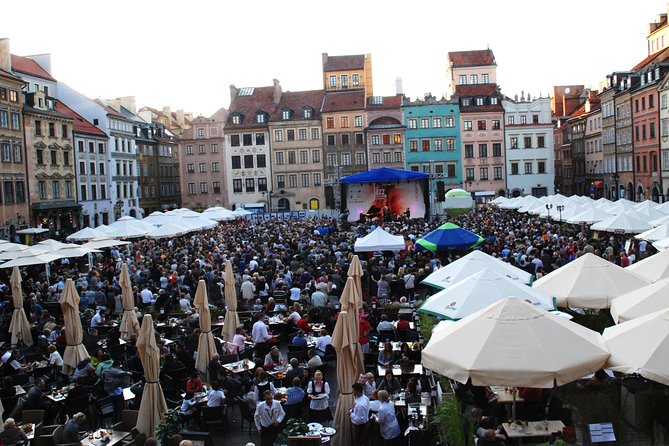
The Market Square is where the route slows slightly, with about ten minutes for the picturesque streets, famous landmarks, legends, and authentic stories tied to the area.
This should be one of the easiest parts of the walk to enjoy at a glance. The streets and square provide the familiar Warsaw images, but the guide’s local stories give them more character. You will hear legends alongside historical information, which keeps the presentation from becoming a sequence of dates.
Again, ten minutes passes quickly. If photography is important to you, keep your camera ready rather than waiting until the end of the stop. The private setup may allow some flexibility, but the tour still has a planned endpoint and many sights to cover.
Crossing into New Town and finding Marie Curie
Through the city gate, the route enters New Town and continues to the Maria Skłodowska-Curie Museum. This is the only listed stop with a separate admission charge, and entry is not included.
The museum marks the birthplace of Marie Curie, described here as the most famous Pole. The stop lasts about ten minutes, which means you should not expect a full museum visit as part of the walk. You explore the area and learn about her birthplace, while a separate museum visit would require extra time and an admission payment.
That distinction is important for planning. If you want to go inside, ask the guide how the timing works, or return later on your own. The tour price covers the licensed city tour and tax, not admissions, food, or transport.
Ending at the Warsaw Uprising Monument
The final section includes the Field Cathedral of the Polish Army and ends at the Warsaw Uprising Monument in Plac Krasińskich. The listed time is about ten minutes, and admission is free.
Ending here makes historical sense. The walk begins with monuments to science and culture, passes royal and political sites, then finishes with wartime memory and the Polish resistance. You leave with the twentieth-century story still fresh rather than ending only on a pretty square.
The endpoint also helps you plan the rest of your day. You will not be returned to the Copernicus Monument, so check your map before booking anything immediately afterward. The provided information confirms that the tour ends at the uprising monument.
What $72.87 buys you
At $72.87 per person, the price is not the cheapest way to see central Warsaw. Its value comes from the private format and the guide’s role in joining many separate subjects into one story.
You are paying for a licensed city tour, tax, and a private experience for your own group. You are not paying for snacks, transport, or museum admissions. Most of the listed outdoor stops are free, but the Maria Skłodowska-Curie Museum is specifically not included.
The price makes more sense for two or more people who want personal attention. A solo visitor pays the full per-person rate, though the one-person booking described for this experience became a private one-on-one tour. For a couple, family, or small group, the chance to ask questions and keep the discussion relevant may justify the cost.
The two-hour length also keeps the commitment manageable. You can use it as a first introduction on arrival day, then return to the places that deserve more time. It is less suitable if you want a full museum visit or a slow photographic walk.
Language, timing, and practical fit
The tour is offered in English, while the guide is described as German-speaking in the tour details. If language is important to you, confirm the language arrangement at booking so there is no confusion.
Most people can participate, service animals are allowed, and the route is near public transportation. The information does not provide a detailed accessibility description, so anyone needing specific mobility arrangements should ask before booking.
The confirmation arrives at booking time. Free cancellation is available up to 24 hours before the local start time. Canceling or changing the booking less than 24 hours ahead does not qualify for a refund.
I would wear comfortable shoes and keep the schedule open around the walk. The tour involves steady movement through streets and squares, and its many short stops reward attention more than leisurely lingering.
Who should book this walk?
I would recommend it to a first-time visitor who wants Warsaw’s basic story quickly and clearly. It is also a good fit if you care about the links between Chopin, Marie Curie, Polish political life, royal history, and the Warsaw Uprising.
Families and small groups may benefit most from the private format. You can ask the guide to explain a confusing point, spend a little longer on a favorite subject if time permits, or keep the conversation suited to your group.
History-focused visitors should enjoy the route, but you need realistic expectations. The walk introduces the sites rather than replacing visits to the Royal Castle, the Maria Skłodowska-Curie Museum, or other museums. The short stops are a feature for orientation and a limitation for detailed study.
Should you book the Warsaw Old and New Town walk?
Book it if you want a private, central introduction to Warsaw with a strong focus on rebuilding, national memory, and famous Polish figures. The route is well chosen, the ending at the Warsaw Uprising Monument has purpose, and the one-on-one option can make the guide’s explanations especially useful.
Skip it if you want extensive indoor sightseeing, a slow pace, or included admissions. At $72.87 per person, the best value comes from personal attention and historical explanation, not from the number of attractions entered.
For most first visits, I would use this as an orientation walk early in your stay. Bring questions, pay close attention at Castle Square and St. John’s Cathedral, and save extra time afterward for the places that catch your interest.
FAQ
Where does the tour begin?
The tour begins at the Nicolaus Copernicus Monument on Krakowskie Przedmiescie in Warsaw. Look for the guide holding a sign marked PolinTours.
Where does the tour end?
The walk ends at the Warsaw Uprising Monument at Plac Krasińskich. It does not return to the starting point.
How long does the experience last?
The tour lasts approximately two hours.
Is this a private tour?
Yes. Only your group participates in the activity.
What language is offered?
The tour is offered in English. The guide is described in the tour details as German-speaking.
Is transport included?
No. Transport is not included, and you are responsible for reaching the meeting point and continuing from the endpoint.
Are admissions included?
Admissions are not included. The Maria Skłodowska-Curie Museum specifically has an admission charge, while the other listed stops are shown with free admission.
Is the tour suitable for most people?
Most people can participate. The experience is near public transportation, and service animals are allowed.
Can I cancel for a full refund?
Yes. You can cancel at least 24 hours before the experience start time for a full refund. Cancellations and changes made less than 24 hours before the start time are not accepted for a refund.
Just added around Warsaw
- Jewish heritage in Warsaw★ 4.5 · 3 reviews
- Warsaw Outdoor Paintball with Transfers (all year round)★ 5.0 · 3 reviews
- World War II Warsaw Old Town, Military Cemetery Walking Tour★ 4.7 · 3 reviews
- Warsaw: Wolf’s Lair & Swieta Lipka Small-Group Tour + Lunch★ 5.0 · 3 reviews
- Sunset Boat Tour with Unlimited Drinks in Warsaw★ 3.5 · 3 reviews
- Majdanek – German camp from II World War – Private Tour – 1 DAY TRIP FROM WARSAW★ 5.0 · 3 reviews
- From Warsaw: Guided Tour to Wieliczka Salt Mine and Krakow★ 4.5 · 3 reviews
- Warsaw Sightseeing with NEW Mercedes Sclass !!!★ 5.0 · 3 reviews
Walking Tours, compared.




Gdańsk City Sights & History Guided Walking Tour in English
Read our review →


Browse the lists this tour appears in