
REVIEW · WARSAW TOURS
Warsaw Behind the Scenes – small group tour with hotel pickup
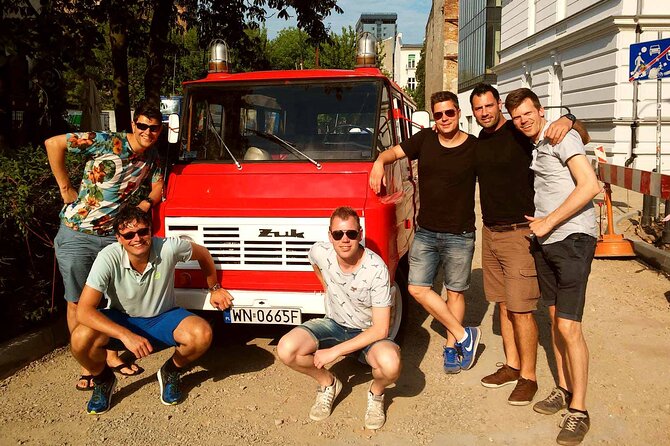
Warsaw keeps its hardest stories under ordinary streets. This three-hour tour makes those stories visible, from the former Jewish Ghetto to postwar communist districts and creative Praga. I like the way it connects World War II, Soviet rule, and modern Warsaw, rather than treating each period as a separate lesson. I also like the small Żuk minibus, which gives the outing a distinctly Polish character.
The main consideration is pace. You cover a great deal of ground in about three hours, and several stops are short. The vehicles are practical for moving between neighborhoods, but some vintage minibuses have no air conditioning and may not have seat belts, as permitted for historic vehicles. Comfortable shoes matter, since the tour includes walking at each stop.
In This Review
- Key points to know before booking
- Why this tour works best early in your stay
- Muranów: a neighborhood built over the ghetto
- Chłodna Street and the wooden bridge
- Nowolipki and the 1943 uprising
- Bielańska and the destruction of Warsaw
- Praga Północ: the city that survived
- Śródmieście and the communist rebuilding project
- 1989 and the road out of communism
- The Żuk minibus: charm with a few compromises
- Guides and the quality of the storytelling
- Price, group size, and practical value
- Who should book this Warsaw tour?
- Should you book Warsaw Behind the Scenes?
- FAQ
- How long does the tour last?
- What time does the tour start?
- Is hotel pickup available?
- How many people can join?
- Can a solo passenger book the tour?
- Can children join the tour?
Key points to know before booking
- The route covers Warsaw’s difficult past: You visit former ghetto areas, Warsaw Uprising sites, postwar rebuilding projects, and places linked to the fall of communism.
- Praga gives you a different Warsaw: Cross the Vistula to see prewar buildings, courtyards, and a district that escaped much of the wartime destruction.
- The Żuk is part of the experience: This old-style Polish minibus adds charm, though comfort depends on the weather and the particular vehicle.
- Guides shape the quality of the tour: Tom, Marcin, Mark, Artur, Jan, Lucas, and others are praised for clear storytelling, humor, and thoughtful answers.
- Hotel pickup saves time: Pickup and return are offered for listed hotels, with the exact time confirmed after booking.
- The price buys orientation as well as history: At $133.08 per person, this is not a cheap transfer, but it can be good value on your first day in Warsaw.
Why this tour works best early in your stay
Warsaw can be confusing at first glance. Wide avenues, rebuilt historic streets, communist-era blocks, new construction, and surviving prewar buildings all sit close together. Without context, the city’s appearance can seem uneven. With the right guide, those contrasts become the point.
This tour is designed to give you that context quickly. You begin with a short introduction to Poland and Warsaw, then move through places shaped by Nazi occupation, Jewish resistance, the 1944 Warsaw Uprising, Soviet control, and the political changes of 1989.
I would schedule it near the start of your visit. Several people who took it on their first day found that it helped them understand the city’s layout and decide what deserved a longer visit later. The tour does not replace museums such as POLIN, but it gives you a useful framework before you enter one.
The route is also a good choice if you have limited time. You are not spending three hours inside one museum or walking one central boulevard. The minibus carries you between areas that are too spread out for an easy short walk, while the guide explains what you are seeing on foot.
A few more Warsaw trips worth weighing up
- Warsaw: Chopin Concert in the Old Town
★ 4.8 · 2,287 reviews - Warsaw: Traditional Galar Cruise on The Vistula River
★ 4.6 · 1,640 reviews - Warsaw: Old Town Highlights Walking Tour in English
★ 4.7 · 1,516 reviews
Muranów: a neighborhood built over the ghetto
The first major stop is Muranów, built on the former site of the Jewish Ghetto created by Nazi Germany in 1940. Today, much of the district looks like a postwar housing area. That ordinary appearance is exactly what makes the stop so powerful.
Your guide explains what stood here before the war, how the ghetto was sealed, and how the district was destroyed. After the war, Warsaw rebuilt Muranów, in part over the ruins. The streets and buildings you see today therefore occupy several layers of the city at once.
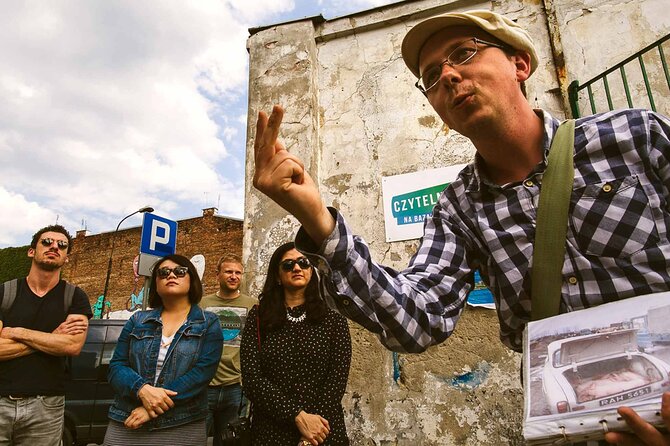
This is not a stop for casual sightseeing. The subject is painful, and the tour moves quickly. Still, the guide’s use of historical photographs helps connect the present-day streets with the vanished city. Guides such as Mark and Artur have been praised for presenting wartime events directly, including the realities of antisemitism and life inside the ghetto.
If you want a more extended study of Jewish Warsaw, allow time for the POLIN Museum on another day. One useful tip is to visit POLIN after this tour, since the introduction in Muranów can make the museum’s exhibits easier to place.
Chłodna Street and the wooden bridge
At Chłodna and Żelazna Streets, the tour pauses at the location of the famous wooden ghetto bridge. The bridge once rose high above the street, allowing traffic to pass underneath while connecting two sealed sections of the ghetto.
There is no surviving bridge to enter. The value here comes from the location, the explanation, and the old photographs your guide uses to show how it looked. This is a good example of what the tour does well: it points out an unremarkable modern intersection and gives you the information needed to read it differently.
The stop lasts about 15 minutes, so you will not have time for a long visit or extensive independent exploration. You will want to listen closely, especially if this is your first introduction to the ghetto’s layout.
Nowolipki and the 1943 uprising
In Nowolipki, the focus shifts to the Warsaw Ghetto Uprising of 1943. Jewish resistance fighters made a final stand against deportation. After weeks of fighting, the ghetto was destroyed.
The guide explains the uprising and the way it is remembered in the modern city. This part of the tour is especially useful because the history is not presented as a list of dates. You see how commemoration, streets, housing blocks, and empty spaces share the same setting.
Expect a serious tone here. The itinerary moves through several difficult wartime subjects in succession, so this tour suits you if you want historical substance rather than a light sightseeing ride. If you prefer to process each site at length, you may find the 15-minute stop too brief.
A completely different kind of day out in Warsaw:
- Warsaw Concert: Chopin – Painted by Candlelights with Wine
★ 4.8 · 1,442 reviews - Warsaw: City Sightseeing Hop-On Hop-Off Bus Tour
★ 3.6 · 1,415 reviews - Warsaw: POLIN Museum of the History of Polish Jews Ticket
★ 4.7 · 1,142 reviews - #1 Pub Crawl Warsaw with Optional Premium 1 Hour Open Bar
★ 5.0 · 790 reviews
Bielańska and the destruction of Warsaw
At Bielańska, the story widens from the ghetto to the fate of Poland during and after World War II. The Western Allies and Stalin’s agreements left Poland under Soviet control, while the Warsaw Uprising of 1944 became the city’s last major attempt to change that outcome.
After the uprising failed, Nazi forces systematically destroyed about 85 percent of Warsaw. The Red Army entered the ruins in January 1945. The guide uses this setting to explain why rebuilding Warsaw was not simply a matter of repairing damaged buildings. Much of the city had to be imagined and created again.
This is one of the most useful parts of the route for understanding Warsaw’s appearance. A rebuilt capital can look old, modern, or deliberately historic, sometimes within a few blocks. The tour helps you see those choices as political and practical decisions, not random architectural contrasts.
Praga Północ: the city that survived
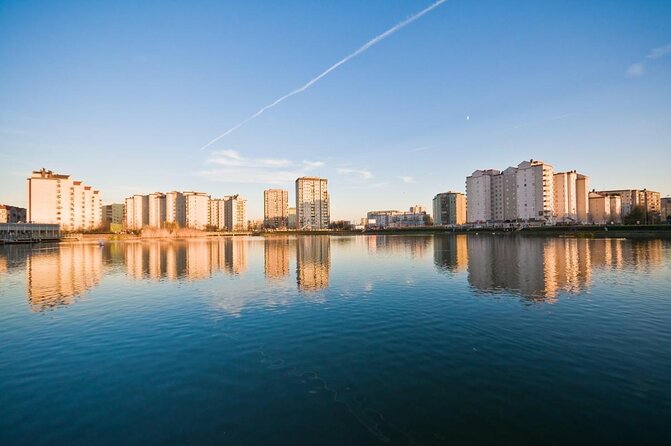
The crossing of the Vistula brings you to Praga Północ, one of Warsaw’s most distinctive districts. You get views of the riverbank before exploring streets with Belle Époque buildings, traditional courtyards, and a strong local identity.
Praga survived the war more intact than much of the left-bank city. That makes it an important counterpoint to Muranów and central Warsaw. Here, you can get a stronger sense of prewar urban fabric, even though the district has also changed.
Praga was once overlooked by many visitors. Today, it is known for creative energy and new interest, but it still feels less polished and less dominated by major tourist sights than the historic center. I like this stop because it shows how Warsaw residents live with the city’s past rather than simply displaying it for visitors.
You have about 30 minutes here, the longest stop on the route. That gives you more time to look around, but it is still an introduction rather than a full neighborhood walk. The vehicle does much of the work between stops, so wear shoes that are comfortable on uneven pavement and courtyard surfaces.
Śródmieście and the communist rebuilding project
Back in central Warsaw, the tour stops near the former headquarters of the Polish Communist Party. Here, you learn how authorities dealt with the problem of rebuilding a destroyed capital after 1945.
Architects wanted a modern, functional city. Their plans, however, had to fit Soviet-inspired political demands. The resulting streets and buildings reveal the compromise between practical reconstruction, architectural ambition, and ideology.
This stop helps explain why central Warsaw can feel so different from Praga. It also adds an important period that many short city tours skip. The city’s story did not end when the Nazis left. Rebuilding took place under a new political system, with its own rules about public space and daily life.
The stop lasts about 30 minutes. That is enough time for a solid explanation and questions, particularly when the guide uses photographs or points out architectural details. Marcin has received praise for adjusting the discussion to suit the group’s interests, which matters on a subject that can otherwise become a dry lecture.
1989 and the road out of communism
The final section brings the story to 1989, when the Solidarity movement and Pope John Paul II played key roles in ending communist rule in Poland. Warsaw then entered a new period of democracy and capitalism, beginning another major transformation.
This closing discussion gives the earlier stops a modern ending. The city you see today is not only a rebuilt capital or a former communist center. It is also a place shaped by rapid political and economic change.
The final 15 minutes are less about one landmark and more about making connections. You leave with a better sense of why Warsaw looks the way it does and why residents may view particular streets, monuments, and districts in very different ways.
The Żuk minibus: charm with a few compromises
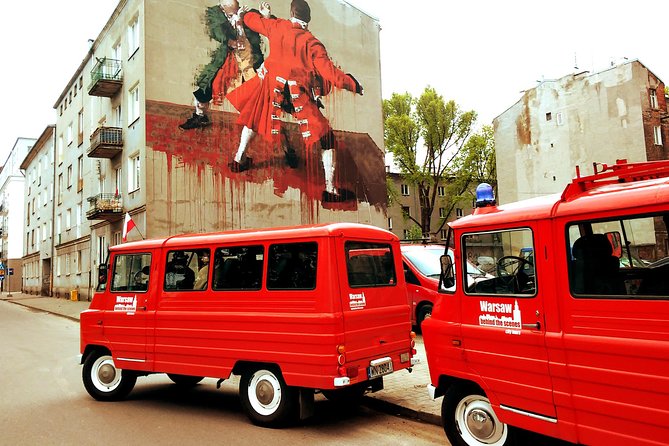
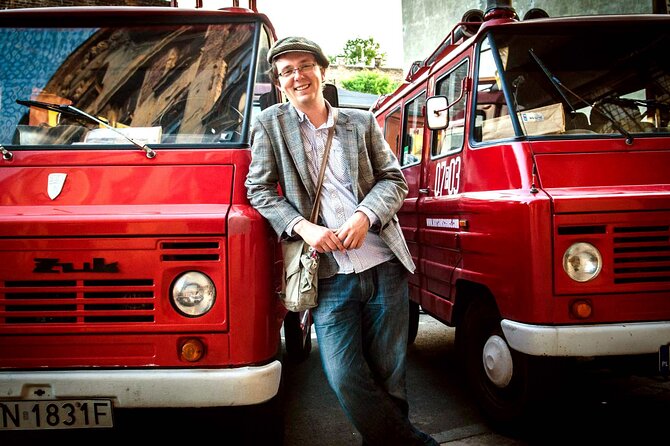
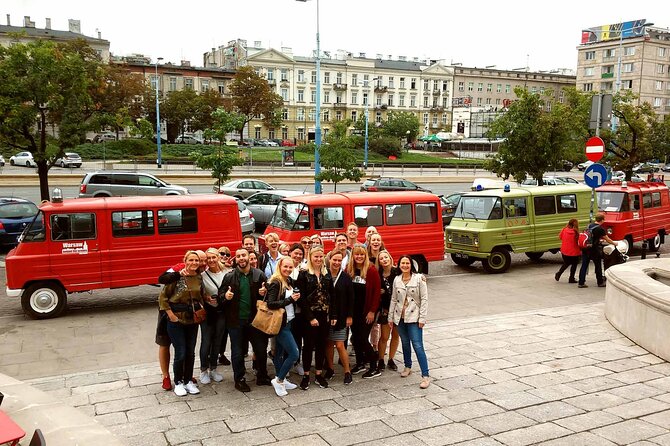
The vintage Żuk is one of the tour’s signature details. It is a small Polish minibus associated with the communist era, and riding in one adds a little humor and historical atmosphere to a serious subject.
Each minibus holds up to eight passengers. The operator has a fleet of five vehicles, and the full activity can include up to 39 people. That means your individual vehicle may feel intimate, even if the overall departure is larger.
The vehicle is mainly used to transfer you between stops. You should not expect a long scenic drive with constant commentary from your seat. The real sightseeing happens outside, during the walking portions.
There are practical limits. Classic vehicles are not equipped with air conditioning, and some do not have seat belts. Heating is available in winter. On a warm day, the lack of air conditioning could make the ride less comfortable. On a cold or wet day, the vehicle’s character may be enjoyable, but you should dress sensibly.
A rainy day does not necessarily ruin the tour. One guide kept the vehicle close to the sights so the group spent less time exposed to bad weather. Still, check the forecast and bring suitable clothing.
Guides and the quality of the storytelling
The guides are the strongest part of this experience. Tom is praised for making the time pass quickly, while Marcin is described as personable and flexible. Mark receives particular credit for clear English and detailed explanations of Warsaw, Poland, the war, and communist rule.
Artur, Art, Jan, Lucas, and Luke are also praised for their warmth, humor, and ability to tell stories. That range of names suggests that the experience depends partly on who leads your departure, but the consistent praise is encouraging.
Historical tours can fail when the guide simply recites dates. Here, the best moments come from visual aids, old photographs, personal explanations, and answers to questions. You may also get small local touches, such as a stop for a Polish bakery item, a local drink, lunch at a traditional Polish cafe, or cucumber vodka. These extras are not guaranteed parts of the published route, so treat them as possible additions rather than promises.
One fair criticism deserves attention. If your background in Polish or World War II history is limited, the early ghetto section may feel under-explained before the tour gets moving. A short introductory history lesson at the beginning would help some people. You can solve much of this by reading a basic Warsaw history before arrival or visiting POLIN afterward.
Price, group size, and practical value
At $133.08 per person, this is a premium half-day tour. You are paying for hotel pickup, a guide, a small vehicle, transport across several districts, and a focused interpretation of Warsaw’s history.
The value is strongest if you are visiting for the first time, have only a few days, or want to reach places that are not obvious on a standard central-city walk. It is also useful if you want a guide to connect the ghetto, the 1944 uprising, Praga, communist rebuilding, and 1989 in one sitting.
The price is harder to justify if you already know Warsaw well, plan to use public transport, or prefer to spend long periods inside museums. The tour does not include major admission tickets because the stops are outdoors. You are paying mainly for access, transportation, and interpretation.
The minimum number needed to run the tour is two. A solo passenger can join if another booking has at least two people. That is a helpful policy for independent visitors, though you should not assume a private tour unless the operator confirms it.
Pickup and drop-off are available only for listed hotels. If your hotel is not included, contact the operator for a suitable meeting point. After booking, the operator confirms the exact pickup time through the Viator message system, since several hotels may be served.
The tour begins at 10:00 a.m. and lasts about three hours, though some descriptions from participants refer to closer to four hours. Allow extra time rather than scheduling a tight lunch or museum appointment immediately afterward.
Most people can take part, but children under 150 centimeters require a booster seat under Polish law. Contact the operator before booking for a child below that height, since booster availability must be checked.
Who should book this Warsaw tour?
You should consider it if you want:
- A first-day orientation to Warsaw
- Serious discussion of WWII and Jewish history
- A look at Praga beyond the main tourist center
- Help understanding postwar architecture and communism
- Hotel pickup and transport between spread-out districts
- A small vehicle and a guide-led experience rather than a large coach
You may prefer another activity if you want a relaxed architectural walk, a museum visit, or lots of free time at each site. The route is busy, the subjects are heavy, and the Żuk’s comfort is less predictable than that of a modern minibus.
Free cancellation is available up to 24 hours before the local start time. Changes or cancellations made within 24 hours are not accepted for a refund.
Should you book Warsaw Behind the Scenes?
I would book this tour early in a Warsaw visit, especially if you want the city to make sense rather than simply look interesting. Its strongest feature is the connection between places: the ghetto, the wartime ruins, surviving Praga, communist reconstruction, and the political changes of 1989.
The tour has a five-star rating from 228 reviews, with 100 percent recommending it. That matches the experience’s clearest strengths: engaging guides, unusual stops, strong historical storytelling, and a memorable Żuk ride.
Book it if you value context and local perspective more than polished comfort. Skip it if you dislike difficult history, need air-conditioned transport, or prefer to explore each sight at your own pace.
FAQ
How long does the tour last?
The tour lasts approximately three hours.
What time does the tour start?
The stated start time is 10:00 a.m. The exact pickup time is confirmed after booking because the operator collects people from different hotels.
Is hotel pickup available?
Yes, pickup and drop-off are available for listed hotels. If your hotel is not listed, contact the operator to arrange a suitable pickup point.
How many people can join?
Each Żuk minibus holds up to eight passengers. The full activity can include a maximum of 39 people across the available vehicles.
Can a solo passenger book the tour?
Yes, a solo passenger may join if another booking has at least two people. The minimum number required to launch the tour is two.
Can children join the tour?
Children over 150 centimeters can be booked online. Children under 150 centimeters require a booster seat under Polish law, so contact the operator in advance to check availability.
Just added around Warsaw
- Jewish heritage in Warsaw★ 4.5 · 3 reviews
- Warsaw Outdoor Paintball with Transfers (all year round)★ 5.0 · 3 reviews
- World War II Warsaw Old Town, Military Cemetery Walking Tour★ 4.7 · 3 reviews
- Warsaw: Wolf’s Lair & Swieta Lipka Small-Group Tour + Lunch★ 5.0 · 3 reviews
- Sunset Boat Tour with Unlimited Drinks in Warsaw★ 3.5 · 3 reviews
- Majdanek – German camp from II World War – Private Tour – 1 DAY TRIP FROM WARSAW★ 5.0 · 3 reviews
- From Warsaw: Guided Tour to Wieliczka Salt Mine and Krakow★ 4.5 · 3 reviews
- Warsaw Sightseeing with NEW Mercedes Sclass !!!★ 5.0 · 3 reviews
Warsaw Tours, compared.

Traditional Galar Cruise on The Vistula River
Read our review →
Warsaw Concert: Chopin – Painted by Candlelights with Wine
Read our review →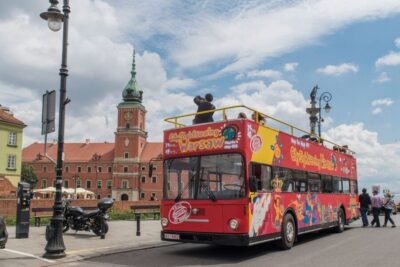

POLIN Museum of the History of Polish Jews Ticket
Read our review →
#1 Pub Crawl Warsaw with Optional Premium 1 Hour Open Bar
Read our review →