
REVIEW · WARSAW TOURS
Warsaw for WWII Buffs – private tour with hotel pickup
Warsaw’s wartime story is written in its streets. This private tour makes that story easier to follow, using a vintage Żuk minibus to connect the Warsaw Ghetto, major memorials, and the 1944 uprising. I like the personal format and the way guides such as Konrad, Tom, Marcin, Karol, Martin, and Lukas adjust the discussion to your interests. I also like that you reach less obvious places, not just the standard city sights. The main drawback is time: three hours goes quickly, especially when hotel transfers count toward the tour.
This is a serious history outing, not a light sightseeing drive. You will hear about the German invasion, Soviet occupation, Jewish persecution, resistance, the Warsaw Ghetto Uprising, the Warsaw Uprising, and the postwar communist period. The vintage vehicle adds charm, but it can be bumpy, lacks air conditioning, and some historic vehicles do not have seat belts.
In This Review
- Key points to know before booking
- Why this three-hour Warsaw tour works
- Starting with the invasion and occupation
- Finding the former Ghetto Wall near Waliców
- Chłodna Street and the wooden bridge
- Waliców’s ruined tenement
- Muranów, a neighborhood built over ruins
- The Ghetto Heroes Monument and POLIN area
- The Soviet invasion and the eastern deportations
- The Warsaw Uprising Monument and the city’s destruction
- What the vintage Żuk adds
- Guides, customization, and the private format
- Timing, pickup, and practical comfort
- Who should book this Warsaw WWII tour?
- Should you book it?
- FAQ
- How long does the Warsaw for WWII Buffs tour last?
- Is hotel pickup included?
- What kind of vehicle is used?
- Is the tour private?
- Is the tour offered in English?
- Is admission to POLIN Museum included?
- Can children join the tour?
Key points to know before booking
- The route links several major WWII sites: You visit Ghetto Wall fragments, Chłodna Street, Muranów, the Ghetto Heroes Monument, the Monument to the Fallen and Murdered in the East, and the Warsaw Uprising Monument.
- The private format lets you ask real questions: Guides can spend more time on the Warsaw Ghetto, the 1944 uprising, Soviet rule, or other subjects that matter most to you.
- The 1970s-style Żuk is part of the experience: It is fun, memorable, and useful for covering ground, though it is not as comfortable as a modern van.
- Hotel pickup is limited to central Warsaw: Pickup and drop-off are available within 3 kilometers of the city center, and transfer time reduces the sightseeing time.
- The history is emotionally heavy: You should be ready for a direct account of mass murder, deportation, destruction, and political repression.
- Three hours gives you an introduction, not every detail: If WWII history is your main reason for visiting Warsaw, you may wish the tour lasted four hours or more.
Why this three-hour Warsaw tour works
Warsaw is a difficult city to read at first. Much of it was destroyed during the war, then rebuilt under different political rules. A modern apartment block may sit above the former Warsaw Ghetto, while a quiet street corner marks a place of extraordinary violence.
That is where a guide makes a real difference. You are not simply driven past monuments. The route connects events in time, beginning with the invasion of Poland in 1939 and moving through the occupation, resistance, Jewish persecution, the Ghetto Uprising, the 1944 Warsaw Uprising, and the Soviet-controlled years that followed.
I especially like the private setup for this subject. You can ask how the German and Soviet occupations differed, how ordinary people lived inside the ghetto, or why the Warsaw Uprising ended in such destruction. Guides have also used photographs and personal explanations to make the places easier to understand.
The tour is offered in English and is limited to your own group. Each minibus holds up to eight people, and the operator has a fleet of five vehicles. That is a useful size: small enough for conversation, but large enough to make the private price more reasonable if you are traveling with family or friends.
The advertised cost is about $169.38 per person. That is not a bargain for a three-hour outing if you are traveling alone or as a couple. It becomes better value when split among a small private group, especially because transport, a local guide, and hotel pickup within the central zone are included.
A few more Warsaw trips worth weighing up
- Warsaw: Chopin Concert in the Old Town
★ 4.8 · 2,287 reviews - Warsaw: Traditional Galar Cruise on The Vistula River
★ 4.6 · 1,640 reviews - Warsaw: Old Town Highlights Walking Tour in English
★ 4.7 · 1,516 reviews
Starting with the invasion and occupation
The opening part of the tour sets the political stage. You learn about the tense conditions of the late 1930s, Germany’s attack on Poland in September 1939, and the Soviet invasion of eastern Poland soon after.
That framing matters. Warsaw’s wartime experience was shaped by two occupying powers, not one. The German occupation brought terror, forced labor, racial persecution, and mass murder. Soviet rule in eastern Poland brought deportations, executions, imprisonment, and the destruction of political and social institutions.
A good guide can keep these events connected without turning the first part into a long classroom lecture. Tom, Marcin, Karol, and the other guides have been praised for making the discussion conversational and for answering questions in clear English. That personal style is important because the subject can become a list of dates unless someone explains how those events affected daily life.
The minibus helps here. You cover ground between locations without spending the whole tour walking. The vehicle is mainly used for transfers, with walking at each stop, so comfortable shoes still matter.
Finding the former Ghetto Wall near Waliców
The Warsaw Ghetto section is the emotional core of the route. Before World War II, Poland had a Jewish population of roughly three million, including about 300,000 people in Warsaw. In 1940, Nazi authorities enclosed nearly half a million people in the Warsaw Ghetto.
Today, the boundary is hard to see. Warsaw has been rebuilt, streets have changed, and ordinary buildings occupy ground where the ghetto once stood. A preserved fragment of the wall, found among later structures and old property lines, gives you a physical reference point.
The stop near Waliców helps correct a common misunderstanding. The ghetto was not an isolated camp outside the city. It was forced into the urban fabric, with residents trapped behind walls while life continued on the other side.
Your guide can explain how the wall divided homes, streets, and families. This is a place to pause and listen rather than rush through with a camera. The visit is free, but its value comes from the explanation. Without context, the remaining brickwork can look like just another fragment of old Warsaw.
Chłodna Street and the wooden bridge
Chłodna Street offers one of the tour’s most striking visual stories. In 1941, the ghetto was divided into two sections, and Chłodna Street carried east-west traffic between them.
A wooden footbridge was built near the intersection of Chłodna and Żelazna streets. It linked the two ghetto sections while allowing trams, German military vehicles, and other traffic to pass below. The bridge reached as high as the third floor of nearby buildings, making it a powerful symbol of separation and forced movement.
The bridge is gone, so this stop depends heavily on photographs and the guide’s description. That is not a weakness if the explanation is good. In fact, seeing the street as it is now, then comparing it with historical images, can make the destruction and rebuilding of Warsaw easier to grasp.
The stop itself is brief, around ten minutes. That is enough for an explanation and a few questions, but not enough for a long discussion. If the ghetto story is your main interest, tell the guide early. The private format may allow more time here or at another related site.
A completely different kind of day out in Warsaw:
- Warsaw Concert: Chopin – Painted by Candlelights with Wine
★ 4.8 · 1,442 reviews - Warsaw: City Sightseeing Hop-On Hop-Off Bus Tour
★ 3.6 · 1,415 reviews - Warsaw: POLIN Museum of the History of Polish Jews Ticket
★ 4.7 · 1,142 reviews - #1 Pub Crawl Warsaw with Optional Premium 1 Hour Open Bar
★ 5.0 · 790 reviews
Waliców’s ruined tenement
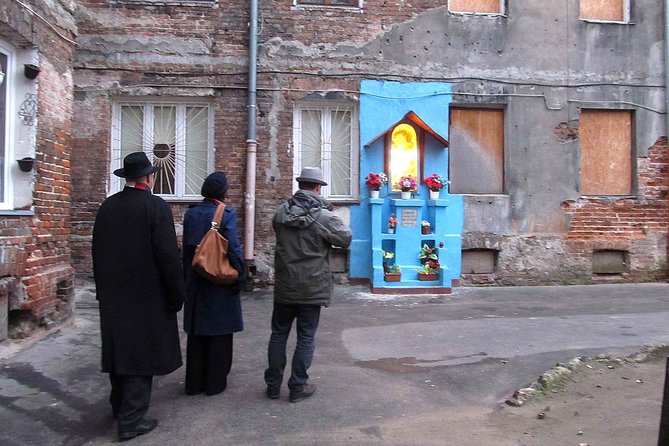
The ruined tenement house on Waliców Street is another rare physical reminder of the former ghetto. It has remained in a damaged state, unlike much of the surrounding district, and a fragment of the Ghetto Wall is preserved nearby.
This stop has a different mood from the formal memorials later in the tour. There is no grand plaza to frame the story. You are looking at a neglected remnant within a functioning city, which makes the past feel close and unfinished.
The route lists two Waliców visits, one for the wall fragment and one for the ruined tenement. In practice, these locations reinforce one another. The first helps you understand the ghetto boundary; the second shows what remains of the built environment itself.
Do not expect a museum-style display at every location. Much of this tour takes place outdoors, beside streets and buildings. The guide supplies the missing details, so the quality of your experience depends strongly on the individual leading your group.
Muranów, a neighborhood built over ruins
Muranów may look like a plain district of squared apartment blocks. That ordinary appearance is exactly what makes the stop important. The neighborhood was rebuilt after the war on the ruins of the Warsaw Ghetto.
A guide can help you see the ground beneath the modern facades. The point is not to admire a preserved old quarter. It is to understand how completely wartime Warsaw was erased and how postwar planners created a new district over the remains.
This is one of the places where the tour goes beyond a short list of famous monuments. You are asked to read the city rather than simply photograph it. Several guides have taken groups away from the usual tourist routes and explained places that are easy to miss on your own.
The Muranów stop is only about ten minutes, so expect an introduction rather than a long walk. If you want extended time around the district, ask whether the guide can adjust the route.
The Ghetto Heroes Monument and POLIN area
The Monument to the Ghetto Heroes is one of Warsaw’s most important memorials. It marks the area where the first armed clashes of the 1943 Warsaw Ghetto Uprising took place.
Near it is POLIN Museum of the History of Polish Jews. The tour includes the area around the museum and monument, but admission to the museum is not listed among the inclusions. If you want to go inside POLIN, plan that as a separate visit and allow much more time.
The monument and museum form a useful pair. One commemorates resistance and loss. The other offers a much longer account of Jewish life in Poland and the destruction of that community during the Holocaust. Even if you only see the exterior during this tour, your guide can explain why this location carries such weight.
This section is allotted about twenty minutes. It is enough to understand the setting and ask questions, but anyone with a strong interest in the Ghetto Uprising should consider returning to the area later.
Some guides also include Mila 18, the former command bunker of the Ghetto Uprising, when the route and timing allow. It is still being excavated, and a museum dedicated to the ghetto is planned there. Because the exact route can be customized, ask about this in advance rather than assuming it is guaranteed.
The Soviet invasion and the eastern deportations
The Monument to the Fallen and Murdered in the East shifts the story from German occupation to Soviet repression. It recalls Poles deported to Siberian labor camps, people killed in executions, and victims of the Katyń massacres.
This stop is essential because a tour focused only on Nazi Germany would leave out half of Poland’s wartime trauma. The Soviet attack came on September 17, 1939, two weeks after the German invasion, and eastern Poland was occupied by the USSR.
The monument’s design and setting help communicate forced displacement and death, but again, the guide’s account is what gives the place meaning. You can ask about the fate of eastern Polish families, the postwar silence around Katyń, and how Soviet rule continued after Germany’s defeat.
The stop is scheduled for about ten minutes. That is concise, but it gives the broader route balance. It also explains why Polish memories of World War II cannot be reduced to a simple story of liberation in 1945.
The Warsaw Uprising Monument and the city’s destruction
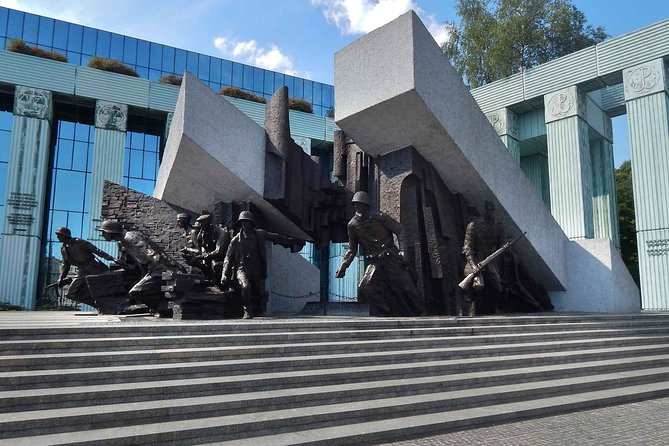
The final main stop concerns the Warsaw Uprising of 1944. Polish resistance fighters tried to regain control of the city before the arrival of the Red Army. The uprising failed, and German forces then destroyed much of what remained of Warsaw.
The Soviet army entered the ruins in January 1945. The city was not returning to its prewar life. Instead, a new period of communist rule began.
The Warsaw Uprising Monument gives your guide a natural place to explain the military decision, the civilian cost, the defeat, and the political consequences. It also brings the tour back to the larger theme: Warsaw was attacked, occupied, fought over, and rebuilt under pressure from outside powers.
Several guides have been praised for connecting wartime events with postwar Poland and present-day political questions. That wider view is useful, but you should expect direct and sometimes painful discussion. This is not a polished sightseeing script designed to keep things cheerful.
What the vintage Żuk adds
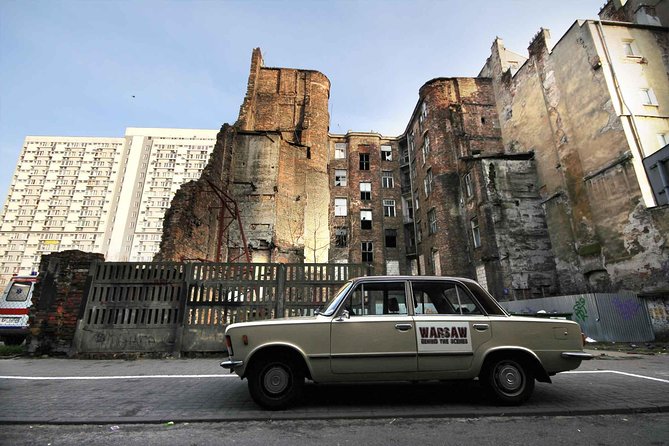
The retro communist minibus is more than a transport detail. It gives the outing a distinct Warsaw flavor and makes moving between scattered sites enjoyable. A few guides use lovingly restored vehicles, including a 1974 Żuk, and the old design becomes an easy conversation starter.
The trade-off is comfort. Historic minibuses are not modern coaches. Some have no seat belts, which is permitted for historic vehicles, and the vehicles do not have air conditioning. Heating is available in winter.
One important practical point is that the vehicle description may not always match what you expect from promotional photographs. The experience is described as a vintage vehicle tour, but the actual vehicle may be a Żuk minibus rather than a smaller classic car. A senior passenger has found the seats uncomfortable and getting in and out difficult.
If vehicle comfort matters to you, ask about the exact vehicle before booking. Wear practical clothes and shoes, and be ready for a somewhat bumpy ride. The minibus is part of the charm, but it is not the best choice for someone who needs easy step-free access or modern suspension.
Guides, customization, and the private format
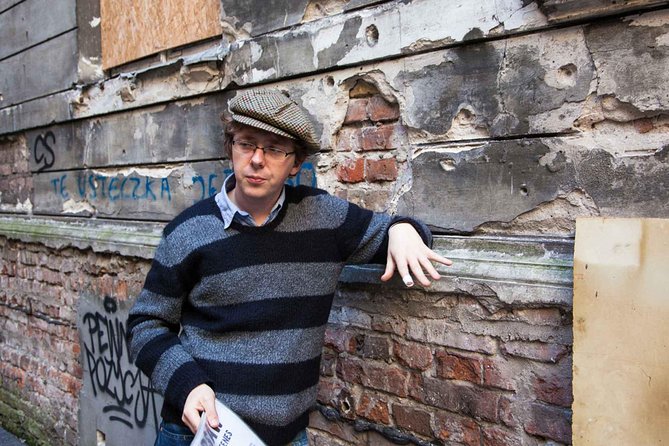
The guides are the strongest part of the experience. Konrad has been praised for his warm manner, excellent English, and ability to make the history feel immediate. Tom has used photographs and offered useful suggestions for museums and restaurants. Marcin is described as a passionate local historian who explains difficult subjects in an informal, conversational way.
Karol has handled longer discussions about the Ghetto Uprising, the Warsaw Uprising, and postwar politics. Martin has been especially good at adapting explanations for families with teenagers, using stories and links to current events to keep the subject understandable.
These names do not guarantee who will lead your tour, but they give you a sense of the standard to expect. The operator uses several guides, and the experience will naturally vary by personality and specialty.
The private format is a major advantage. You can tell the guide that you already know the basic wartime timeline and want more detail on resistance networks, Jewish Warsaw, Soviet deportations, or communist Poland. If you know little about the subject, the guide can build the story from the beginning without assuming prior study.
Timing, pickup, and practical comfort
The tour lasts about three hours, but hotel pickup and drop-off count toward that total. Pickup is available from hotels, apartments, and Airbnb accommodations within 3 kilometers of central Warsaw.
If your accommodation is farther away or difficult to reach by car, you will be offered a nearby meeting point. It may be smarter to meet in the center, since a long transfer can take time away from the actual sites.
The route includes several short walking segments. Comfortable footwear is important, and you should dress for the weather because much of the explanation takes place outside. Most people can participate, but the old minibus may be awkward for passengers with limited mobility.
Children taller than 150 centimeters can be booked online. Polish law requires booster seats for shorter children, so you need to contact the operator in advance to check availability.
Free cancellation is available if you cancel at least 24 hours before the start time. Changes or cancellations inside that window are not accepted for a refund.
Who should book this Warsaw WWII tour?
I would choose this tour if you want a strong wartime introduction in a short amount of time. It is particularly suitable for couples, families, or small groups who value conversation and want to ask questions as they go.
It also works well for people who have already visited Warsaw’s Old Town and want to understand the city’s less visible wartime story. The route reaches memorials, former ghetto sites, and ordinary-looking neighborhoods that can be hard to interpret alone.
I would be more cautious if you dislike difficult historical subjects, need a quiet modern vehicle, or want long museum visits. Three hours is enough to connect the main events, but not enough to study every site properly. One guide joked through action by needing four hours for all the material, and that sounds plausible.
Should you book it?
Book this tour if you want a personal, place-based account of Warsaw in World War II, rather than a quick drive past monuments. The guides bring strong historical knowledge, the private format rewards questions, and the Żuk makes the route memorable.
Before paying, ask about the exact vehicle, especially if a passenger has difficulty climbing into a minibus. Also decide whether hotel pickup is worth losing some sightseeing time. If you can meet centrally and use the full three hours at the sites, the value improves.
For serious WWII enthusiasts, I would treat this as a well-organized introduction and then add POLIN Museum, the Warsaw Uprising Museum, or a return visit to the Ghetto Heroes Monument area. For anyone with only a short stay in Warsaw, this tour gives you a thoughtful way to understand why the modern city looks the way it does.
FAQ
How long does the Warsaw for WWII Buffs tour last?
The tour lasts approximately three hours. Hotel pickup and drop-off time count toward the total duration.
Is hotel pickup included?
Pickup and drop-off are included for hotels, apartments, and Airbnb accommodations within 3 kilometers of Warsaw’s city center. A nearby meeting point may be suggested if your accommodation is farther away or difficult to reach by car.
What kind of vehicle is used?
Transport is provided by a retro communist Żuk minibus. Each minibus can carry up to eight passengers, and the operator has five vehicles.
Is the tour private?
Yes. Only your own group participates in the activity.
Is the tour offered in English?
Yes. A professional English-speaking local guide leads the tour.
Is admission to POLIN Museum included?
The tour visits the area of the POLIN Museum and the Ghetto Heroes Monument. Museum admission is not listed among the included services.
Can children join the tour?
Adults and children over 150 centimeters can book instantly online. Children under 150 centimeters need a booster seat under Polish law, so you must contact the operator in advance to check availability.
Just added around Warsaw
- Jewish heritage in Warsaw★ 4.5 · 3 reviews
- Warsaw Outdoor Paintball with Transfers (all year round)★ 5.0 · 3 reviews
- World War II Warsaw Old Town, Military Cemetery Walking Tour★ 4.7 · 3 reviews
- Warsaw: Wolf’s Lair & Swieta Lipka Small-Group Tour + Lunch★ 5.0 · 3 reviews
- Sunset Boat Tour with Unlimited Drinks in Warsaw★ 3.5 · 3 reviews
- Majdanek – German camp from II World War – Private Tour – 1 DAY TRIP FROM WARSAW★ 5.0 · 3 reviews
- From Warsaw: Guided Tour to Wieliczka Salt Mine and Krakow★ 4.5 · 3 reviews
- Warsaw Sightseeing with NEW Mercedes Sclass !!!★ 5.0 · 3 reviews
Warsaw Tours, compared.

Traditional Galar Cruise on The Vistula River
Read our review →
Warsaw Concert: Chopin – Painted by Candlelights with Wine
Read our review →

POLIN Museum of the History of Polish Jews Ticket
Read our review →
#1 Pub Crawl Warsaw with Optional Premium 1 Hour Open Bar
Read our review →