
REVIEW · WALKING TOURS
Krakow: Plaszow Concentration Camp Guided Walking Tour
Here, empty ground carries a heavy story. This two-hour Kraków walk connects Ghetto Heroes Square with Plaszow Concentration Camp, using surviving buildings, memorials, cemetery traces, and old camp routes to explain what happened. I like the clear connection to Oskar Schindler, and I like that the tour begins where the Kraków ghetto’s deportations were organized. The price, about $30.04 per person, is fair for a small-group history tour with an English-speaking guide.
The main drawback is that Plaszow is not a preserved camp museum. Much has disappeared, so you must picture parts of the camp from photographs and spoken explanation. You will also walk for much of the two hours over uneven ground, making comfortable shoes and moderate fitness important.
In This Review
- Key points to know before you book
- Why Plaszow deserves a guided walk
- Starting at Ghetto Heroes Square and Apteka pod Orłem
- The route from the ghetto to Plaszow
- Reading the remains at Plaszow
- Oskar Schindler beyond the film
- The guides make the difference
- Is $30.04 a fair price?
- Walking conditions and practical planning
- Who should choose this experience?
- Should you book the Plaszow walking tour?
- FAQ
- How long does the Plaszow concentration camp tour last?
- Where does the tour begin?
- Where does the tour end?
- Is the tour offered in English?
- How many people can join the group?
- How early should I arrive?
- Is the tour physically demanding?
- What places are included in the visit?
- Can I cancel for a full refund?
Key points to know before you book
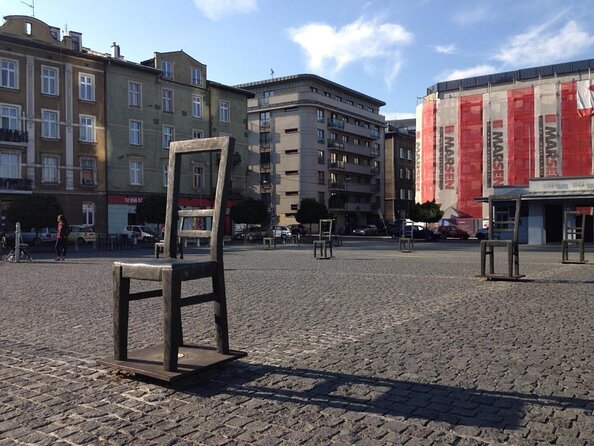
- The route begins at Ghetto Heroes Square, the former Plac Zgody and the departure point for many ghetto transports.
- Plaszow is explained through what remains, including the Grey House, cemetery traces, the pre-burial hall ruins, and major memorials.
- Schindler’s story is part of the wider camp history, not the whole focus of the tour.
- Strong guiding is central to the experience, with Bartholomew, Barbara, and Phil praised for clear explanations and patient answers.
- The tour ends away from the starting point, at a bus stop on Kamieńskiego Street, so plan your onward route.
- The group can include up to 25 people, and late arrivals cannot join once the walk has left.
Why Plaszow deserves a guided walk
Plaszow can be hard to understand on your own. The former camp occupies an open area where buildings, boundaries, and daily routines are not always obvious. If you arrive expecting the preserved barracks and clear displays found at some memorial sites, you may find the first impression confusing.
That is exactly where a good guide earns the fee. The camp has to be pieced together from small clues: a surviving building, a memorial, a line in the ground, cemetery remnants, or an old photograph showing a place that now looks very different. The guide turns those fragments into a map of the former camp.
The history is also layered. Plaszow began in October 1942 on the grounds of two Jewish cemeteries. It first operated as a forced-labor camp for Jewish prisoners from the liquidated Kraków ghetto. From July 1943, it also held Poles in a penal-labor section. In January 1944, the camp was redesignated as a concentration camp.
Later, Plaszow served as a transit camp for Hungarian Jews being sent onward to Auschwitz. More than 35,000 people were imprisoned there during its existence, and around 6,000 were murdered. Executions took place at several sites, with mass graves and memorials now marking parts of the area.
Those numbers can feel distant when read in a book. On foot, the guide can connect them to specific places. That shift from general history to physical location is the strongest reason to choose this tour.
More Walking Tours in Kraków
- Old Town Krakow & Wawel Castle Walking Tour
★ 5.0 · 1,508 reviews - Creepy Krakow: 2-Hour City Walking Tour
★ 4.7 · 1,131 reviews - Krakow: The Old Town Walking Tour
★ 4.8 · 794 reviews
Starting at Ghetto Heroes Square and Apteka pod Orłem
The meeting point is Apteka pod Orłem, Plac Bohaterów Getta 18. The square was known during the German occupation as Plac Zgody. It served as the Kraków ghetto’s center for control, registration, and departures.
This is a powerful place to begin because the tour does not treat Plaszow as an isolated site. You first see the point from which people were registered and sent away. The square links the ghetto’s forced liquidation with the camp that received many of its prisoners.
The postwar name, Ghetto Heroes Square, honors those caught in that system. The setting also gives you an early chance to orient yourself before walking onward. You can expect about 15 minutes here, with the guide explaining how the square functioned and why it matters.
The nearby pharmacy, Apteka pod Orłem, is part of the address and provides a clear reference point. Arrive at least 10 minutes early. This matters because the group leaves on time, and late arrivals cannot join or receive a refund.
The route from the ghetto to Plaszow
The tour then links the square with Plaszow. The supplied information describes the activity as a guided walking tour, while one account notes that a guide took the group by tram from Heroes Square to Plaszow. The exact movement between points should be confirmed at booking, but you should expect the experience to cover a meaningful distance rather than remain in one compact memorial site.
That connection is useful. It helps you understand that the camp was part of Kraków’s wartime machinery, not a separate place with no relation to the ghetto. The route itself becomes part of the explanation.
The tour is offered in English, and group tours operate in only one language at a time. That keeps the explanations focused. With a maximum of 25 people, it is not a private walk, but it is small enough for questions to be practical if the guide manages the group well.
Reading the remains at Plaszow
The main Plaszow portion lasts roughly an hour, followed by about 45 minutes focused on the camp’s surviving features and memorials. In practice, these parts form one connected visit rather than a neat museum-style sequence.
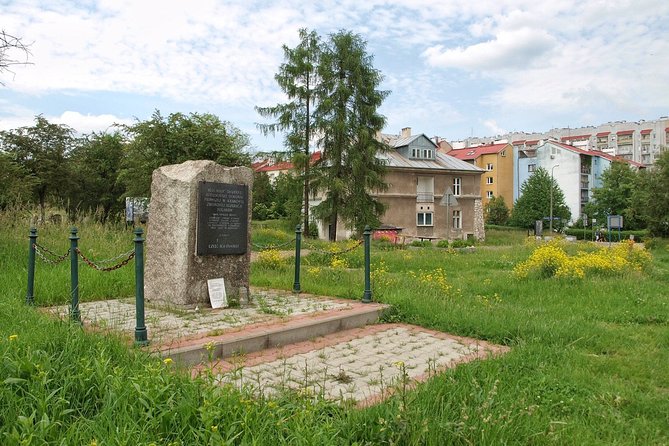
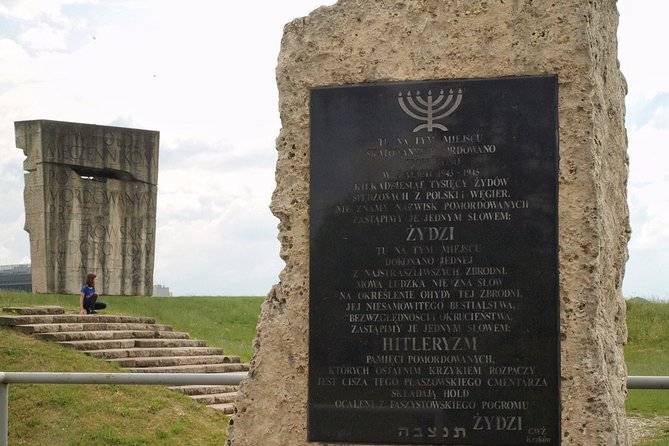
Your guide helps locate the Grey House, a surviving structure associated with the camp administration. You also see the ruins of the pre-burial hall and traces of the Jewish cemeteries on which the camp was built.
One especially grim detail is the use of fragments of gravestones to pave camp roads. It shows how the Nazi authorities physically erased and abused the cemetery sites. Underfoot, the remains are not simply old stones. They are evidence of a deliberate assault on Jewish memory and dignity.
The guide also explains the roll-call square and the way the camp was divided. Plaszow contained living areas, hospital sections, administrative spaces, and industrial sections. These divisions help you picture how prisoners were controlled, worked, housed, treated, and moved through the camp.
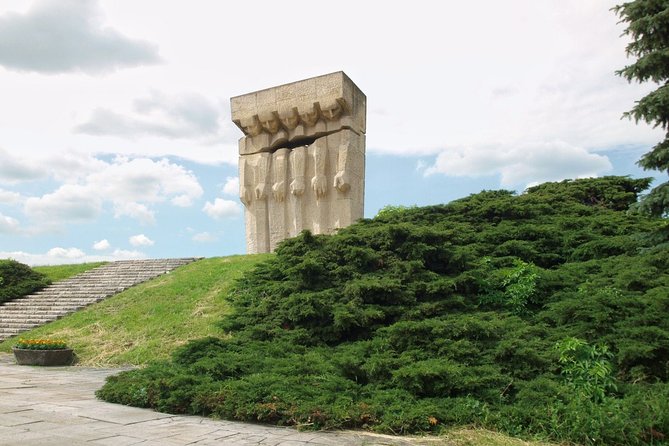
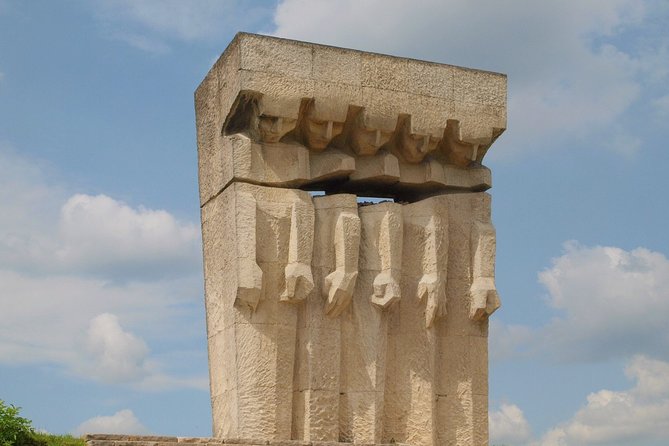
The Monument of Torn-Out Hearts is one of the major points for reflection. Memorials such as this give the walk a place to pause after the factual explanations. The visit is not built around entertainment, and it should not be. The tone is serious, direct, and at times painful.
Because so much of the original camp has gone, photographs are valuable. Guides have used historical images to show what once stood where you are walking. This is one of the most useful parts of the experience, especially if you have seen Schindler’s List and want to understand how the film’s locations and events relate to the real site.
A completely different kind of day out in Kraków:
- From Krakow: Auschwitz-Birkenau Guided Tour & Hotel Pickup
★ 4.5 · 33,358 reviews - From Krakow: Auschwitz-Birkenau Guided Tour & Hotel Pickup
★ 4.5 · 29,340 reviews - Krakow: Auschwitz Guided Tour with Optional Hotel Pickup
★ 4.5 · 15,280 reviews - Krakow–Zakopane: Cable Car, Chocholow Baths, Cheese & Vodka
★ 5.0 · 10,720 reviews
Oskar Schindler beyond the film
Many people arrive at Plaszow because of Schindler’s List. The tour makes room for that interest but places Oskar Schindler within the larger story of the camp.
Through his enamelware enterprise, Schindler sought work permits for Jewish prisoners registered through Plaszow. Those permits could shield people from further transports. Later, he arranged their transfer to his wartime factory in Brunnlitz, saving more than 1,000 lives.
This does not turn the visit into a film-location tour. Schindler’s story is important, but Plaszow was a vast system that affected tens of thousands of people. A strong guide keeps both points in view: the personal actions of one industrialist and the wider persecution carried out by the Nazi German occupiers.
If you have watched the film, bring that background with you, but do not expect the movie alone to explain the site. The real camp was more complex, and some locations shown in the film were reconstructed elsewhere. The walk helps separate cinema from the actual history.
The guides make the difference
The most highly praised part of this experience is the guiding. Bartholomew is described as informative and engaging, while Barbara is praised for giving a steady stream of explanations, showing photographs, and answering questions. Phil is noted for taking his time at the main sites and explaining events in detail.
Those qualities matter especially at Plaszow. Without context, you may see an open area and a few memorials. With a patient guide, you can understand how the camp was organized, what the surviving structures were used for, and where the most important events took place.
The guides are also praised for making the walk educational without losing its human weight. That balance is important. A guide who rushes through dates can make the visit feel like a checklist. A guide who focuses only on emotion may leave you without a clear understanding of the camp’s function.
You should have opportunities to ask questions, though the experience is a group tour rather than a private conversation. The one-language format helps keep the talk coherent, and the 25-person maximum places a reasonable limit on the crowd.
Is $30.04 a fair price?
At about $30.04 per person, this is a solid value if you want interpretation rather than simple access to an open memorial area. Admission to the named stops is free, so you are mainly paying for the guide, organization, and historical explanation.
That distinction matters. You could visit the area without paying an entrance fee, but you would likely miss much of the meaning behind the Grey House, the cemetery traces, the road fragments, the roll-call square, and the memorials. The guide’s photographs and explanations are the service you are buying.
The value is strongest for first-time visitors, people interested in Kraków’s wartime history, and anyone who has seen Schindler’s List. It is less compelling if you want a self-guided stroll with plenty of free time or a formal museum with extensive indoor exhibits.
The tour’s average booking lead time is 39 days. That suggests you should not leave it until the last minute if your Kraków dates are fixed. Free cancellation is available up to 24 hours before the start time, but cancellations or changes made inside that window are not refunded.
Walking conditions and practical planning
Wear shoes that can handle a long walk. The route includes outdoor paths, and the information specifically calls for a moderate level of physical fitness. Plaszow is not presented as a fully paved, step-free museum route, so allow for a less polished walking environment.
Weather will affect the experience. The tour is outdoors for much of its duration, and there is no indication of an indoor alternative. Carry what you need for the conditions on the day, but keep in mind that the subject calls for a respectful, understated approach rather than a casual sightseeing mood.
The starting point is in the former ghetto area, while the tour ends at Henryka Kamieńskiego 57, at the bus stop on Kamieńskiego Street. Do not assume you will finish where you began. Check your route back to central Kraków before setting out.
The tour is mobile-ticket based and confirmation is sent at booking. Select English when reserving, since each group tour operates in one language only.
Who should choose this experience?
I would recommend this walk if you want to understand how the Kraków ghetto, Plaszow, forced labor, deportations, and Schindler’s actions fit together. It is also a good choice if you value a guide who can show photographs and explain a site that no longer presents its story clearly.
It suits adults and older children who can manage a serious subject and a moderate walk. The tone is educational and thought-provoking, not light sightseeing.
I would think twice if you need a highly accessible route, dislike outdoor walking, or expect preserved camp buildings at every stop. You may also prefer a different format if you want to spend most of your time inside exhibitions rather than standing at memorials and reconstructing the past from what remains.
Should you book the Plaszow walking tour?
Book it if you want the human and historical context that the bare site cannot provide. The strongest reasons are the route from Ghetto Heroes Square, the detailed explanation of Plaszow’s surviving traces, the thoughtful treatment of Schindler’s role, and guides such as Bartholomew, Barbara, and Phil who are praised for making difficult material clear.
Do not book it expecting a polished museum visit or a short, effortless stroll. Plaszow asks you to look closely, listen carefully, and accept that absence is part of what you are seeing. For about $30.04, that guided interpretation makes the visit worthwhile.
FAQ
How long does the Plaszow concentration camp tour last?
The experience lasts approximately two hours. The schedule includes about 15 minutes at Ghetto Heroes Square, one hour at Plaszow, and around 45 minutes examining the camp’s remains and memorials.
Where does the tour begin?
It begins at Apteka pod Orłem, Plac Bohaterów Getta 18, Kraków.
Where does the tour end?
The tour ends at Henryka Kamieńskiego 57, at the bus stop on Kamieńskiego Street.
Is the tour offered in English?
Yes. English is an available language, and each group tour operates in only one language.
How many people can join the group?
The group can have a maximum of 25 participants.
How early should I arrive?
Arrive 10 minutes before the scheduled start. Once the group has departed, late arrivals cannot join, and the ticket is not refundable.
Is the tour physically demanding?
You should have a moderate level of physical fitness. Comfortable walking shoes are recommended because the experience involves substantial outdoor walking.
What places are included in the visit?
The route includes Ghetto Heroes Square, Plaszow Concentration Camp, the Grey House, the pre-burial hall ruins, cemetery traces, the roll-call square, the Monument of Torn-Out Hearts, and other memorial points.
Can I cancel for a full refund?
Yes, if you cancel at least 24 hours before the experience’s start time. Cancellations or changes made less than 24 hours before the start are not refunded.
Just added around Kraków
- Rynek Underground Museum & Wawel Castle, Cathedral – Cracow★ 5.0 · 3 reviews
- Schindler’s Factory, Ghetto and Plaszow Camp Guided Tour★ 4.7 · 3 reviews
- Nowa Huta – a guided tour of a utopian socialist city★ 5.0 · 3 reviews
- Krakow: Kazimierz by Golf Cart and Schindler’s Factory Tour★ 4.8 · 3 reviews
- Private Krakow City Tour by Car and Walk with private tour guide★ 5.0 · 3 reviews
- Krakow: Jewish Traces Private Electric Car Tour★ 4.1 · 3 reviews
- Discover the Jewish Quarter with a Bike Tour★ 5.0 · 3 reviews
- Krakow: Indoor Go-Karting (24-Minute Races)★ 4.8 · 3 reviews
Walking Tours, compared.




Gdańsk City Sights & History Guided Walking Tour in English
Read our review →


Browse the lists this tour appears in