
REVIEW · GOLF CART TOURS
Krakow: Regular Extended City Sightseeing Tour By Golf Cart
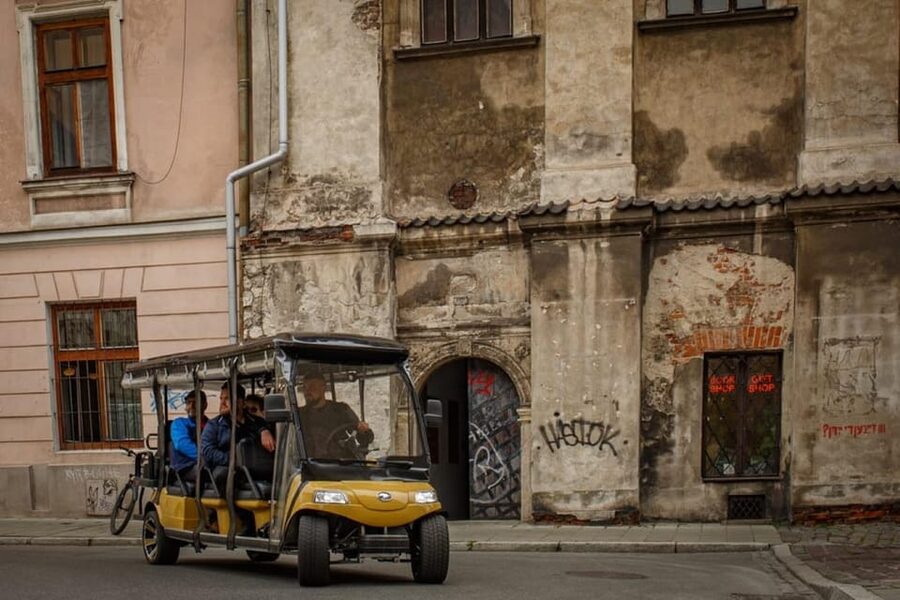
Krakow reveals itself in layers. This 135-minute golf cart tour links the Old Town, Kazimierz, and Podgórze in one well-packed route, giving you a quick grasp of the city before you return to favorite places on foot. I like the broad coverage, and I like that the audio guide offers a long list of language choices. The main drawback is simple: a golf cart is open at the sides but not always above, so tall buildings can be hard to see from your seat.
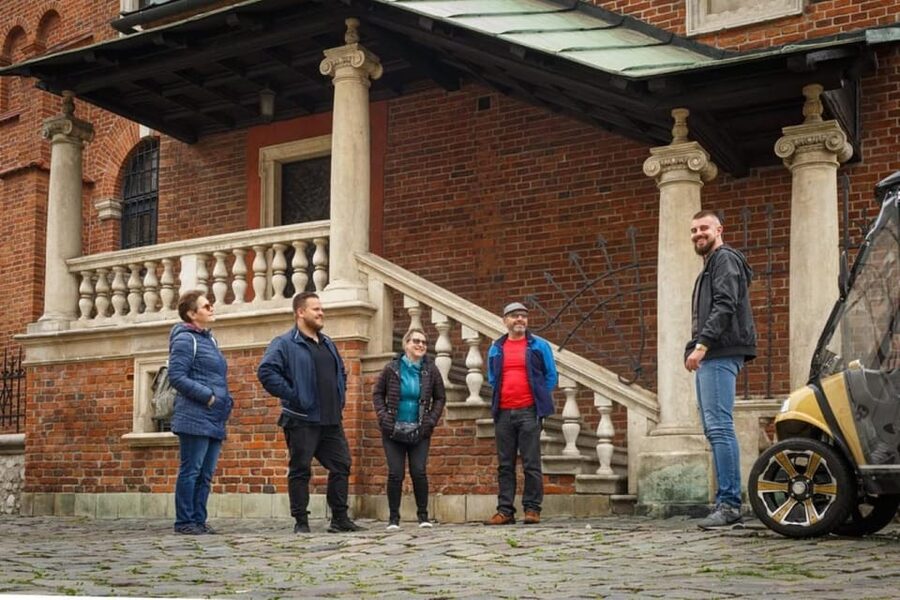
The small-group format keeps the tour easy on your feet, and the driver may add personal comments beyond the recorded narration. One driver praised in the feedback was Jakub, who offered extra facts in both Polish and English. Seating is assigned, and the vehicle can carry up to 13 people, so couples or friends may not always sit together.
In This Review
- Key points to know before booking
- Why this golf cart tour works well in Krakow
- Starting with the Planty and Krakow’s old defenses
- Krakow’s Main Square and the heart of the Old Town
- Kazimierz, from Wolnica Square to the old synagogues
- Podgórze and the former Krakow ghetto
- What the audio guide adds, and what the driver adds
- Seating, comfort, weather, and mobility
- How to get the best value from $55
- Who should book this Krakow golf cart tour?
- FAQ
- How long does the Krakow golf cart tour last?
- Which parts of Krakow does the tour visit?
- Is a live guide included?
- Which audio guide languages are available?
- How many people can ride in one golf cart?
- Can I sit beside the person I booked with?
- Is the tour wheelchair accessible?
- Are food and drinks included?
- Should you book it?
Key points to know before booking
- Three major districts in 135 minutes: You cover the Old Town, the former Jewish quarter of Kazimierz, and Podgórze, including the former ghetto area.
- A practical first look at Krakow: The route helps you get your bearings without spending two hours walking between far-flung sights.
- Audio in 27 languages: English, Polish, German, French, Spanish, Italian, Chinese, Japanese, Korean, and many other options are available.
- Live help from the driver: The official live guide languages are Polish and English, and drivers can add useful remarks beyond the audio.
- Up to 13 people per cart: Seating is assigned, with up to three people in each row, so sitting beside your companion is not guaranteed.
- A strong choice for limited mobility: The activity is wheelchair accessible, though you should still confirm your exact meeting and boarding arrangements before departure.
Why this golf cart tour works well in Krakow
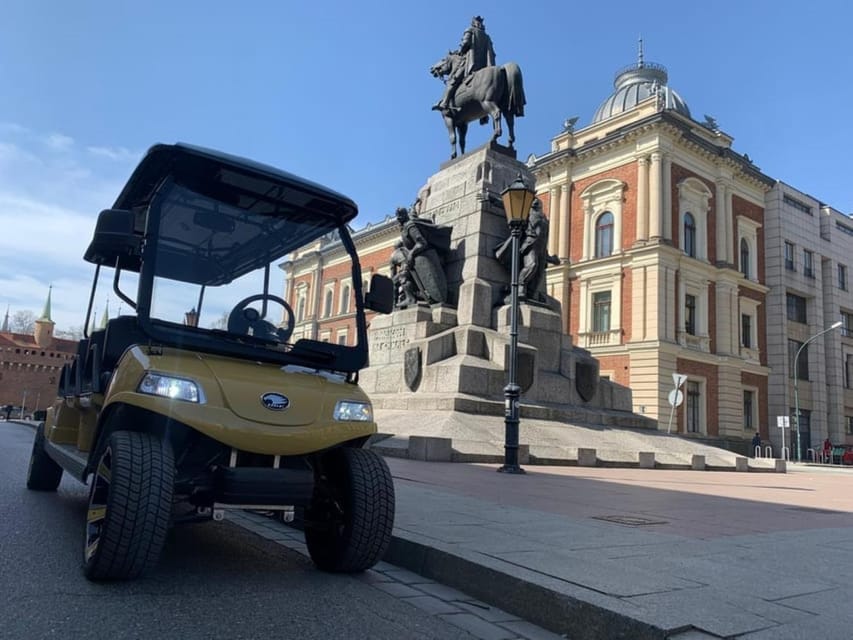
Krakow is compact enough to walk, but its main sights are spread across several distinct areas. The Old Town sits inside the Planty park ring. Kazimierz lies south of the historic center, and Podgórze is across the Vistula River. Seeing all three on foot in a single afternoon takes effort and careful planning.
A golf cart removes much of that strain. You can sit back while the route connects major sights, churches, squares, former walls, synagogues, and memorial sites. It is not a replacement for entering museums or spending quiet time at memorials, but it is a useful introduction.
The price is $55 per person. That is not the cheapest way to see Krakow, especially if you are happy walking and using your own guidebook. Still, the value improves if you want one organized ride through three districts, a driver to handle the route, and narration in a language you understand. You also avoid spending your first day working out how the Old Town connects with Kazimierz and Podgórze.
The experience lasts 135 minutes, or two hours and 15 minutes. That extra quarter hour matters because the route covers a lot of ground. You should think of it as a city overview with historical commentary, not a series of long stops.
More Golf Cart Tours in Kraków
- Krakow: City Sightseeing Tour by Electric Golf Cart
★ 4.5 · 3,264 reviews - Krakow: City Sightseeing Tour Eco Electric Buggy Golf Cart
★ 4.7 · 3,143 reviews - Krakow: Extended City Sightseeing Tour – Eco Buggy Golf Cart
★ 4.7 · 794 reviews
Starting with the Planty and Krakow’s old defenses
The tour begins with a general introduction to Krakow and then follows the Planty, the green belt that circles the Old Town. This is one of the best ways to understand the shape of central Krakow. The park occupies the old defensive area that once separated the medieval city from its surroundings.
You then pass the Church of St. Cross and the Juliusz Słowacki Theater. The theater is one of the city’s prominent historic buildings, and its position near the old fortifications makes it a useful landmark as you begin to see how Krakow grew beyond its medieval core.
The route continues past sections of the former city walls and the Barbican. The Barbican is a round defensive structure connected historically with the city gates. From a moving cart, you get the broad picture rather than a detailed architectural inspection. If medieval military design interests you, plan to return later and walk around it slowly.
Jan Matejko Square, the Church of St. Florian, and Sławkowska Street follow. These stops show different sides of Krakow: a civic square, a church connected with the northern entrance to the city, and a street leading toward the center.
The Czartoryski Museum and St. John’s Street come next. The museum is one of Krakow’s best-known cultural institutions, while St. John’s Church adds another layer of religious and architectural interest. The cart lets you identify these places quickly, but the audio cannot give every interior detail in the time available.
Krakow’s Main Square and the heart of the Old Town
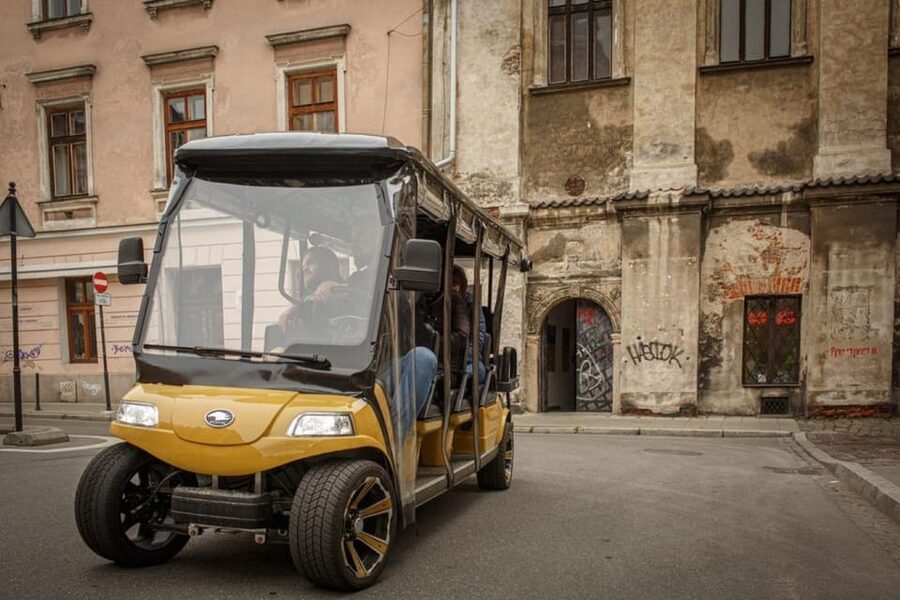
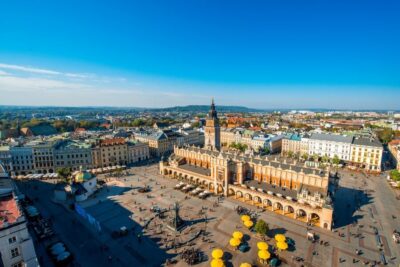
The route then reaches the Main Square, the large central plaza that anchors Krakow’s Old Town. This is the point where the city’s layout becomes easiest to read. Streets run out from the square, and many of the most familiar historic buildings gather around it.
You see Plac Szczepański, the Palace of Art, and St. Anne’s Church before or around the central area. St. Anne’s is especially important for its ornate interior, though this ride focuses on the outside view. The Palace of Art gives you another visual marker and helps show that Krakow is not only a medieval city, but also a center for later Polish culture.
The Town Hall, Franciscan Church, and the route toward Wawel Castle round out this section. The Franciscan Church is known for its colorful interior and religious art, but again, the main benefit here is orientation. You learn where the church sits in relation to the Main Square and Wawel.
Wawel Castle is one of the major reasons people come to Krakow. It sits above the Vistula and carries royal, religious, and national importance. A cart tour cannot replace time inside the castle complex, cathedral, or exhibitions. What it can do is bring Wawel into the larger city story and show how close it is to the Old Town.
If this is your first visit, pay attention to the route around Wawel rather than trying to photograph every building from the seat. One practical weakness of the cart is the roof design. One person found that tall buildings were difficult to view through the roof and had to take a picture outside the cart later. Some vehicles may have a transparent roof, but the vehicle type is not guaranteed, so treat photography as a bonus rather than the main purpose.
Kazimierz, from Wolnica Square to the old synagogues
The second major district is Kazimierz, historically Krakow’s Jewish quarter. The tour gives this area a substantial run of stops, and that is one of its strongest features. You pass Skałka Church and St. Catherine’s Church before reaching Wolnica Square, once the center of the separate medieval Jewish city.
Wolnica Square is important because it helps explain that Kazimierz was not simply a neighborhood added to Krakow. It had its own civic identity and town hall. The Church of Corpus Christi adds another major landmark, showing the close physical relationship between Christian and Jewish communities in the district.
The synagogue route includes Tempel, Kupa, Isaac, the Old Synagogue, and Popper synagogues. You also pass Ciemna Street, the former home of Helena Rubinstein’s family, the Remuh Synagogue, and the old cemetery. Together, these places point to the size and variety of Jewish life that once shaped Kazimierz.
The Remuh Synagogue and cemetery deserve special care. Even from a cart, the stop has emotional weight because it connects religious practice with burial traditions and the destruction of the Jewish community during the Second World War. The audio guide can provide the basic story, while the driver may add local context.
You also see old Jewish shops and a memorial stone from the Nissembaum Family Foundation. These details matter because they move the tour beyond the most famous synagogue facades. You get reminders of ordinary work, family life, and community memory, not only grand monuments.
Still, you should know what the format cannot provide. You will not have much time to enter religious buildings, study inscriptions, or sit in the cemetery. If Kazimierz is a central reason for your Krakow visit, use this tour to mark places for a later walking visit. If you have only one afternoon, the cart gives you a useful first pass without the fatigue of crossing the entire district.
A completely different kind of day out in Kraków:
- From Krakow: Auschwitz-Birkenau Guided Tour & Hotel Pickup
★ 4.5 · 33,358 reviews - From Krakow: Auschwitz-Birkenau Guided Tour & Hotel Pickup
★ 4.5 · 29,340 reviews - Krakow: Auschwitz Guided Tour with Optional Hotel Pickup
★ 4.5 · 15,280 reviews - Krakow–Zakopane: Cable Car, Chocholow Baths, Cheese & Vodka
★ 5.0 · 10,720 reviews
Podgórze and the former Krakow ghetto
The final section moves into Podgórze, the district associated with the former ghetto. The route includes Ghetto Heroes Square, the Pharmacy under the Eagle, the former residence of Tadeusz Pankiewicz, and a section of the ghetto wall.
This is where the tour changes tone. The earlier parts focus on city design, churches, royal power, and Jewish community life. Podgórze brings the Nazi occupation and the forced confinement of Krakow’s Jewish population into direct view.
Ghetto Heroes Square is a memorial space with a difficult story. The chairs placed around the square represent the belongings and people taken from the ghetto during its liquidation. You may not get the time for a long silent visit, but the stop gives you a clear place to return to on foot.
The Pharmacy under the Eagle is tied to Tadeusz Pankiewicz, the pharmacist who worked in the ghetto and helped those trapped there. The site offers one of the more personal connections to daily life under occupation. You pass the location during the route, but anyone wanting a fuller account should plan time for the museum.
The tour also explains Oskar Schindler’s story and the wider life of the ghetto. Schindler’s name is familiar from film and popular history, but the ghetto route helps place his factory story within the much larger experience of the people imprisoned there. The audio commentary provides continuity as the cart moves between the sites.
The remaining section of the ghetto wall is another important stop. It shows how physical barriers shaped daily life, and it is more direct than a general historical explanation. The Church of St. Joseph completes the Podgórze portion and gives you a final architectural landmark after the memorial sites.
This part requires a respectful frame of mind. The tour is designed to keep moving, so you may find the history compressed. That is not a reason to skip it. It is a reason to return to the Pharmacy under the Eagle, Ghetto Heroes Square, or the ghetto wall if the subject matters deeply to you.
What the audio guide adds, and what the driver adds
The audio guide is available in an unusually wide range of languages: English, Chinese, Croatian, Czech, Danish, Finnish, French, Greek, Spanish, Dutch, Japanese, Korean, Lithuanian, German, Norwegian, Polish, Portuguese, Russian, Romanian, Serbian, Slovak, Swedish, Turkish, Ukrainian, Hungarian, and Italian.
That choice makes the tour accessible to many visitors who would not want to follow a Polish or English explanation. The audio system also keeps the route moving because you can receive information while the cart travels between sites.
The live guide languages are Polish and English. That distinction matters. If you book the audio in another language, you should not expect the driver to provide a full live tour in that same language. The driver handles the route and can help with practical questions, while the recorded system carries most of the explanation.
A good example is Jakub, who was praised for being courteous and attentive and for adding facts beyond the audio. That is the best version of this experience: a clear recording supported by a driver who notices what the group needs and adds local color at the right moments.
The audio may also feel less personal than a walking tour with one dedicated historian. I would choose the golf cart if you value coverage and comfort. I would choose a private walking guide if you want long questions, flexible stops, or close attention to one subject.
Seating, comfort, weather, and mobility
The vehicles carry up to 13 people. Each row can hold up to three, and the company assigns seats. If you are traveling with a partner or family member, you may not sit directly beside them, so do not book this expecting a private ride.
That group size is still small enough to feel manageable compared with a large coach. The cart can reach streets and areas that are less practical for a full-size bus, which suits the historic center.
Wear comfortable shoes, even though you will sit for most of the route. You may want to walk before or after the ride, and boarding or brief sightseeing around the meeting point can still involve standing. Eating breakfast is sensible because food and drinks are not included.
The vehicle is wheelchair accessible. You should still check the boarding details for your particular departure, especially if a wheelchair user needs extra time or a specific seating arrangement.
Smoking is not allowed in the vehicle or indoors. Pets, large bags, oversize luggage, weapons, sharp objects, alcohol, drugs, and explosive substances are also prohibited. Red wine is specifically listed among the prohibited items, so this is not the ride for carrying a picnic or drinks onboard.
How to get the best value from $55
At $55, the tour makes the most sense when you use it as a planning tool. You see the three districts first, then decide where to spend your remaining time. Mark the places you want to revisit, especially the Main Square, Wawel, the Remuh area, Ghetto Heroes Square, and the Pharmacy under the Eagle.
The price also buys convenience. You do not need to map the route between the Old Town and Podgórze, and you avoid spending your first hours walking in circles. For older visitors, families, or anyone with limited energy, that convenience may be worth more than the cost difference from a self-guided day.
The value is weaker if you already know Krakow well or plan to walk every street at your own pace. You will pass many sites rather than stop for a full visit. The tour gives you breadth, not deep time at individual monuments.
Book it early in your stay if possible. That way, the ride helps shape the rest of your Krakow plans. Because cancellation is free up to 24 hours before departure and payment can be delayed, you can keep plans flexible, subject to the booking terms shown at the time you reserve.
Who should book this Krakow golf cart tour?
I would recommend it to first-time visitors, families, people who want to limit walking, and anyone with only a short stay. It is also useful if you want the major districts explained in your own language without arranging a private guide.
It suits visitors who like a steady route and a mix of history, architecture, and practical orientation. The high rating of 4.8 from 13 reviews fits the strongest parts of the experience: polite drivers, good coverage, and the relief of seeing Krakow without wearing out your feet.
I would hesitate if your main goal is detailed photography or close architectural study. The cart roof can block views of tall buildings, and assigned seating means you may not get the best angle. I would also choose another format if you want to spend long, quiet periods at memorials or inside synagogues and museums.
FAQ
How long does the Krakow golf cart tour last?
The tour lasts 135 minutes, which is two hours and 15 minutes.
Which parts of Krakow does the tour visit?
It visits Krakow’s Old Town, Kazimierz, the historic Jewish district, and Podgórze, including the former ghetto area.
Is a live guide included?
Yes. Live guiding is available in Polish and English. A multilingual audio guide is also included.
Which audio guide languages are available?
The audio guide is available in English, Chinese, Croatian, Czech, Danish, Finnish, French, Greek, Spanish, Dutch, Japanese, Korean, Lithuanian, German, Norwegian, Polish, Portuguese, Russian, Romanian, Serbian, Slovak, Swedish, Turkish, Ukrainian, Hungarian, and Italian.
How many people can ride in one golf cart?
The vehicles are designed to carry up to 13 passengers. Each row can seat up to three people.
Can I sit beside the person I booked with?
Not necessarily. The driver assigns seating, and sitting next to another member of your booking is not guaranteed.
Is the tour wheelchair accessible?
Yes, the activity is listed as wheelchair accessible.
Are food and drinks included?
No. Food and drinks are not included, and alcohol is not allowed in the vehicle.
Should you book it?
Book this tour if you want one efficient introduction to Krakow’s three key districts and prefer sitting to walking. The route covers far more ground than a short Old Town ride, and the multilingual audio makes it practical for many visitors.
Do not book it expecting detailed entrance visits, flexible photography stops, or a private conversation with a historian. Think of it as a well-organized first look. Use it to understand the city’s shape, note the places that catch your attention, and then return on foot to the sights that deserve more time.
Just added around Kraków
- Rynek Underground Museum & Wawel Castle, Cathedral – Cracow★ 5.0 · 3 reviews
- Schindler’s Factory, Ghetto and Plaszow Camp Guided Tour★ 4.7 · 3 reviews
- Nowa Huta – a guided tour of a utopian socialist city★ 5.0 · 3 reviews
- Krakow: Kazimierz by Golf Cart and Schindler’s Factory Tour★ 4.8 · 3 reviews
- Krakow: Jewish Traces Private Electric Car Tour★ 4.1 · 3 reviews
- Private Krakow City Tour by Car and Walk with private tour guide★ 5.0 · 3 reviews
- Discover the Jewish Quarter with a Bike Tour★ 5.0 · 3 reviews
- Krakow: Indoor Go-Karting (24-Minute Races)★ 4.8 · 3 reviews
Golf Cart Tours, compared.
City Sightseeing Tour Eco Electric Buggy Golf Cart
Read our review →
Extended City Sightseeing Tour – Eco Buggy Golf Cart
Read our review →
City Sightseeing Tour by Golf Cart/Buggy Guided Tour
Read our review →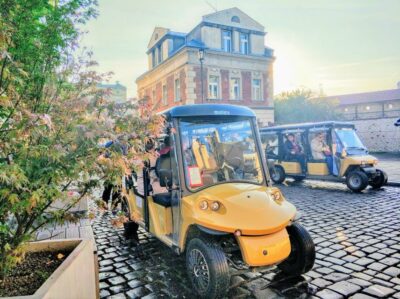
Jewish Quarter and Ghetto Electric Golf Cart Tour
Read our review →City Sightseeing Tour Eco Electric Buggy Golf Cart
Read our review →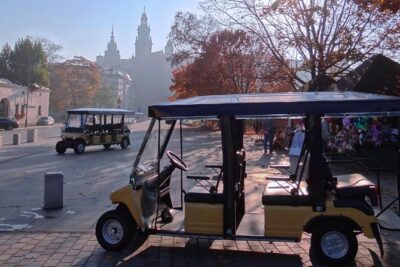
Krakow Grand City Tour by golf cart – All 3 districts
Read our review →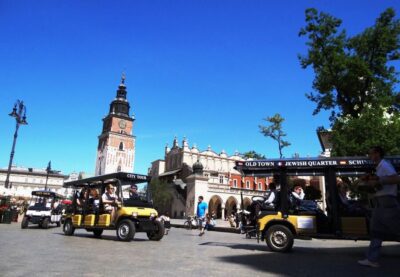
Browse the lists this tour appears in