
REVIEW · AUSCHWITZ-BIRKENAU MEMORIAL TOURS
Krakow to Auschwitz Birkenau Guided Tour with Transfer and Ticket
Some places ask you to remember.
This seven-hour Auschwitz-Birkenau tour from Krakow combines round-trip transport, museum admission, and a licensed guide into one carefully timed day. I like the clear organization, especially the advance pickup messages and tickets handled for you. I also like the headsets used at Auschwitz I, which let you hear the guide without breaking the quiet mood. The main drawback is pace: you follow a fixed group schedule, so you may not have enough time to pause over every photograph, display, or personal object.
The tour costs about $36.28 per person, which is strong value for transport over roughly 130 kilometers round trip, entry to both camp sites, and a museum-approved guide. It is not a casual outing, though. You will walk on uneven ground, spend much of the day outdoors, and confront difficult evidence of mass murder. Bring food, water, and clothing suited to the forecast.
In This Review
- Key points before you book
- Why Auschwitz-Birkenau belongs on your Krakow plans
- The drive from Krakow to Oswiecim
- Auschwitz I and the gate marked Arbeit Macht Frei
- The personal evidence inside the museum
- Birkenau: the scale changes everything
- Timing, walking, and the need for breakfast
- Standard group or limited 15-person option
- Is $36.28 good value?
- Communication and the return to Krakow
- Who should book this Auschwitz tour?
- Should you book it?
- FAQ
- How long does the Krakow to Auschwitz-Birkenau tour take?
- Does the tour include transportation from Krakow?
- Is admission to both Auschwitz sites included?
- Do I need to bring a passport or ID?
- Is lunch included?
- How large is the tour group?
- Are headsets provided during the visit?
- What happens if the weather is bad?
Key points before you book
- Two camps, one guided visit: You see Auschwitz I and the much larger Birkenau site in the same day.
- About 7 hours door to door: The drive takes roughly 1 hour 15 minutes each way, with time at both memorial sites.
- Headsets at Auschwitz I: You can hear the guide clearly, even when the camp is busy.
- Groups of up to 30 people: The standard tour is not private, while the limited 15-person option offers a smaller setting and hotel pickup.
- Bring your passport or ID: Every participant must provide their full legal name and carry identification for entry.
- Pack a snack: Lunch is not included, and there is no time for a full meal between the two camp visits.
Why Auschwitz-Birkenau belongs on your Krakow plans
Auschwitz-Birkenau is not a sightseeing stop in the usual sense. It is a memorial and museum on the site of the largest Nazi concentration and extermination camp complex, where more than a million people were murdered, most of them Jews. A visit asks you to look closely, listen carefully, and behave with respect.
The museum preserves buildings, objects, documents, and ruins connected with the camp system. You will see evidence that is painfully personal: shoes, suitcases, spectacles, hair, and ordinary domestic belongings taken from people who were stripped of their identities on arrival.
I think a guided visit is especially useful here because the sites are large and the meaning of what you see is not always obvious. A good guide supplies dates, names, and context without turning the visit into a cold list of facts. The guides on this tour are licensed by the Auschwitz-Birkenau Museum, and that matters at a place where accuracy and restraint are both essential.
The emotional weight is real. You may feel sad, angry, numb, or simply exhausted. That is normal. Give yourself a quiet evening afterward rather than planning a packed Krakow schedule.
More Private Driver Tours in Kraków
- From Krakow: Auschwitz Birkenau Tour with Transfer
★ 4.0 · 6,134 reviews - Krakow: Auschwitz-Birkenau Guided Tour with Ticket and Transfer
★ 4.5 · 3,784 reviews - Krakow to Wieliczka: Salt Mine Guided Tour with Ticket & Transfer
★ 4.5 · 3,193 reviews
The drive from Krakow to Oswiecim
The day begins with pickup from a Krakow hotel or apartment, if you choose the small-group option, or from an assigned meeting point for the lower-priced option. Guests near the Main Square are generally directed to the closest practical pickup location. If your accommodation sits in a restricted traffic zone, you may need to walk to a nearby accessible street.
The departure time is not entirely in your control. Auschwitz Museum entry slots determine the schedule, and the final time is confirmed the day before. Traffic can also affect the pickup and return. Treat the stated departure as approximate, not as a railway timetable.
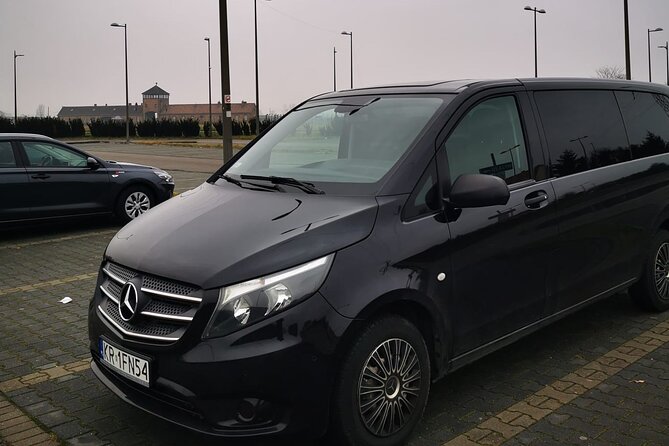
The journey to Oswiecim takes about 1 hour 15 minutes each way. The vehicle is air-conditioned and may be a van or minibus. Several accounts describe punctual transport, warm vehicles in winter, and drivers who kept people informed. Drivers named Daniel and Norbert were singled out for helpful service, while Eric was praised for calling when a passenger was running late.
There can be a little confusion at busy pickup points, especially when several vehicles are loading at once. Read the welcome message carefully, arrive early, and keep your phone available. The Main Square is easy to reach, but the exact meeting point may change because of roadworks. The previously used point at Floriana Straszewskiego 19, beside the Philharmonic, is temporarily closed.
After arrival, you usually get a short break. You can buy or drink coffee, look at outdoor displays, and prepare yourself for the museum entrance. Security is similar to an airport check, so allow time and follow staff instructions.
Auschwitz I and the gate marked Arbeit Macht Frei
The first part of the memorial is Auschwitz I, the original camp. Nazi Germany established it after the 1939 annexation of Poland, initially as a detention center for Polish prisoners. It later became part of the machinery of the Holocaust.
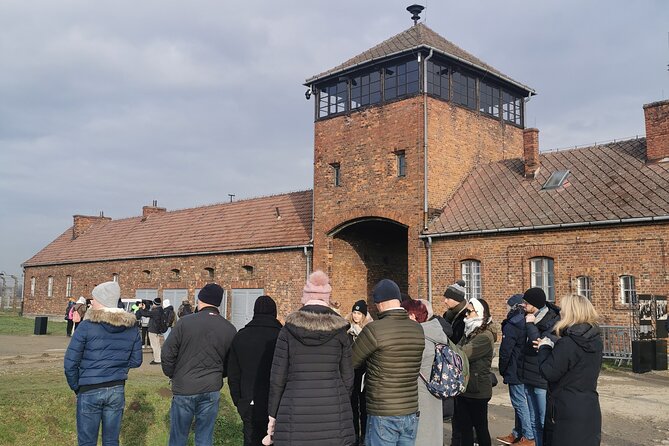
You enter through the familiar iron gate marked Arbeit Macht Frei, meaning Work Makes You Free. The sign is stark, deceptive, and instantly recognizable. Inside, the original brick buildings contain exhibitions about prisoners, deportations, daily life, punishment, medical experiments, and murder.
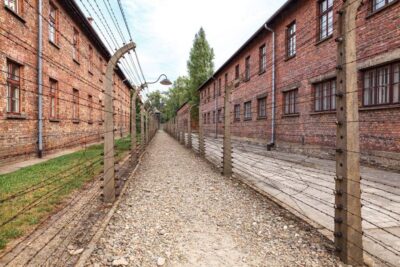
This section usually takes about two hours. You move between buildings, fortified walls, barbed wire, cells, gas chambers, and crematoria. The guide explains how the camp operated and how the Nazi system turned administration, transport, forced labor, and killing into one coordinated process.
I especially value the headsets at Auschwitz I. They allow you to hear a quiet explanation while keeping the group together. You do not need to crowd around the guide or strain to catch every word. This is useful when the museum is busy, which it often is.
The drawback is the pace. You are part of a scheduled group, generally capped at 30 people, and the guide must keep everyone moving through the buildings. If you want to read every panel or spend several minutes with each photograph, this format may feel hurried. One guide may be excellent at covering the facts while still moving quickly enough to meet the next time slot.
The buildings are mostly manageable for people who can walk for a couple of hours, though there are stairs in some sections. The ground is generally flat, but the full day includes uneven surfaces and plenty of walking. Comfortable shoes are more important than fashionable ones.
The personal evidence inside the museum
Auschwitz I can be difficult because the objects are so ordinary. A pile of shoes or suitcases is not an abstract statistic. Each item belonged to a person who expected to live, work, or return home.
You may see displays of glasses, clothing, luggage, and other belongings confiscated from people arriving at the camp. The exhibit of human hair is particularly upsetting. These rooms are presented in a subdued, documented way, not as theatrical attractions. You should not rush through them, but you also need to accept that the tour schedule limits how long you can remain.
Photography is allowed in most areas, except where signs prohibit it. Flash is not permitted inside buildings. Take photographs only where appropriate, and do not treat the memorial like a backdrop for cheerful personal pictures.
More Auschwitz-Birkenau memorial tours:
- From Krakow: Auschwitz-Birkenau Guided Tour & Hotel Pickup
★ 4.5 · 33,358 reviews - From Krakow: Auschwitz-Birkenau Guided Tour & Hotel Pickup
★ 4.5 · 29,340 reviews - Krakow: Auschwitz Guided Tour with Optional Hotel Pickup
★ 4.5 · 15,280 reviews - Krakow: Auschwitz-Birkenau Guided Tour with Pickup & Lunch
★ 4.5 · 9,800 reviews
Birkenau: the scale changes everything
After Auschwitz I, there is a break of up to about 15 minutes. The vehicle then takes you roughly three minutes to Birkenau, also called Auschwitz II, in the nearby village of Brzezinka.
Birkenau is much larger and feels very different. The site was constructed in 1941 under Heinrich Himmler and could hold around 90,000 prisoners. It was built primarily as a killing center, with mass deportation, selection, forced labor, starvation, and extermination at its core.
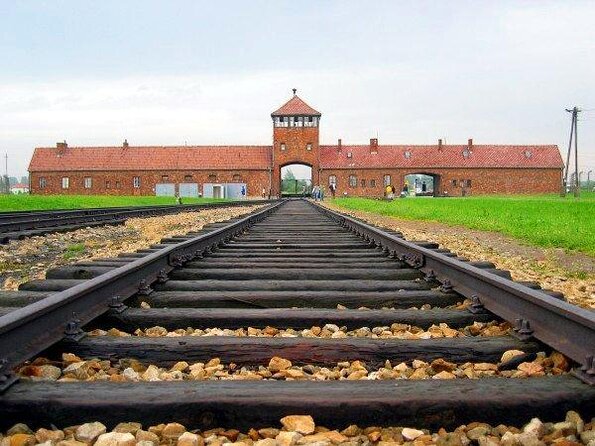
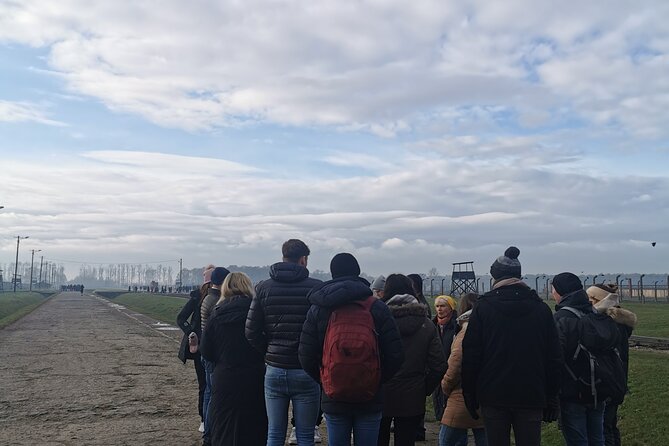
The famous railway entrance gives you a sense of scale. Tracks lead into an enormous open area bordered by barracks, wire fencing, watchtowers, and ruined structures. Much of what you see here is outside, so the weather can shape the experience. In winter, the cold can be severe. In summer, sun and lack of shade can wear you down.
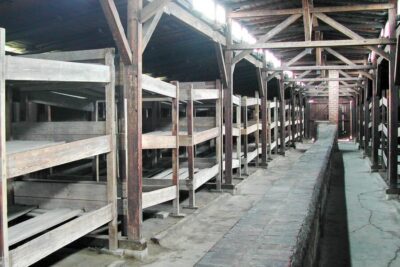
The same guide usually continues the tour, explaining the prisoner barracks, living conditions, selections, gas chambers, crematoria, and the role of medical experiments carried out by Nazi doctors including Josef Mengele. The guide also discusses the liberation of Auschwitz on January 27, 1945, when soldiers of the 60th Army of the First Ukrainian Front opened the camp gates.
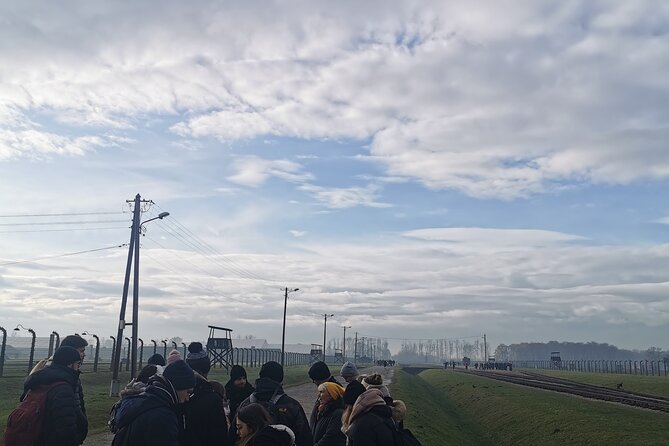
The Birkenau section lasts about an hour. Headsets may not be available outdoors, which is one practical weakness of the tour. If wind, distance, or nearby groups make it hard to hear, you may miss parts of the commentary. Stay close to the guide and position yourself where you can hear clearly.
This part is less about individual displays and more about physical scale. You see how far the fences run and how the camp was designed to control thousands of people. The openness makes the site feel exposed, but the vastness also makes it harder to absorb every detail in one visit.
Timing, walking, and the need for breakfast
The advertised duration is about seven hours, but the day includes roughly two and a half hours of road travel. The actual museum program takes about three hours, divided between Auschwitz I and Birkenau, with short breaks and waiting time around entry.
This is not a day for skipping breakfast. Lunch is not included, there are no food facilities on-site, and there is no time for a full restaurant meal between the two camps. Bring a sandwich, fruit, or other snack, plus water. Packed lunch boxes may be available as an option, and some people found them useful, but you can also bring your own food.
Wear shoes that can handle uneven ground and possibly mud. In cold weather, dress in layers, add gloves and a hat, and protect yourself from wind. Up to 70 percent of the visit takes place outdoors. On hot days, water and sun protection matter just as much.
The tour runs in all weather. That sounds simple, but it is important here. A bitter winter day can make you want to move quickly, while extreme heat can shorten your attention span. Good clothing gives you more room to listen and reflect.
Standard group or limited 15-person option
The standard group can contain up to 30 people. That is not enormous, and the headsets help, but you should not expect private attention or the freedom to set your own pace.
The limited 15-person option costs more, but I think it deserves serious consideration. A smaller group can make pickup easier, reduce crowding, and give the guide a better chance to answer questions. Hotel pickup is available with this option, while lower-priced choices may use a designated meeting point.
The small-group upgrade does not turn the visit into a private tour. Museum rules and timed entry still control the route. You will still walk together and follow the guide. The value is mainly in a more personal group size and easier logistics.
Is $36.28 good value?
At about $36.28 per person, this is an appealing price for a full day built around a major memorial outside Krakow. You get transport, admission to Auschwitz I and Birkenau, insurance, taxes, a licensed local guide, and headsets at Auschwitz I.
The price saves you from arranging separate transport to Oswiecim, buying museum entry, and working out how to move between the two sites. It also reduces the risk of arriving without the required timed admission. For a first visit, that convenience is worth real money.
The tradeoff is control. You are buying an organized group experience, not an independent museum day. You cannot linger freely, and the departure time may be assigned according to museum availability. If you want maximum time with individual exhibitions, a different format may suit you better, assuming it is available for your dates.
Communication and the return to Krakow
The operator sends pickup details and timing information before the day, with the final departure confirmed the day before. This is one of the strongest practical features of the experience. You should know where to wait, when to arrive, and what to do if your hotel is not directly accessible.
At the end, you normally have at least a 20-minute break. You can rest, visit a bookstore, or buy something small before the return drive. The vehicle then heads back to Krakow and drops you at the predetermined address or meeting point.
The return journey takes about 1 hour 15 minutes, though traffic can stretch the day. An early departure may get you back around lunchtime, making it easier to preserve part of your afternoon. Later departures may fit your sleep schedule better but can take up more of the day.
Free cancellation is available up to 24 hours before the start time. If the minimum number of participants is not met, the operator offers another date or experience, or a full refund.
Who should book this Auschwitz tour?
I would choose this tour if you are staying in Krakow and want a straightforward, guided visit without arranging transport yourself. It suits first-time visitors, history students, families with older children, and anyone who wants a factual explanation of a difficult site.
It is also a good choice if you value reliable communication. The pickup system can involve changes, especially with roadworks and restricted streets, but the operator provides instructions and day-of support.
I would think twice if you dislike fixed schedules, long drives, outdoor walking, or emotionally heavy subjects. This is not a light day trip. You should also consider a smaller group if personal space and easier communication matter to you.
Should you book it?
Yes, if you want solid value and a well-managed first visit to Auschwitz-Birkenau. The combination of transport, admission, a licensed guide, and clear support removes much of the practical hassle. The 4.8 rating from 8,198 reviews and 95 percent recommendation rate fit the tour’s strongest qualities: punctual transport, helpful drivers, clear messages, and respectful guiding.
Book the 15-person option if your budget allows and you prefer a calmer group. Choose an early departure if you want part of your Krakow day back. Above all, carry ID, eat breakfast, pack food and water, and dress for the weather. You are not simply filling a spare day in Krakow. You are going to a place that demands your full attention.
FAQ
How long does the Krakow to Auschwitz-Birkenau tour take?
The experience lasts approximately seven hours. The drive takes about 1 hour 15 minutes each way, with roughly two hours at Auschwitz I and one hour at Birkenau, plus breaks and transfer time.
Does the tour include transportation from Krakow?
Yes. Round-trip transportation is provided in an air-conditioned van or minibus. Hotel pickup is available only with the tour option limited to 15 people. Other options use a designated meeting point.
Is admission to both Auschwitz sites included?
Yes. Entry fees for Auschwitz I and Auschwitz II Birkenau are included in the tour price.
Do I need to bring a passport or ID?
Yes. Every participant must carry a passport or national ID, and it will be checked before entry. You must also provide each participant’s full legal name during booking.
Is lunch included?
No. Food and drinks are not included, and there is no time for a full meal between the two visits. Bring a snack and water. A packed lunch may be available as an optional purchase.
How large is the tour group?
The group can contain up to 30 people. A limited 15-person option is also available and includes hotel pickup.
Are headsets provided during the visit?
Headsets are provided so you can hear the guide clearly at Auschwitz I. They may not be available during the outdoor Birkenau section.
What happens if the weather is bad?
The tour operates in all weather. Much of the visit takes place outdoors, so you should dress appropriately, wear comfortable shoes, and bring water on warm days.
Just added around Kraków
- Rynek Underground Museum & Wawel Castle, Cathedral – Cracow★ 5.0 · 3 reviews
- Schindler’s Factory, Ghetto and Plaszow Camp Guided Tour★ 4.7 · 3 reviews
- Nowa Huta – a guided tour of a utopian socialist city★ 5.0 · 3 reviews
- Krakow: Kazimierz by Golf Cart and Schindler’s Factory Tour★ 4.8 · 3 reviews
- Private Krakow City Tour by Car and Walk with private tour guide★ 5.0 · 3 reviews
- Krakow: Jewish Traces Private Electric Car Tour★ 4.1 · 3 reviews
- Discover the Jewish Quarter with a Bike Tour★ 5.0 · 3 reviews
- Krakow: Indoor Go-Karting (24-Minute Races)★ 4.8 · 3 reviews
Auschwitz-Birkenau Memorial Tours, compared.

Auschwitz-Birkenau Guided Tour & Hotel Pickup
Read our review →Auschwitz-Birkenau Guided Tour & Hotel Pickup
Read our review →
Auschwitz Guided Tour with Optional Hotel Pickup
Read our review →
Auschwitz-Birkenau Guided Tour with Pickup & Lunch
Read our review →
Auschwitz-Birkenau Guided Tour Pickup/Lunch Options
Read our review →
Browse the lists this tour appears in