
REVIEW · HISTORICAL TOURS
Private Tour: Warsaw’s Jewish Heritage by Retro Fiat
History feels different when the streets are part of the lesson. This private four-hour tour links Warsaw’s Jewish sites by vintage Fiat 125p, giving you one-on-one attention from a driver-guide rather than a set script. I like the personal format, and I like that the route joins prewar Jewish life, Nazi persecution, the 1943 uprising, and present-day memory in one thoughtful outing.
The Fiat adds charm without being the main event. The stronger reason to book is the guide’s ability to explain places that can otherwise seem scattered or hard to read. The main drawback is timing: a late afternoon departure may miss entry to the Nożyk Synagogue and Jewish Cemetery, both of which close from Friday evening through Saturday and may also be unavailable later in the day.
The tour is priced at $108.28 per person, with hotel pickup and drop-off in central Warsaw. That is a fair price for a private four-hour experience, especially for two or more people who want a flexible route. Groups of four or more use a vintage minivan instead of the Fiat.
In This Review
- Key Points Before You Book
- Why a Private Car Tour Works in Warsaw
- The Ghetto Wall Fragment and Chłodna Street
- Muranów and the Former Large Ghetto
- The Ghetto Heroes Monument
- Nożyk Synagogue and the Need to Check the Clock
- The Jewish Cemetery: The Most Quietly Powerful Stop
- Film Locations and Family Questions
- Price, Group Size, and What You Receive
- Who Should Book This Tour
- Should You Book the Warsaw Jewish Heritage Fiat Tour?
- FAQ
- How long does the Warsaw Jewish Heritage by Retro Fiat tour last?
- Is hotel pickup included?
- Is the tour private?
- What vehicle is used for groups of four or more?
- Is entry to POLIN Museum included?
- Are the Nożyk Synagogue and Jewish Cemetery always open?
Key Points Before You Book
- The remaining Ghetto Wall is easy to miss: Your guide helps you find the surviving fragment and explains how little of the wartime district remains.
- Nożyk Synagogue is Warsaw’s only surviving prewar synagogue: Entry matters, so book a morning or early afternoon time and check opening arrangements.
- The Jewish Cemetery adds quiet depth: Its graves represent generations of Warsaw Jews, along with victims of the ghetto.
- Muranów requires explanation: Modern apartment blocks and street art now cover much of the former Large Ghetto, making a guide especially useful.
- The private format is genuinely flexible: You can ask about family history, The Pianist filming locations, or particular memorials.
- The guide makes or breaks the experience: Past guides praised by name include Karol, Marcin, Martin, Conrad, Konrad, Alex, Alec, and Max.
Why a Private Car Tour Works in Warsaw
Warsaw’s Jewish heritage sites are spread across several streets and districts. Some are marked by large memorials, but others are small plaques, fragments of walls, courtyards, or ordinary-looking buildings. Walking between every stop would take time and energy, while public transport would not give you the same running explanation.
The Fiat 125p solves that problem in a memorable way. It is an old Communist-era Polish car, and it attracts attention as it moves through modern Warsaw. That visual contrast is part of the experience: a vintage vehicle carries you through a city rebuilt after near destruction.
You are not simply sitting in a car for four hours. At several stops, you get out to walk and look closely. The guide can use photographs to show how streets appeared during the war, which is especially useful in areas now filled with newer buildings.
The private setup also matters emotionally. This is difficult material. You may want to pause, ask a family question, or spend longer at the cemetery. A private guide can adjust the pace in a way a large group usually cannot.
Past guests repeatedly praised the guides’ English, patience, good humor, and ability to answer questions. Karol, Marcin, Martin, Conrad, Konrad, Alex, Alec, and Max were singled out in particularly warm comments. One guide was a doctoral history student, while another brought snacks and tailored the stops around the group’s interests. Guide assignments can change, so treat those names as examples of the standard you may receive, not a promise of a particular person.
More History Tours in Warsaw
- Warsaw: POLIN Museum of the History of Polish Jews Ticket
★ 4.7 · 1,142 reviews - Warsaw: Chopin Concert at Historical Venue in Old Town
★ 4.7 · 445 reviews - Small-Group Historical Guided Tour of Warsaw with pick up/drop off. Public Tour.
★ 4.5 · 343 reviews
The Ghetto Wall Fragment and Chłodna Street
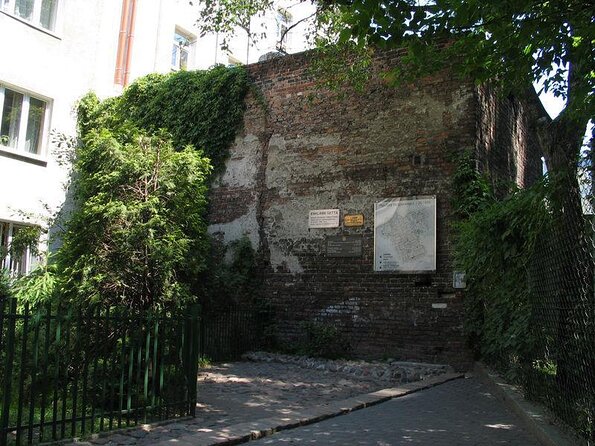
The first stop is a remaining section of the Ghetto Wall, where commemorative plaques help identify the site. You have about 15 minutes here, with no admission charge.
This is a brief stop, but it sets the tone. Warsaw’s Jewish Ghetto was created in 1940, and more than 400,000 Jews were imprisoned there. Today, the wall fragment is surrounded by the living city, which can make the scale of the past difficult to grasp. Your guide’s explanation connects the small surviving section to the much larger sealed district that once occupied this part of Warsaw.
Next comes Chłodna Street, where you see the Footbridge of Memory and the building connected with Adam Czerniakow, head of the Jewish Community Council, known as the Judenrat. The stop lasts about 10 minutes.
The footbridge is an important reminder that the ghetto was divided into smaller sections. It also shows why visual material from the period is so useful. The road looks like a modern city street now, but the guide can point out how movement, separation, and control shaped life here.
This is one of the places where driving alone would not be enough. Without context, you could pass through Chłodna and see only traffic and buildings. With a good explanation, the street becomes evidence of how the ghetto operated.
Muranów and the Former Large Ghetto
The tour then moves into Muranów, the area of the former Large Ghetto. You spend roughly 30 minutes seeing the district and hearing how it changed after the war.
Muranów can be unsettling in a quiet way. Newer apartment buildings, paved streets, and street art now cover much of the former ghetto area. The modern surroundings are not a flaw, but they do make the past less visible. This is exactly where a guide earns the fare by showing what has disappeared and what remains.
The route also includes several smaller points connected with the ghetto, including a street that survived from both sides of the former district. Another stop recalls the departure point for Treblinka, the extermination camp where gas chambers were used. There is also a memorial connected with a group suicide during the Ghetto Uprising.
These are not quick photo opportunities. They require a respectful pace and careful explanation. The tour’s subject is painful, and the best guides described in the feedback handled that material with restraint, clarity, and reverence rather than turning it into spectacle.
The Ghetto Heroes Monument
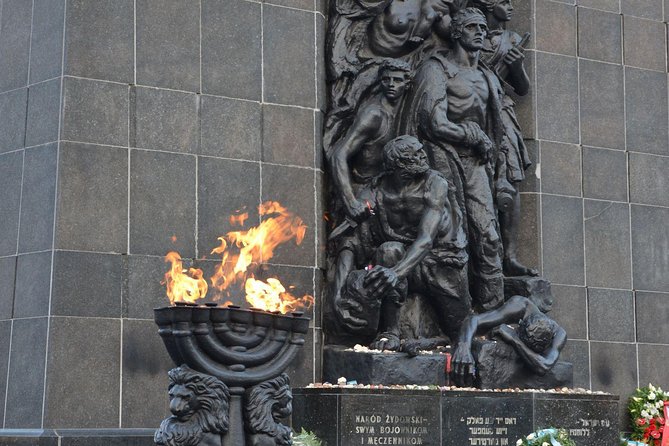
At the Monument to the Ghetto Heroes, you spend about 15 minutes. The monument commemorates the Warsaw Ghetto Uprising of 1943, when Jewish fighters resisted the German destruction of the ghetto.
This is one of the tour’s most important pauses. The monument’s setting gives you space to consider both the uprising and the people who had already endured years of hunger, confinement, deportation, and murder. Your guide can help distinguish between the history of the ghetto’s daily life, the armed uprising, and the later process of remembrance.
The location is also directly beside POLIN Museum of the History of Polish Jews. The museum is viewed from the outside during the tour, but you can choose to enter afterward at your own expense. The guide may leave you there once the driving tour ends, depending on your arrangement.
That option is useful, but do not expect the museum to be part of the four-hour visit itself. POLIN covers more than 1,000 years of Polish Jewish history, while this tour gives greater attention to Warsaw’s streets, memorials, and surviving sites. The two experiences work well together, but they serve different purposes.
If you want the museum, plan your day carefully. A private route focused on wartime Warsaw can prepare you for POLIN, while the museum provides the wider historical frame that a four-hour tour cannot fully supply.
More Retro Car Tours in Warsaw
- Private Tour: Warsaw City Sightseeing by Retro Fiat
★ 5.0 · 562 reviews - Private Historical Tour of Warsaw by a Retro Fiat with Pickup
★ 5.0 · 190 reviews - Warsaw Must-Sees: 4-Hour Private Tour by Retro Fiat
★ 4.9 · 123 reviews - Private Tour: Warsaw’s Communist History by Retro Fiat
★ 5.0 · 115 reviews
Nożyk Synagogue and the Need to Check the Clock
Nożyk Synagogue is the only surviving prewar Jewish house of prayer in Warsaw. The planned stop lasts about 30 minutes, and admission is not included.
This is a valuable counterpoint to the memorials. The tour is not only about destruction. Nożyk Synagogue connects you with Jewish religious life in Warsaw before the war and with the city’s Jewish community today. It remains an active place of worship, so visitors need to behave respectfully and follow site rules.
You may be required to cover your head when visiting some Jewish sites. This is a small practical detail, but it is worth knowing before you arrive.
Timing is the key issue here. The synagogue is closed from Friday evening through Saturday because of the Sabbath. One past booking began at 5 p.m. during summer, when daylight lasted well into the evening, but the synagogue was no longer available. The overall tour was still worthwhile, yet the missed interior visit was a serious disappointment.
My advice is simple: choose a morning or early afternoon departure if entering Nożyk Synagogue matters to you. Ask for clear confirmation of opening times before booking, particularly for Friday and Saturday plans.
The Jewish Cemetery: The Most Quietly Powerful Stop
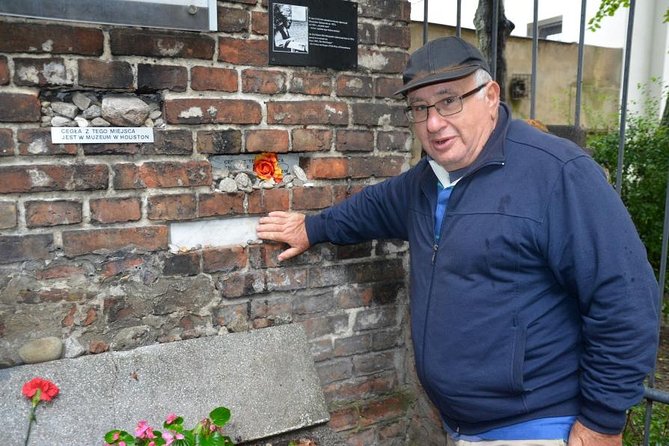
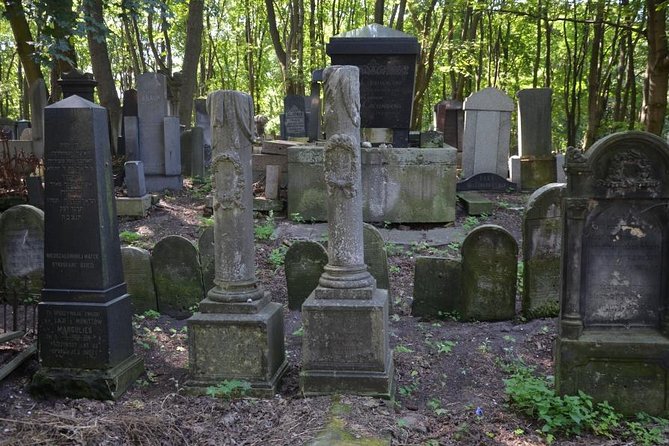
The Jewish Cemetery is scheduled for about 30 minutes, with admission paid separately. It contains the remains of more than 200,000 people, including religious and political leaders, figures from Jewish cultural life, many generations of Warsaw Jews, and unnamed victims of the ghetto.
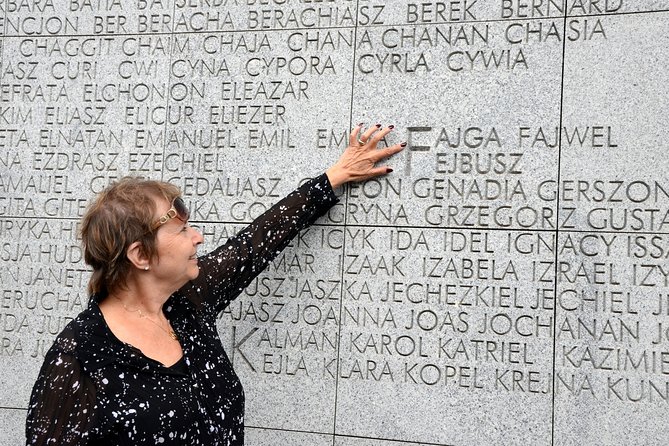
For many people, this becomes the most affecting stop. A cemetery can show the scale of a community in a way a wall fragment cannot. The names, stones, symbols, and older graves connect the wartime story to Jewish Warsaw across generations.
Expect uneven ground and a setting that calls for a slower pace. The point is not to rush from one marker to the next. You may want to ask about particular names, families, or traditions, especially if you have Polish Jewish ancestry.
The cemetery is closed from Friday evening through the whole of Saturday. It may also be unavailable during late tours, so the same timing warning applies as with the synagogue. If these two interiors are priorities, do not book solely around evening daylight.
Admission is not included, but the extra cost can be worthwhile. The cemetery is not something most people would understand fully from a passing visit, and the guide’s explanations help you read what you are seeing.
Film Locations and Family Questions
Because the tour is private, you can ask your guide to include sites linked with The Pianist, the film set in Warsaw during World War II. You can also raise particular family interests or ask to see lesser-known Jewish sites.
This flexibility has real value. One group was able to make an unscheduled stop at Mi Polin, a small shop near a synagogue selling mezuzot made from molds of original doorposts from Jewish homes in Polish towns. That kind of detour will depend on time and the guide’s judgment, but the private format makes such requests possible.
You should tell the operator about special interests before the tour begins. Be specific if you are researching a family name, looking for a certain street, or hoping to focus on the uprising rather than general Warsaw history.
The guides have also been praised for bringing historical photographs. Seeing an old image beside a present-day street can make the changes easier to understand. Ask for this kind of comparison if it is important to you.
Price, Group Size, and What You Receive
At $108.28 per person, the tour is not the cheapest way to see Warsaw. It is also not a standard group bus ride. You receive about four hours of private transport, a professional driver-guide, central hotel pickup and drop-off, and a route built around Jewish heritage sites.
The value improves for a small group. You can ask questions without waiting for a busload of people, and the guide can adjust the order or focus when practical. For groups of four or more, the transport changes to a vintage minivan, so do not book expecting everyone to ride in the Fiat.
Pickup is offered from hotels in central Warsaw. If your hotel is outside the pickup area, contact the provider to find another meeting arrangement. The listed meeting point is the Palace of Culture and Science at Plac Defilad 1, and the activity returns to the starting point.
The tour is offered in English and uses a mobile ticket. Most people can participate, and the route is near public transport, though the experience includes walking at outdoor memorials and the cemetery.
Free cancellation is available up to 24 hours before the start time. Changes or cancellations inside that window are not accepted for a refund.
Who Should Book This Tour
I would choose this tour if you want a focused introduction to Jewish Warsaw and prefer conversation to a large group presentation. It suits anyone interested in World War II, the Warsaw Ghetto Uprising, Jewish family history, or the way a city remembers a destroyed community.
It is also a good first step before visiting POLIN. The car route gives you physical reference points, while the museum can then supply a longer historical account.
You may not need it if you already know Warsaw well, have visited every listed site, and prefer to explore independently. It is also a poor fit for anyone seeking a light sightseeing ride. The Fiat is fun, but the subject is grave and often heartbreaking.
Should You Book the Warsaw Jewish Heritage Fiat Tour?
Yes, if you want a private, serious, and practical way to connect Warsaw’s Jewish history with the city you see today. The best parts are the guide’s personal attention, the cemetery, the surviving synagogue, and the explanations at places that are easy to overlook.
Book early in the day if Nożyk Synagogue and the Jewish Cemetery matter to you. Confirm the route and opening arrangements, mention family or film interests in advance, and remember that four or more people will ride in a minivan.
The retro Fiat is a delightful extra. The real reason to book is the chance to ask questions while moving through the actual streets of Jewish Warsaw, with a guide who can turn scattered remains into a clear and respectful story.
FAQ
How long does the Warsaw Jewish Heritage by Retro Fiat tour last?
The tour lasts approximately four hours.
Is hotel pickup included?
Yes. Hotel pickup and drop-off are included for hotels in central Warsaw. If your hotel is outside the pickup area, you should contact the provider to arrange the best meeting solution.
Is the tour private?
Yes. Only your group participates in the activity.
What vehicle is used for groups of four or more?
Groups of four or more are driven in a vintage minivan instead of the retro Fiat 125p.
Is entry to POLIN Museum included?
No. The museum is viewed from the outside during the tour. Entry is optional and must be paid for separately, and the guide can leave you at the museum after the tour if you choose to visit.
Are the Nożyk Synagogue and Jewish Cemetery always open?
No. Both are closed from Friday evening through the whole of Saturday. Late departures may also miss entry, so choose an earlier start if you want to go inside.
Just added around Warsaw
- Jewish heritage in Warsaw★ 4.5 · 3 reviews
- Warsaw Outdoor Paintball with Transfers (all year round)★ 5.0 · 3 reviews
- World War II Warsaw Old Town, Military Cemetery Walking Tour★ 4.7 · 3 reviews
- Warsaw: Wolf’s Lair & Swieta Lipka Small-Group Tour + Lunch★ 5.0 · 3 reviews
- Sunset Boat Tour with Unlimited Drinks in Warsaw★ 3.5 · 3 reviews
- Majdanek – German camp from II World War – Private Tour – 1 DAY TRIP FROM WARSAW★ 5.0 · 3 reviews
- From Warsaw: Guided Tour to Wieliczka Salt Mine and Krakow★ 4.5 · 3 reviews
- Warsaw Sightseeing with NEW Mercedes Sclass !!!★ 5.0 · 3 reviews
Historical Tours, compared.


POLIN Museum of the History of Polish Jews Ticket
Read our review →

Gdańsk City Sights & History Guided Walking Tour in English
Read our review →


Small-Group Historical Guided Tour of Warsaw with pick up/drop off. Public Tour.
Read our review →Browse the lists this tour appears in