
REVIEW · HISTORICAL TOURS
Historical Walking Tour of Jewish Warsaw
Warsaw’s past is written in fragments. This three-hour walk links the remaining traces of Jewish Warsaw with the places where the former ghetto once stood, making a difficult subject easier to understand on foot. I especially like the small groups of no more than 10 people and the use of old maps, photographs, and other visual aids. The tour also earns points for its careful route, which includes both famous memorials and easy-to-miss sites.
The main drawback is simple: you walk a long way. Much of the ghetto was destroyed, so this is not a tour of preserved streets and intact buildings. You need sturdy shoes, and an umbrella is sensible. At $28.87 per person, the price is fair for three hours of guiding, but the value depends on whether you want context and memorials rather than a large number of historic buildings.
In This Review
- Key points to know before you book
- Starting at Sienna 53 with Warsaw before the war
- Nożyk Synagogue, a rare surviving building
- The ghetto wall fragment and the power of small remains
- Two hours through the former Warsaw ghetto
- Monuments, resistance, and the city’s memory
- Ending at Umschlagplatz
- What the guides add to the experience
- Walking conditions and how to prepare
- Is $28.87 a fair price?
- Who should book this walk?
- Should you book the Historical Walking Tour of Jewish Warsaw?
- FAQ
- Where does the tour begin?
- Where does the tour end?
- How long does the walking tour last?
- What language is the tour offered in?
- Is the Nożyk Synagogue entry fee included?
- How many people can join the tour?
- Is the tour suitable for people with limited mobility?
- Can I cancel for a full refund?
Key points to know before you book
- A three-hour route connects Sienna Street with Umschlagplatz, covering much of the former Jewish ghetto on foot.
- Nożyk Synagogue is the only Warsaw synagogue to survive the war and still function as a historic place of worship.
- Maps, photographs, and visual aids help fill in what no longer exists, especially in the former ghetto.
- Guides such as Aga, Agnieszka, and Oliwia receive especially strong praise for clear English, warmth, and careful historical explanation.
- The tour includes the ghetto wall fragment, Mila 18, the Ghetto Heroes Memorial, and Umschlagplatz, among other important locations.
- The walk suits people interested in World War II and Jewish Warsaw, but it is not ideal if long walks or cobblestones are difficult.
Starting at Sienna 53 with Warsaw before the war
The meeting point is at Sienna 53, on the corner with Jana Pawła II Avenue, outside Baguette Mi, a banh mi bistro. This is a practical starting place near public transportation, and the short introduction gives you a chance to get oriented before the serious walking begins.
That opening matters because Jewish Warsaw can be hard to picture today. Modern streets, apartment blocks, traffic, and postwar construction cover much of the former district. The guide’s role is not simply to point at a monument. It is to explain what stood here before the war, how Jewish life fitted into the city, and how occupation changed the area.
I like that the route begins with background rather than rushing straight to a memorial. You get a better sense of the city as a living place, not only as a site of wartime suffering. The supplied information pack, with frequently asked questions and useful links, can also help you prepare before arriving.
More History Tours in Warsaw
- Warsaw: POLIN Museum of the History of Polish Jews Ticket
★ 4.7 · 1,142 reviews - Warsaw: Chopin Concert at Historical Venue in Old Town
★ 4.7 · 445 reviews - Small-Group Historical Guided Tour of Warsaw with pick up/drop off. Public Tour.
★ 4.5 · 343 reviews
Nożyk Synagogue, a rare surviving building
The next stop is Nożyk Synagogue, the only Warsaw synagogue that survived the war and remains today. You have about 10 minutes here, and admission is not included in the tour price. The entry fee is 20 PLN.
This is one of the most valuable stops for anyone who wants to see an actual prewar Jewish building rather than only a monument or a modern marker. The synagogue gives the route a physical connection to the Jewish community that existed before the destruction of the ghetto.
You should bring cash or otherwise be ready to pay the separate entrance fee, since it is the only specific admission cost listed for the experience. The stop is short, so do not expect a long interior visit. Its importance comes from the fact that the building survived when so much else was lost.
The ghetto wall fragment and the power of small remains
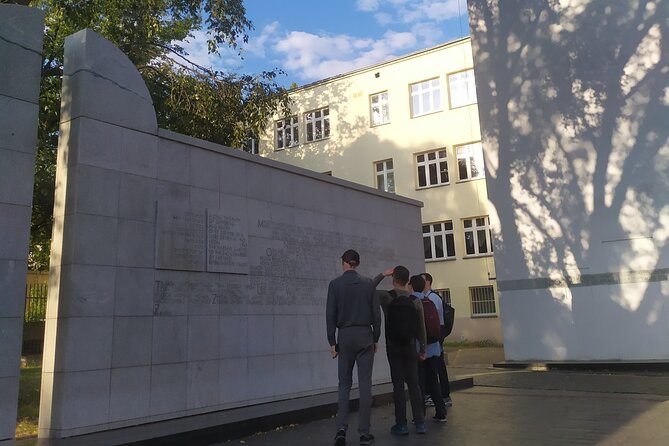
The tour then reaches one of the few surviving pieces of the Warsaw ghetto wall. You spend roughly 15 minutes here. Admission is free, but the site is easy to miss without a guide.
This is a good example of why a walking tour helps. A small section of wall may not look dramatic at first glance, especially beside modern Warsaw, but its meaning changes once you understand its purpose and the lives confined behind it. The guide uses visual material to show how the wall fitted into the wider ghetto.
If you expect a vast preserved stretch of wall, adjust your expectations. The surviving fragment is modest. Its value lies in the contrast between its size today and the scale of the system it represents.
Two hours through the former Warsaw ghetto
The longest part of the route takes about two hours and five minutes. This is where the tour earns its price. Instead of concentrating on one or two famous memorials, it moves through a broad section of the former ghetto and connects many separate reminders of wartime Jewish life.
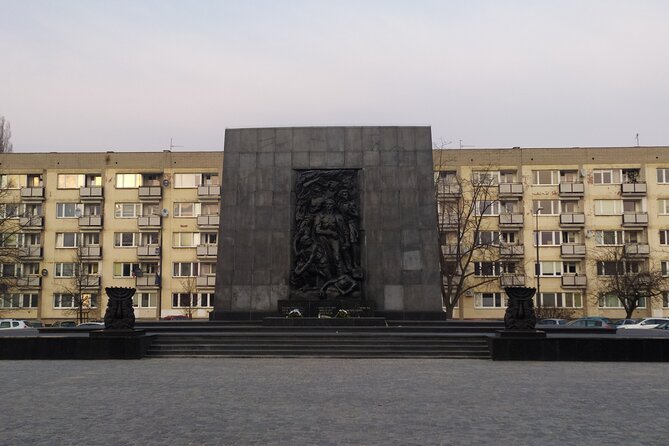
You see the Jewish Ghetto Memorial and the Heroes of the Jewish Ghetto Memorial, two places that mark resistance, loss, and remembrance. The route also includes Miła 18, associated with the bunker of Jewish resistance leader Mordechai Anielewicz. These sites are central to understanding the Warsaw Ghetto Uprising and the final stages of the ghetto’s destruction.
The walk also points out the courthouse on Solidarności Street, the Muranów residential district, and the area where the Ringelblum Archive was discovered. The archive is especially important because it preserved first-hand accounts and documents created by people inside the ghetto. The guide’s maps and photographs help you connect those records to the streets beneath your feet.
You also see the Church of St. Augustine. The route does not present Jewish Warsaw as a sealed-off story separate from the rest of the city. It shows how surrounding buildings and institutions fit into the wartime setting, while also explaining the difficult relationship between Polish society, German occupation, and the Jewish population.
I appreciate this wide approach. You are not only shown where people were imprisoned or killed. You learn about daily life, the physical boundaries of the ghetto, acts of resistance, and the ways modern Warsaw now marks the past.
At the same time, this section demands attention. The walk includes long stretches between stops, and the subject is emotionally heavy. The best guides, including Aga, Agnieszka, and Oliwia, are praised for presenting painful material with humanity and restraint. Their approach seems factual without turning the tour into a dry lecture.
One point deserves careful handling. The tour explains that the concentration camps were German camps, which is an accurate historical distinction. It also addresses Poland’s experience under German occupation and the suffering of Polish civilians. The subject of Polish responsibility, resistance, collaboration, and victimhood is complex, and a three-hour walk cannot settle every argument. You should see this tour as a structured introduction, not a substitute for the POLIN Museum or serious reading.
More Walking Tours in Warsaw
- Warsaw: Old Town Highlights Walking Tour in English
★ 4.7 · 1,516 reviews - Warsaw: Old Town Guided Walking Tour
★ 4.9 · 599 reviews - Half-Day Polish Food Walking Tour with Guide and Dinner
★ 4.5 · 381 reviews - Warsaw: Warsaw Ghetto Private Walking Tour with Hotel Pickup
★ 4.9 · 369 reviews
Monuments, resistance, and the city’s memory
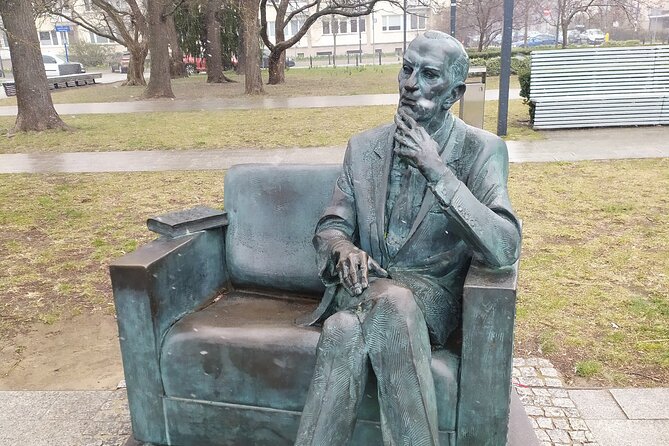
The stop at the Ławeczka Jana Karskiego takes about 15 minutes and includes several monuments connected with the Jews’ struggle in the ghetto. Jan Karski is remembered for reporting on the Holocaust and for carrying information about the destruction of Polish Jewry to the outside world.
The bench is part of a wider set of memorials that ask you to consider how Warsaw remembers people who resisted, documented, or tried to reveal what was happening. This section can be especially useful if you already know the basic wartime chronology and want to connect individual figures with the city’s memorial spaces.
The route’s many markers can feel scattered if you explore alone. A guide gives them order. You are shown not just a statue or plaque, but how it relates to the surrounding streets and to other sites visited earlier in the walk.
Ending at Umschlagplatz
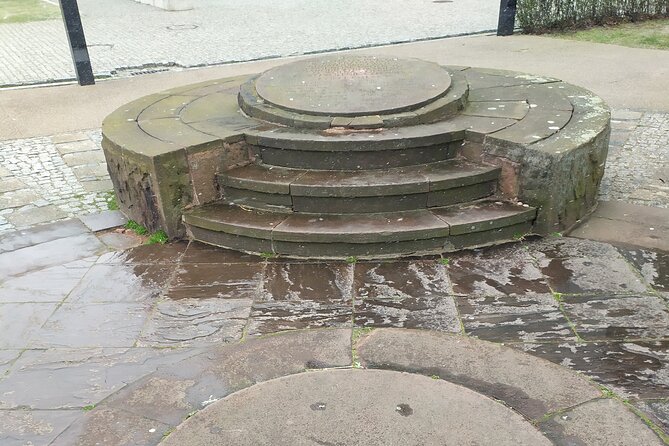
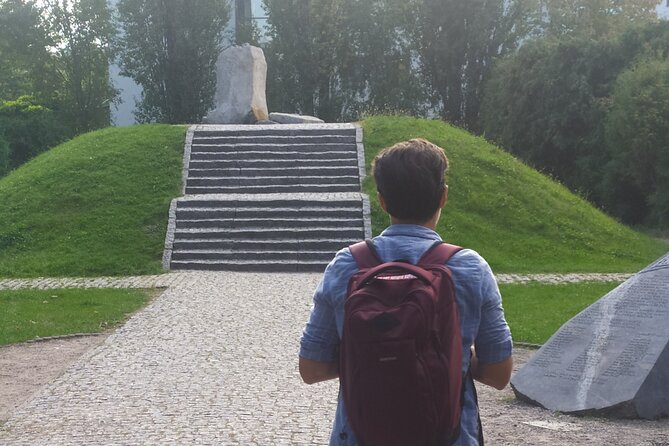
The walk ends at the Umschlagplatz Monument on Stawki 10. You spend about 10 minutes here. This was the place from which approximately 300,000 Jews were transported to Treblinka.
The ending is direct and solemn. After walking through the former ghetto and seeing places linked with resistance and daily life, you arrive at the point associated with deportation. The route therefore moves from the city before the war, through confinement and resistance, to mass removal and murder.
Ending here also makes the tour practical for the rest of your day. You finish at a clearly marked monument rather than returning to the starting point. You can continue to another Warsaw sight from there, although you should allow yourself some quiet time after such a serious visit.
What the guides add to the experience
The strongest feature of this experience is the guiding. Aga and Agnieszka are described as friendly, clear, and well prepared, while Oliwia receives special praise for her command of the subject and her personal connection to Warsaw. Several guides use photographs and maps during the walk, which is vital in an area where many original buildings no longer exist.
The guides also seem willing to tailor the experience within reason. One guide helped a late-arriving participant find the group after a navigation mistake, and another helped someone reach the correct tram after the tour. Those small acts matter when you are in an unfamiliar city.
Do not expect theatrical performance. This subject calls for care rather than forced excitement. A good guide here should be precise, compassionate, and able to answer difficult questions. The strongest accounts describe exactly that balance.
There is one less favorable experience in the supplied material: a participant found the guide defensive and insufficiently expressive about the Holocaust and Poland’s role. That concern points to a real issue. Historical interpretation can feel different depending on your expectations, family background, and prior reading. If you want an openly emotional presentation, ask questions during the walk and judge the guide’s tone for yourself. If you prefer documents, dates, and a measured explanation, the factual approach may suit you better.
Walking conditions and how to prepare
Plan on three hours outdoors, with substantial walking between stops. Some streets may be cobbled, and the route is not recommended for people who have trouble walking long distances.
Wear sturdy, comfortable shoes. Bring water and an umbrella, since the walk continues in changing weather. The group size is capped at 10, which makes it easier to hear the guide and pause for photographs without losing the group.
The route is not described as difficult in a technical sense, but its length can be tiring. Several short pauses are built into the experience, and guides are praised for keeping a steady pace. Still, you should not schedule too many other walking-heavy activities on the same day.
A museum visit can complement this tour, especially POLIN, but doing both in one day may leave you on your feet for hours. I would choose the walking tour first if you want to understand the city’s streets. Then visit a museum on another day when you can give the indoor exhibits your full attention.
Is $28.87 a fair price?
At $28.87 per person, this is reasonably priced for a small-group, English-language tour lasting about three hours. The price includes the guide, visual aids, a pre-tour information pack, and recommendations for other places to visit, eat, and drink.
You also get a route that covers a large section of the former ghetto. A cheaper self-guided visit may be possible, but you would need to research the sites, find the surviving wall fragment, understand the memorials, and bring your own maps and photographs. The tour’s value lies in the connections between places.
The separate 20 PLN synagogue entry is modest, but remember to add it to your budget. There are no other entrance fees listed. Free cancellation is available up to 24 hours before the start time, which gives you useful flexibility when planning a Warsaw itinerary.
Who should book this walk?
I would recommend it to you if you want a serious introduction to Jewish Warsaw, World War II, the Warsaw Ghetto Uprising, and the city’s memorials. It is also a strong choice if you have read books or seen films about the ghetto but want to understand how the story fits into the modern city.
You may prefer another activity if you mainly want preserved historic architecture. Much of the ghetto was destroyed, and some stops are memorials, fragments, or modern streets rather than intact buildings. If you want exhibits, artifacts, and indoor displays, add POLIN rather than treating this walk as a replacement.
The experience is best for people who can walk steadily for three hours and remain engaged with a difficult subject. Families with older children may find it worthwhile, but the emotional weight and distance should be considered carefully.
Should you book the Historical Walking Tour of Jewish Warsaw?
Book it if you want the city itself to serve as the classroom. The guide links Nożyk Synagogue, the wall fragment, Miła 18, the major memorials, Muranów, and Umschlagplatz into one clear story. At a fair price and with a group limited to 10, it offers more personal attention than a large coach tour.
Skip it if you want a short outing or a collection of preserved buildings. This is a long, sober walk through absence as much as through surviving places. For the right visitor, that is precisely its strength.
FAQ
Where does the tour begin?
The tour begins at Sienna 53, 00-820 Warszawa, on the corner with Jana Pawła II Avenue, near Baguette Mi.
Where does the tour end?
It ends in front of the Umschlagplatz Monument at Stawki 10, 00-178 Warszawa.
How long does the walking tour last?
The experience lasts approximately three hours.
What language is the tour offered in?
The tour is offered in English.
Is the Nożyk Synagogue entry fee included?
No. Entry to Nożyk Synagogue costs 20 PLN and is not included in the tour price.
How many people can join the tour?
The maximum group size is 10 people.
Is the tour suitable for people with limited mobility?
It is not recommended for people who have problems walking long distances. The route lasts about three hours and may include cobblestone streets.
Can I cancel for a full refund?
Yes. You can cancel at least 24 hours before the experience start time for a full refund. Changes or cancellations made less than 24 hours before the start time are not accepted for a refund.
Just added around Warsaw
- Jewish heritage in Warsaw★ 4.5 · 3 reviews
- Warsaw Outdoor Paintball with Transfers (all year round)★ 5.0 · 3 reviews
- World War II Warsaw Old Town, Military Cemetery Walking Tour★ 4.7 · 3 reviews
- Warsaw: Wolf’s Lair & Swieta Lipka Small-Group Tour + Lunch★ 5.0 · 3 reviews
- Sunset Boat Tour with Unlimited Drinks in Warsaw★ 3.5 · 3 reviews
- Majdanek – German camp from II World War – Private Tour – 1 DAY TRIP FROM WARSAW★ 5.0 · 3 reviews
- From Warsaw: Guided Tour to Wieliczka Salt Mine and Krakow★ 4.5 · 3 reviews
- Warsaw Sightseeing with NEW Mercedes Sclass !!!★ 5.0 · 3 reviews
Historical Tours, compared.


POLIN Museum of the History of Polish Jews Ticket
Read our review →

Gdańsk City Sights & History Guided Walking Tour in English
Read our review →


Small-Group Historical Guided Tour of Warsaw with pick up/drop off. Public Tour.
Read our review →Browse the lists this tour appears in