
REVIEW · HISTORICAL TOURS
Warsaw Praga Guided Historical Walking Tour
Praga rewards curious walkers. This 2.5-hour tour brings you into Warsaw’s eastern district through industrial landmarks and local streets, not just postcard sights. I like the small maximum of 10 people, and I like that guides such as Oliwia connect the past with modern issues such as gentrification and displacement. The main consideration is that the walk is in English, and the Polish Vodka Museum costs extra.
The route is especially appealing if you want more than Warsaw’s rebuilt Old Town. Guides have been praised for a relaxed pace, useful food and shopping advice, and a willingness to answer questions. Mobility can be accommodated to some degree, but this remains a long urban walk, with about 90 minutes devoted to Praga Północ.
In This Review
- Key points to know before you book
- Why Praga makes a worthwhile half-day walk
- Starting at Strzelecka 46
- Koneser and the old vodka factory
- Ząbkowska Street, cafes and old facades
- Praga Północ’s long central section
- A thoughtful look at change in Praga
- St. Mary Magdalene and the Orthodox story
- Finishing at St. Florian’s Cathedral
- What the small group and guide add
- Language, timing and booking details
- Who should choose this walk?
- Should you book the Warsaw Praga walk?
- FAQ
- Where does the Warsaw Praga Guided Historical Walking Tour start?
- Where does the tour finish?
- How long does the tour last?
- What language is the tour offered in?
- How much does the tour cost?
- Is admission to the Polish Vodka Museum included?
- What does the tour include besides the walking route?
- How many people can join the tour?
- Is the tour suitable for people with mobility difficulties?
- What is the cancellation policy?
Key points to know before you book

- Praga beyond the postcard route: See old factories, film locations, street art, religious buildings, and everyday neighborhood streets.
- A genuinely small group: The tour accepts no more than 10 people, which leaves room for questions and a slower pace.
- Strong local storytelling: Oliwia and Aga have been praised for personal, detailed explanations and practical recommendations.
- The vodka museum is optional: The walking tour includes the old Koneser factory area, but entrance to the Polish Vodka Museum costs 70 PLN.
- A useful finish for sightseeing: The tour ends by St. Florian’s Cathedral, close to buses, trams, and the metro.
- English only on this booking: Other languages may be possible only if available, so check the language carefully before paying.
Why Praga makes a worthwhile half-day walk
Warsaw’s Praga district sits across the Vistula River from the historic center. It has a different feel from the carefully restored Old Town and the monumental streets around the Royal Route. Here, old industrial buildings, worn facades, creative spaces, churches, murals, and ordinary residential streets share the same few blocks.
That mix is the reason to take this walk. You are not simply ticking off famous buildings. You are getting a framework for understanding how Praga has changed, and how those changes affect people who live there.
I particularly like that the tour does not present every new cafe or renovated building as an unquestioned success. Oliwia has been praised for discussing dispossession and gentrification, along with the more cheerful side of redevelopment. That balance gives you a more useful picture of the district.
The price is $28.68 per person. For 2.5 hours with a guide, visual aids, a pre-tour information pack, and suggestions for further places to eat and visit, that is a fair price. You are paying mainly for interpretation and access to a small group, not for entrance tickets. Since nearly all of the route is outdoors and admission is free at the listed stops, the value depends on how much you want context and local guidance.
The experience has a 4.5 rating from 21 reviews, with 90 percent recommending it. That is a good signal, though the sample is not huge. The praise is strongest for the guides, pacing, personal stories, and depth of explanation.
More History Tours in Warsaw
- Warsaw: POLIN Museum of the History of Polish Jews Ticket
★ 4.7 · 1,142 reviews - Warsaw: Chopin Concert at Historical Venue in Old Town
★ 4.7 · 445 reviews - Small-Group Historical Guided Tour of Warsaw with pick up/drop off. Public Tour.
★ 4.5 · 343 reviews
Starting at Strzelecka 46
The walk begins at Strzelecka 46 with a short introduction to Praga. This opening lasts only about five minutes, so it is not a long historical lecture before you start moving.
That brief introduction matters because Praga can seem confusing at first. The guide helps you understand the district as a place shaped by old industry, wartime survival, religious communities, and recent redevelopment. You will then have a clearer lens for the streets and buildings ahead.
The meeting point is near public transportation, but the tour details do not specify the best route from your hotel. I would allow a little extra time to reach Strzelecka 46, especially if you are unfamiliar with Warsaw’s transit system.
The group size is capped at 10. That is one of the tour’s strongest practical features. A guide can usually hear questions more easily in a group this size, and you are less likely to spend the whole walk at the back of a crowd.
Koneser and the old vodka factory
The next stop is Centrum Praskie Koneser, the former vodka factory. You spend about 15 minutes here, looking at the original industrial architecture and hearing stories tied to the site.
The tour does not include entry to the Polish Vodka Museum. Admission costs 70 PLN, so you should treat the museum as a separate option rather than part of the $28.68 experience. The walking tour gives you the setting and the stories, while the museum requires extra time and money.
Koneser is a useful example of Praga’s changing identity. An old industrial site now serves as a cultural and commercial area, and that contrast helps explain the broader changes taking place in the district. The guide’s slightly tipsy tales add humor without turning the stop into a simple drinking-themed detour.
If you want to visit the museum, ask about timing before the walk begins. The listed route allows only 15 minutes at Koneser, so you should not assume there will be time for a full museum visit during the scheduled tour.
Ząbkowska Street, cafes and old facades
The walk continues along Ząbkowska, described as Praga’s most popular street. You spend about 20 minutes here, seeing cafes, older architecture, and places tied to neighborhood stories.
This is a good point to pay attention to the gap between appearance and meaning. A cafe-lined street can look like a simple leisure district, but the older buildings and guide’s explanations add the social and historical background that you would probably miss on your own.
The included recommendations for places to eat and drink are useful here. You can ask the guide for suggestions that fit the rest of your visit, rather than choosing a place at random after the tour.
Do not expect a long cafe stop. The 20 minutes are part of a moving walking tour, not a scheduled break with food included. Wear comfortable shoes and bring water, particularly in warm weather.
More Walking Tours in Warsaw
- Warsaw: Old Town Highlights Walking Tour in English
★ 4.7 · 1,516 reviews - Warsaw: Old Town Guided Walking Tour
★ 4.9 · 599 reviews - Half-Day Polish Food Walking Tour with Guide and Dinner
★ 4.5 · 381 reviews - Warsaw: Warsaw Ghetto Private Walking Tour with Hotel Pickup
★ 4.9 · 369 reviews
Praga Północ’s long central section
The largest part of the tour lasts about 90 minutes in Praga Północ. This is where the experience earns its price. Instead of rushing through one or two headline attractions, you move through several streets and sites that show different sides of the district.
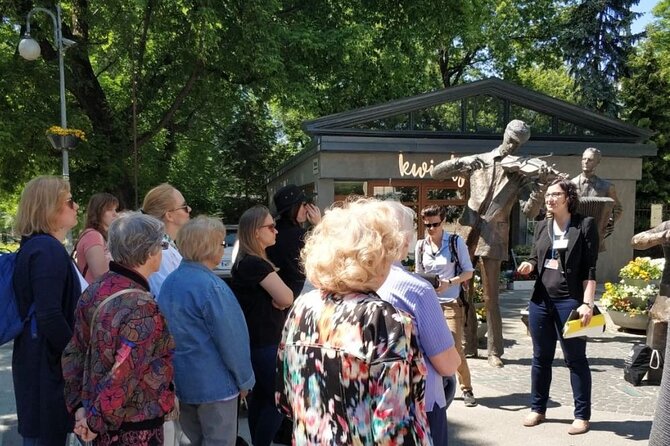
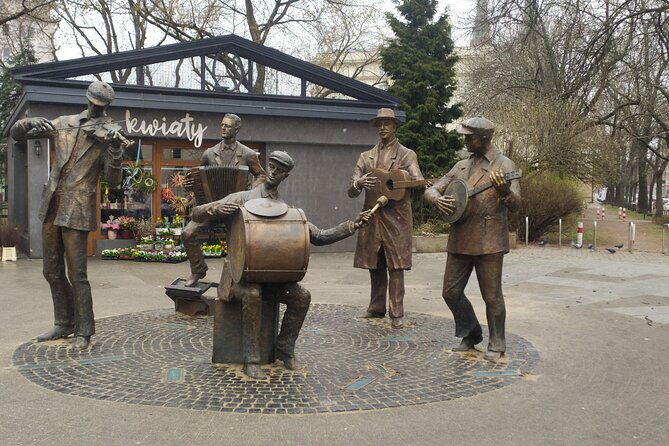
The route includes Szwedzka Street, Konopacki Palace, walls covered with well-known street art, Stalowa Street, the remains of a horse-drawn tram depot, and a memorial to a street band. Each stop gives the guide another way to explain Praga’s identity.
Stalowa Street is known as the street of films. That detail adds an entertaining angle to the walk, but it also shows how the area’s older streets have been used to represent Warsaw in popular culture. The remains of the horse-drawn tram depot offer another reminder that the district once depended on transport systems very different from today’s buses, trams, and metro.
The street art is likely to appeal to visitors who want something beyond formal museums and churches. Murals can change, so the exact works may not always be the same, but the walls are part of the district’s current visual character. The guide’s role is important here because the route links newer art with older buildings and local stories.
The street band memorial is a small detail, yet these are often the things that make a neighborhood walk memorable. It gives you a human-scale connection to Praga, rather than only grand architecture.
Konopacki Palace adds another architectural marker to the route. You should not expect a lengthy interior visit, since the scheduled experience is an outdoor walk and all listed admissions are free. The value comes from seeing the building in its street setting and learning why it matters.
A thoughtful look at change in Praga
One of the best reasons to choose this tour is the way it handles change. Praga has become more attractive to visitors, businesses, and developers, but improvement is not experienced in the same way by everyone who lives there.
Oliwia has received particular praise for including local feelings about dispossession and gentrification. That is important because a tour can easily turn an old neighborhood into a backdrop for charming cafes and photogenic walls. Here, you get a chance to think about who benefits from redevelopment and what may be lost.
Her personal connection to Warsaw has also been praised. One description of the walk valued the way she linked her own experiences growing up in the city to the places along the route. That kind of detail can make a street feel less like a display and more like part of a living community.
Aga, another guide associated with the tour, has been praised for a well-judged pace and depth of information. The guide you receive may vary, but the most positive feedback points to a style that is informed, friendly, and open to questions.
St. Mary Magdalene and the Orthodox story
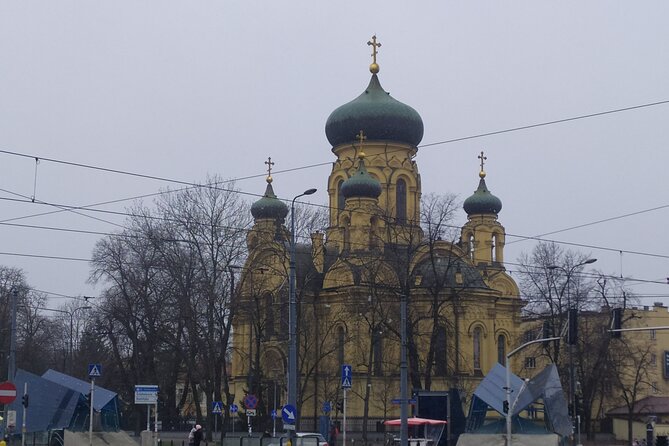
The route then reaches Warsaw’s Metropolitan Cathedral of St. Mary Magdalene. You spend about 10 minutes seeing this Russian Orthodox cathedral, described as one of the few Russian Orthodox sites left in Warsaw.
This stop broadens the story beyond Polish Catholic landmarks. Religious buildings often reveal political and cultural ties that are not obvious from a quick look at the facade. A guide can explain why this cathedral matters in Warsaw and how it fits into the city’s complicated past.
The scheduled stop is short, so think of it as an introduction rather than a full architectural visit. The tour data does not promise interior access, a service, or a detailed museum-style examination. If you are especially interested in Orthodox architecture, ask the guide what you can see and what should be visited separately.
Finishing at St. Florian’s Cathedral
The final stop is the Cathedral of St. Michael the Archangel and St. Florian the Martyr on Floriańska Street. The tour ends in front of the cathedral after about 10 minutes there.
This gives the walk a clear finish and leaves you in a useful part of Praga. Buses, trams, and the metro are easily accessible from the end point, so you can continue sightseeing without arranging a taxi or retracing the route.
The cathedral also provides a strong closing contrast with St. Mary Magdalene. You have seen two important religious sites connected with different traditions, then finish beside a major Catholic cathedral. The route does not treat Praga as culturally one-dimensional.
Because the walk ends at a transit-connected location, you can use the guide’s recommendations immediately. Ask where to eat, which nearby places deserve more time, or how to continue toward other parts of Warsaw.
What the small group and guide add
A 10-person limit changes the feel of a history walk. It is easier to ask about a detail on a wall, stop briefly for a photograph, or explain that someone in your party needs a slower pace.
One family specifically praised Oliwia for accommodating a relative with mobility difficulties while also answering many questions. That is encouraging, but it does not mean the walk is fully accessible or effortless for every participant. The route lasts 2.5 hours and includes a long section on city streets, so contact the operator if your mobility needs are significant.
The tour allows service animals and is near public transportation. Most people can participate, according to the supplied details. There is no stated maximum age or fitness requirement, but sensible shoes remain a good idea.
The visual aids are another useful inclusion. Historical districts can be hard to read when buildings have changed or disappeared. A photograph, map, or other visual reference can help you connect the present street with its earlier form.
Language, timing and booking details
This experience is offered in English. That point deserves careful attention because one unhappy booking resulted from a request for Spanish when the reservation was made for the English tour. Other languages may be possible only if available, and the supplied information says Spanish was not available for that booking.
Check the language shown at checkout and read any messages sent after booking. Do not assume that requesting another language guarantees a guide in that language.
The tour is often booked 28 days ahead. That does not prove every date sells out, but it suggests that booking before your visit is sensible, particularly if you want a specific day or a small group.
Confirmation arrives at booking. Cancellation is free up to 24 hours before the start time. Cancellations or changes made less than 24 hours before the tour are not accepted for a refund, and cut-off times use Warsaw’s local time.
Who should choose this walk?
I would recommend it to you if you have already seen Warsaw’s central sights and want a district with a different pace and visual character. It also suits first-time visitors who want a guide to explain why Praga matters instead of wandering without context.
The walk is a good match for:
- People interested in urban change, architecture, and local stories
- Visitors who prefer a small group to a large coach tour
- Families who value a patient guide and the chance to ask questions
- Photographers and film fans drawn to street art and older streets
- Anyone who wants food and drink suggestions for the rest of a Warsaw stay
It may not suit you if you want a museum-heavy outing, a food tour, or a Spanish-language experience. It also may disappoint if you expect every historic building to be open for interior visits. Most of the value comes from walking, listening, and noticing the district as a whole.
Should you book the Warsaw Praga walk?
Yes, if you want context rather than a checklist. The fair price, small group, useful visual aids, and strong praise for Oliwia and Aga make this a practical way to spend a half-day in Praga.
I would book it before arrival, confirm that your reservation is in English, and plan the Polish Vodka Museum separately if it interests you. Choose this tour for its local perspective and honest discussion of change, not because it includes paid attractions or grand interiors.
FAQ
Where does the Warsaw Praga Guided Historical Walking Tour start?
It starts at Strzelecka 46 in Warsaw, Poland.
Where does the tour finish?
The walk finishes in front of the Cathedral of St. Michael the Archangel and St. Florian the Martyr at Floriańska 3.
How long does the tour last?
The tour lasts approximately 2 hours and 30 minutes.
What language is the tour offered in?
The tour is offered in English. Other languages may be possible only subject to availability.
How much does the tour cost?
The listed price is $28.68 per person.
Is admission to the Polish Vodka Museum included?
No. Entrance to the Polish Vodka Museum is not included and costs 70 PLN.
What does the tour include besides the walking route?
You receive an information pack about Warsaw before the tour, visual aids, and recommendations for other places to visit, eat, and drink.
How many people can join the tour?
The maximum group size is 10 travelers.
Is the tour suitable for people with mobility difficulties?
Most people can participate, and a guide has accommodated a family member with mobility difficulties at a slower pace. The tour is still a 2.5-hour city walk, so contact the provider about specific needs.
What is the cancellation policy?
You can cancel for a full refund up to 24 hours before the experience starts. Changes or cancellations made less than 24 hours before the start time are not accepted for a refund.
Just added around Warsaw
- Jewish heritage in Warsaw★ 4.5 · 3 reviews
- Warsaw Outdoor Paintball with Transfers (all year round)★ 5.0 · 3 reviews
- World War II Warsaw Old Town, Military Cemetery Walking Tour★ 4.7 · 3 reviews
- Warsaw: Wolf’s Lair & Swieta Lipka Small-Group Tour + Lunch★ 5.0 · 3 reviews
- Sunset Boat Tour with Unlimited Drinks in Warsaw★ 3.5 · 3 reviews
- Majdanek – German camp from II World War – Private Tour – 1 DAY TRIP FROM WARSAW★ 5.0 · 3 reviews
- From Warsaw: Guided Tour to Wieliczka Salt Mine and Krakow★ 4.5 · 3 reviews
- Warsaw Sightseeing with NEW Mercedes Sclass !!!★ 5.0 · 3 reviews
Historical Tours, compared.


POLIN Museum of the History of Polish Jews Ticket
Read our review →

Gdańsk City Sights & History Guided Walking Tour in English
Read our review →

Small-Group Historical Guided Tour of Warsaw with pick up/drop off. Public Tour.
Read our review →Browse the lists this tour appears in