
REVIEW · JEWISH QUARTER & GHETTO TOURS
Kazimierz District, the Wawel Hill and Cracow Old Town
Krakow’s story unfolds on foot. This four-hour private walking tour links the former Jewish district, Wawel Hill, the university quarter, the Old Town, and the Barbican in one well-planned route. I like the wide sweep of the itinerary, which gives you a useful first look at Krakow, and I like the whisper system, which helps you hear the guide clearly while walking through busy streets and open squares.
The tour also earns praise for its guides. Marta is singled out for being friendly, helpful, and clear, with the skill to explain a great deal in one morning without losing sight of the clock. The main consideration is pace: several major sites are included in about four hours, while entry fees for Remuh Synagogue, Wawel Cathedral, and St Mary’s Basilica are extra.
In This Review
- Key points at a glance
- Why this four-hour route works well
- Szeroka Street and Remuh Synagogue
- Kazimierz streets, Nowy Square and a film location
- Wawel Hill and the Renaissance royal courtyard
- Wawel Cathedral and Poland’s royal past
- Kanonicza, Grodzka and the Franciscan Basilica
- Collegium Novum and Jagiellonian University
- Krakow’s Main Market Square and the Cloth Hall
- St Mary’s Basilica and the hourly Hejnał
- Floriańska Street, Saint Florian’s Gate and the Barbican
- What the $65 price really covers
- Who should book this walking tour?
- Final verdict: a strong Krakow introduction with paid extras
- FAQ
- Where does the tour start?
- Where does the tour end?
- How long does the experience last?
- Is this a private tour?
- Are admission tickets included?
- Is transportation provided?
- Can I cancel for a full refund?
Key points at a glance
- Three Krakow districts in four hours: Walk from Kazimierz through Wawel Hill and into the medieval Old Town.
- A private experience: Only your own group takes part, rather than joining a large general tour.
- Important interiors cost extra: Remuh Synagogue, Wawel Cathedral, and St Mary’s Basilica are optional paid visits.
- A guide-led historical route: The walk connects Jewish Krakow, Polish royal history, Catholic landmarks, and university life.
- A smart first-day choice: The route covers many major sights and ends near the Barbican and Floriańska Street.
- Practical footwear matters: This is a long city walk and is not recommended for people with impaired mobility.
Why this four-hour route works well
Krakow is compact enough to explore on foot, but its story is not simple. The city’s Jewish quarter, royal hill, medieval market, university buildings, churches, and defensive walls each tell a different part of the past. This tour puts those pieces into one continuous walk rather than treating them as isolated photo stops.
I like the route because it begins in Kazimierz, the former Jewish district, then moves toward Wawel and the Old Town. That direction gives you a natural sense of how Krakow developed. You start with a neighborhood shaped by Jewish religious and civic life, continue to the royal center, and finish in the medieval commercial heart.
The tour lasts about four hours and starts at 9:30 a.m. at Szeroka 40. It finishes near the Krakow Barbican on Basztowa, close to the Old Town’s northern edge. Since there is no private transportation, you should expect a continuous walking experience, not a vehicle-assisted sightseeing tour.
The format is private, so only your group participates. That matters if you want to ask questions, adjust the pace when possible, or spend a little longer on a particular subject. Group discounts are listed, although the private format means you should check the final price for your party before booking.
More Old Town Walking Tours in Kraków
- Old Town Krakow & Wawel Castle Walking Tour
★ 5.0 · 1,508 reviews - Krakow: Bike Tour of Old Town, Jewish Quarter and the Ghetto
★ 4.9 · 1,155 reviews - Krakow: The Old Town Walking Tour
★ 4.8 · 794 reviews
Szeroka Street and Remuh Synagogue
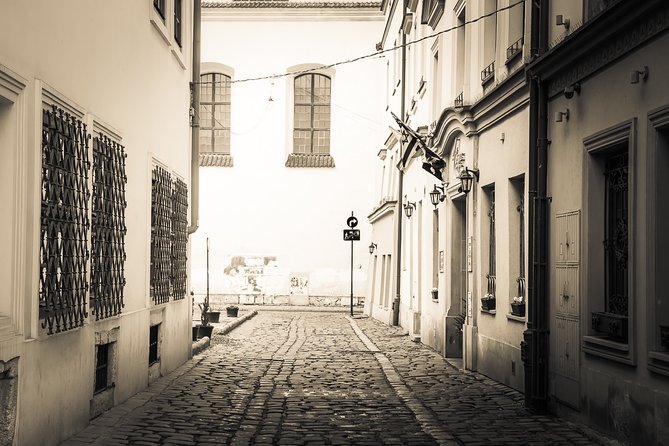
The morning begins on Szeroka Street, the former center of Jewish religious, cultural, and political life in Kazimierz. This is a strong starting point because the neighborhood gives you more than old façades. It introduces a major part of Krakow’s identity and sets up the contrast between Jewish Kazimierz and the royal and Catholic landmarks later in the walk.
The optional visit to Remuh Synagogue adds a focused look at 16th-century Jewish Krakow. Its adjacent cemetery is one of the oldest Jewish cemeteries in Europe, and it contains the graves of Jewish sages including Rabbi Moses and Natan Spira.
You have about 20 minutes here, and admission is not included. That short time can work well for a first orientation, but it may feel tight if you want a quiet, detailed visit to both the synagogue and cemetery. If this stop matters greatly to you, ask the guide how the optional entry fits into the morning before deciding to pay the extra fee.
The tour gives you the choice rather than forcing every participant to enter. That is useful for a mixed group, especially when some people prefer architectural context and others want more time outdoors.
Kazimierz streets, Nowy Square and a film location
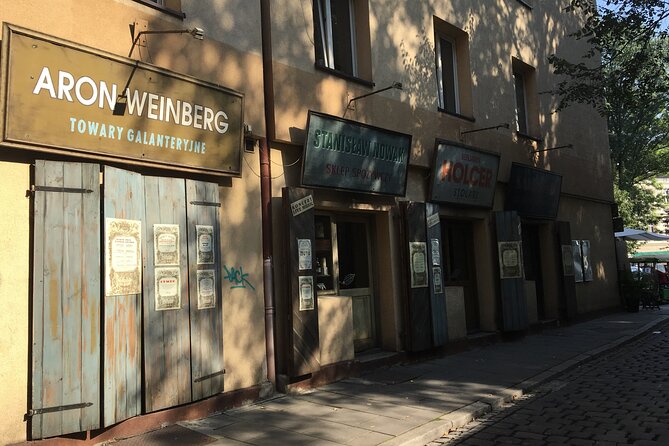
From Szeroka Street, the route passes near Isaac’s Synagogue and crosses Nowy Square before reaching a courtyard between Józefa and Meiselsa streets. The courtyard appeared in Steven Spielberg’s Schindler’s List, making it a recognizable place for film fans.
The 45-minute Kazimierz section is one of the more generous parts of the tour. You get time to connect individual places rather than simply stop, take a photograph, and move on. Isaac’s Synagogue adds another reference point, while Nowy Square helps show how public spaces function within the district.
I appreciate the film connection, but it should not be the whole reason to visit this part of Krakow. The value lies in seeing how the streets, synagogues, squares, and courtyards fit together. The film location is an extra layer, not a substitute for the neighborhood’s own story.
Because the route is guided by a person rather than an audio recording, you can ask for clarification when the chronology becomes complicated. That is where the whisper system helps. You receive the guide’s commentary through the device, so small details are less likely to disappear under street noise.
Wawel Hill and the Renaissance royal courtyard
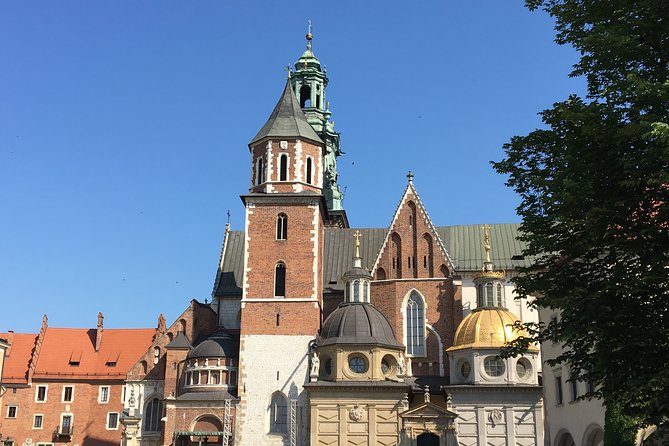
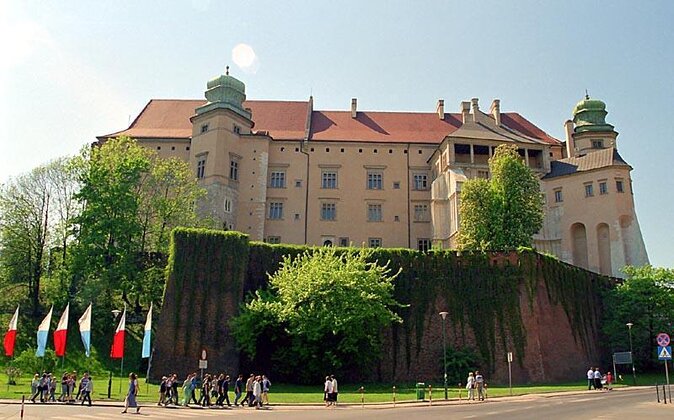
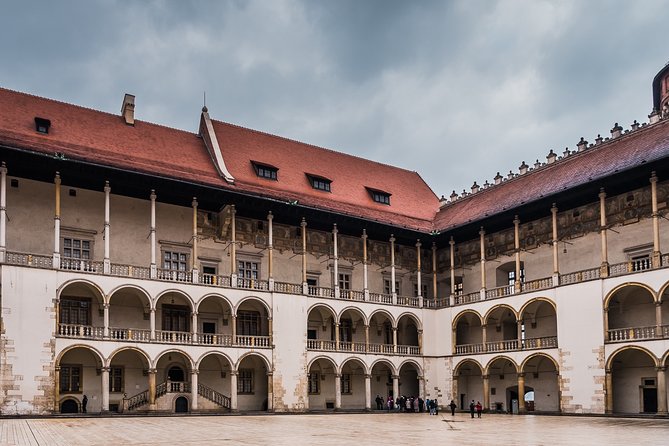
The walk continues to Wawel Hill, one of Krakow’s defining landmarks. The tour focuses on the Royal Castle courtyard, a 16th-century Renaissance masterpiece associated with Francesco Fiorentino and Bartolomeo Berrecci.
The visit to the courtyard is free and lasts about 15 minutes. That is enough for an introduction to the architecture and royal setting, but not a full examination of the castle collections or state rooms. If you want to see more of the castle beyond the courtyard, this tour does not promise that additional time.
Wawel works especially well as a transition point. After the streets of Kazimierz, the hill changes the scale of the story. You move from a neighborhood shaped by community life to the seat of Polish kings and the ceremonial center of the country.
The hill can also make the walking feel more demanding, particularly when combined with several hours on city streets. The tour is not recommended for people with impaired mobility, and that warning deserves attention. Even though most people can participate, you should be comfortable walking between multiple sites.
More Wawel Castle tours:
- Krakow: Wawel Castle & Cathedral Guided Tour
★ 4.7 · 2,111 reviews - Krakow: Wawel Royal Hill with Optional Castle and Cathedral
★ 4.2 · 1,220 reviews - Krakow: Wawel Castle and Cathedral Guided Tour
★ 4.6 · 595 reviews - Kraków: Old Town & Wawel Castle Walking Tour in English
★ 4.8 · 532 reviews
Wawel Cathedral and Poland’s royal past
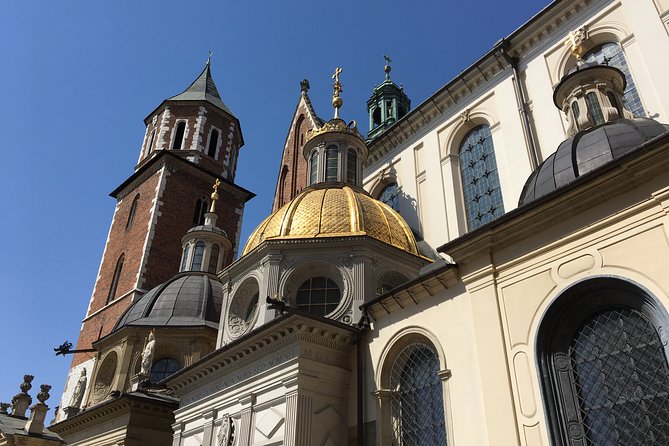
Wawel Cathedral is an optional stop lasting about 40 minutes. The cathedral is dedicated to Saint Stanislas and Saint Venceslas and has more than a thousand years of history. It served as a coronation church for Polish kings and as a burial place for rulers.
This is one of the most important optional additions on the route. The cathedral connects religious ceremony, national identity, and royal power in one building. If you want a stronger sense of Poland’s monarchy and sacred traditions, this is likely worth considering.
Admission is not included, so budget for the extra ticket. The 40-minute allocation is much longer than the courtyard stop, which suggests that the interior receives serious attention when your group chooses to enter.
The trade-off is time. Every optional interior visit reduces the time available elsewhere, and the tour still has several major stops ahead. I would ask at the start whether the group plans to enter the cathedral and how that affects the rest of the walk.
Kanonicza, Grodzka and the Franciscan Basilica
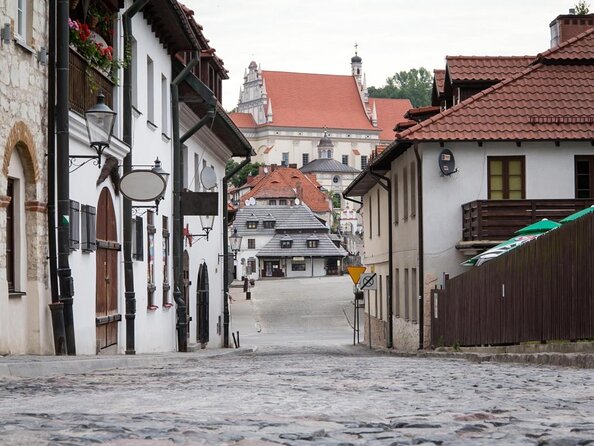
After Wawel, the route follows Kanonicza and Grodzka, described as among Krakow’s oldest streets. These streets lead to the Gothic Basilica of the Franciscan Friars.
The basilica is a short 15-minute stop, with no admission fee listed. The focus is on its polychromy and modernist stained-glass windows designed by Stanislas Wyspiański. This pairing is a fine reminder that Krakow’s churches are not all about medieval stonework. Interior color and modern Polish art also play a major role.
You should keep the stop’s length in mind. Fifteen minutes allows for a guided look at the main features, but it is not enough for a slow, reflective visit. If church interiors are a major interest, you may want to return independently later.
Still, the basilica earns its place because it breaks up the royal and marketplace sections of the tour. It adds a different artistic mood before you enter the university quarter.
Collegium Novum and Jagiellonian University
The university section begins at Collegium Novum, an impressive 19th-century building that serves as the seat of the rector of Jagiellonian University. The stop lasts about 10 minutes and is free.
From there, the route continues to medieval buildings connected with the former Krakow Academy. King Casimir the Great founded the academy in 1364, and it is now known as Jagiellonian University. Collegium Maius, the oldest university building, dates from the 15th century. Nicolaus Copernicus studied here.
This section gives the tour welcome range. You are not only seeing churches and royal buildings; you are also seeing the institutions that shaped Polish education and public life. The presence of Copernicus gives the university story a clear human connection.
The time is brief, but the buildings are close together. You can get the essential context without making the university quarter a separate half-day visit. If you want to enter Collegium Maius, confirm whether that is part of the planned route, since the stated stop describes the exterior and medieval buildings rather than an included interior visit.
Krakow’s Main Market Square and the Cloth Hall
The route then reaches Rynek, Krakow’s Main Market Square. Dating from 1257, it is described as the largest medieval square in Europe. Its present layout followed the destruction caused by the Mongolian invasion of 1241.
The square is a natural high point of the walk. It brings together trade, civic life, churches, and urban design in one broad space. You have about 30 minutes here, including entry into the Cloth Hall, the old textile market.
The Cloth Hall began in the 13th century and was remodelled in the 16th century with work linked to the Florentine artist Santi Gucci. The building shows how Krakow’s commercial importance was expressed through architecture, not just through goods sold inside.
Admission is listed as free for this part of the route. The guide can help you read the square as a planned medieval center rather than just a pleasant open space. That context is useful because the square can otherwise become a quick photograph between church visits.
A practical point: this is a busy part of the route, and the whisper system is particularly helpful in an open public space. Stay close enough to hear clearly and keep track of your group while moving around the square.
St Mary’s Basilica and the hourly Hejnał
St Mary’s Basilica is another optional interior visit, with about 20 minutes allotted. It was the most important church for Krakow’s bourgeoisie and contains a major Gothic work, the 15th-century wooden High Altar carved in linden wood by the German artist Veit Stoss.
The altar presents scenes from the lives of the Virgin Mary and Jesus Christ. If you care about medieval art, this is one of the paid additions most worth weighing carefully. The time is short, but the central artwork gives the visit a clear focus.
Admission is not included. As with the cathedral and Remuh Synagogue, you should decide based on your interests and budget rather than assume every interior is covered by the $65 tour price.
Next to the basilica, at plac Mariacki 5, the group listens for the Hejnał. This old melody is played every hour, four times, from the church’s highest tower. The stop lasts about 10 minutes and is free.
The Hejnał gives the Old Town section a memorable local detail. It is not merely another church fact; it is a sound that still marks the passing hour in Krakow. The timing of the tour may affect exactly how this stop works, so ask the guide how the 9:30 a.m. start lines up with the performance.
Floriańska Street, Saint Florian’s Gate and the Barbican
The final stretch follows Floriańska Street toward the medieval defenses. The tour ends near Saint Florian’s Gate and the adjacent Krakow Barbican.
The city walls date from the 14th century, and the Barbican provides a clear finish to the Old Town story. After seeing Krakow’s religious, academic, royal, and commercial centers, you end with the structures that protected the city.
This final location is practical as well as historic. The endpoint is close to the Barbican and near the northern side of the Old Town, making it a useful place to continue exploring after the tour. The route does not return you to Szeroka Street, so plan your next stop from the Barbican rather than assuming a round trip.
The last 20 minutes give the walk a proper ending. You can see how Krakow’s old center was entered and defended, then continue along Floriańska Street or remain near the Old Town.
What the $65 price really covers
At $65, the main value is the private guiding across a broad section of Krakow, not admission to every landmark. The price includes the guide’s time and the whisper system, while bottled water, coffee, tea, soda, transportation, and optional entry tickets are not included.
For a private group, the price can be fair if you value personal attention and a guide who can connect many periods of Krakow’s past. The structure also saves you the work of planning a route between Kazimierz, Wawel, and the Old Town.
The value is less clear if you want long interior visits. Remuh Synagogue, Wawel Cathedral, and St Mary’s Basilica all require extra admission, and the tour’s four-hour limit means you cannot linger everywhere.
I would view this as a strong orientation tour. It gives you the framework, the major landmarks, and the city’s broad story. You can then return to the one or two interiors that mattered most to you.
Who should book this walking tour?
I would recommend it to first-time visitors who want to cover Krakow’s main historic areas in one morning. It also suits families or private groups who prefer a guide focused only on them, rather than a large group with fixed questions and a slower loading process.
It is a good fit if you enjoy context as much as photographs. The route moves from Jewish Krakow to Polish royal power, Catholic art, university life, medieval commerce, and city defenses.
You should think twice if you have impaired mobility or dislike long walks. There is no private transportation, and the route includes many stops over four hours. It may also be less suitable if your priority is extended time inside museums, churches, or synagogues.
Marta’s praise is worth noting because the strongest feature here appears to be the human side of the experience. Her approach is described as friendly, helpful, clear, and thorough, with enough detail to make the city’s key sights understandable in a single day.
Final verdict: a strong Krakow introduction with paid extras
I like this tour for its route and its sense of proportion. In four hours, you move through Kazimierz, Wawel Hill, the university quarter, Main Market Square, and the medieval defenses without needing a taxi or a complicated map.
The private format and whisper system add real value, especially if you want to ask questions and hear every explanation. The main weakness is that the schedule is ambitious, and the most important interiors cost extra.
Book it if you want a well-organized first look at Krakow and plan to choose only the optional sites that matter most. Skip it if you prefer a slow museum day or need a less demanding route. Free cancellation is available if you cancel at least 24 hours before the 9:30 a.m. start, which gives you some useful flexibility when planning.
FAQ
Where does the tour start?
The tour starts at Szeroka 40, 31-053 Kraków, Poland, at 9:30 a.m.
Where does the tour end?
It ends near the Krakow Barbican on Basztowa, close to the Barbican.
How long does the experience last?
The walking tour lasts approximately four hours.
Is this a private tour?
Yes. Only your own group participates in the activity.
Are admission tickets included?
Admission tickets are not included for Remuh Synagogue, Wawel Cathedral, or St Mary’s Basilica. Other listed stops are described as free.
Is transportation provided?
No. Private transportation is not included, and the experience is conducted as a walking tour.
Can I cancel for a full refund?
Yes, if you cancel at least 24 hours before the experience start time. Cancellations or changes made within 24 hours are not refunded or accepted.
More Jewish Heritage Tours in Kraków
- Krakow: Schindler’s Factory & Ghetto Guided Tour
★ 4.7 · 1,694 reviews - Krakow: Jewish Quarter and Former Ghetto Tour
★ 4.9 · 1,441 reviews - Krakow: Kazimierz Jewish Quarter Walking Tour
★ 4.8 · 571 reviews - Krakow: Kazimierz, Schindler’s Factory & Ghetto Guided Tour
★ 4.8 · 460 reviews
Just added around Kraków
- Rynek Underground Museum & Wawel Castle, Cathedral – Cracow★ 5.0 · 3 reviews
- Schindler’s Factory, Ghetto and Plaszow Camp Guided Tour★ 4.7 · 3 reviews
- Nowa Huta – a guided tour of a utopian socialist city★ 5.0 · 3 reviews
- Krakow: Kazimierz by Golf Cart and Schindler’s Factory Tour★ 4.8 · 3 reviews
- Private Krakow City Tour by Car and Walk with private tour guide★ 5.0 · 3 reviews
- Krakow: Jewish Traces Private Electric Car Tour★ 4.1 · 3 reviews
- Discover the Jewish Quarter with a Bike Tour★ 5.0 · 3 reviews
- Krakow: Indoor Go-Karting (24-Minute Races)★ 4.8 · 3 reviews
Jewish Quarter & Ghetto Tours, compared.


Bike Tour of Old Town, Jewish Quarter and the Ghetto
Read our review →
Kazimierz, Schindler’s Factory & Ghetto Guided Tour
Read our review →
Full Bike Tour – the Old Town, Jewish Qtr & the Ghetto NEW BIKES
Read our review →
Warsaw Ghetto Private Walking Tour with Hotel Pickup
Read our review →
Bike Tour of the Old Town, Kazimierz, and the Ghetto
Read our review →Browse the lists this tour appears in