
REVIEW · JEWISH QUARTER & GHETTO TOURS
Past Meets Present in Warsaw’s Jewish Ghetto
Warsaw remembers in plain sight. This 2.5-hour walking tour connects Jewish social life before the war with the destruction of the ghetto and the courage of the Warsaw Ghetto Uprising. I especially like the small maximum group of 10, which gives the certified guide room to answer questions, and the focus on real places rather than a long list of indoor exhibits.
I also like the way the route moves from the former northern Jewish quarter to the main memorials, ending near Willy Brandt Square with suggestions for a nearby coffee stop. The main consideration is the walking: the tour is not recommended if you have mobility problems, and the $112.43 price is high for an experience with no admission tickets or refreshments included.
In This Review
- Key details to know before you book
- Why this walk matters in Warsaw
- Starting at Bankowy Square and the Jewish Historical Institute
- Długa and the former northern Jewish quarter
- Krasinski Garden and a pause outside the ghetto
- POLIN Museum Square and the Ghetto Heroes Monument
- Mila 18 and Anielewicz Mound
- Umschlagplatz and the road to Treblinka
- Willy Brandt Square and a reflective finish
- Is $112.43 a fair price?
- Who will get the most from this walk?
- Booking and cancellation details worth noting
- Should you book Past Meets Present in Warsaw’s Jewish Ghetto?
- FAQ
- How long does the Warsaw Jewish Ghetto tour last?
- What language is the tour offered in?
- What is included in the price?
- Is admission to the stops included?
- How large is the tour group?
- Where does the tour begin and end?
Key details to know before you book
- A 10-person maximum keeps the walk personal: The group size should make it easier to hear the guide and ask about Jewish history, Warsaw, and the uprising.
- Guide Mona receives especially warm praise: Her gentle manner, personal connection to the subject, and clear explanations are central strengths of the experience.
- The route covers seven meaningful locations: You visit the Jewish Historical Institute, Długa, Krasinski Garden, POLIN Museum Square, Mila 18, Umschlagplatz, and Willy Brandt Square.
- Every listed stop is free to enter: The price pays for the guided interpretation and time, not museum admissions.
- The walk ends near coffee recommendations: You finish at Willy Brandt Square, close to the final memorials rather than returning to the starting point.
- The mood is serious but not hopeless: The route deals directly with murder, deportation, and resistance while also recognizing survival and the continuing life of Warsaw’s Jewish community.
Why this walk matters in Warsaw
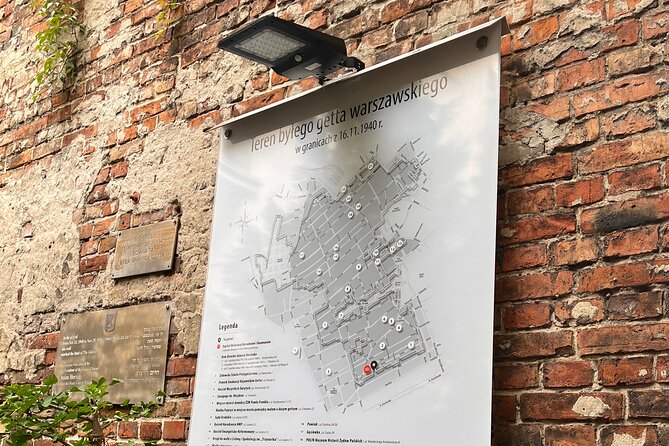
Warsaw’s Jewish Ghetto is not preserved as a single walled district. Much of what you see today is an urban neighborhood shaped by war, rebuilding, memorials, and ordinary modern life. That can make the past hard to read without a guide.
This tour gives you a framework. Instead of seeing a memorial in isolation, you learn how the streets connected to Jewish homes, shops, social institutions, forced confinement, deportation, and armed resistance. I find that approach far more useful than simply stopping at the best-known monument, taking a photo, and moving on.
The experience is also carefully scaled. With no more than 10 people, the guide can keep the pace measured and respond to questions. That matters on a subject that often raises difficult personal and historical questions. The feedback about Mona points to a guide who combines careful facts with humanity. She is described as gentle, personable, and deeply engaged with the story of the uprising.
You should expect an emotionally demanding walk. This is not light sightseeing, and the route includes places connected with the deaths of hundreds of thousands of Jewish people. At the same time, the experience is not presented only as a catalogue of suffering. It also considers human survival, courage, remembrance, and the continuing importance of Jewish history to Warsaw.
More Jewish Heritage Tours in Warsaw
- Warsaw: Warsaw Ghetto Private Walking Tour with Hotel Pickup
★ 4.9 · 369 reviews - Warsaw: Ghetto, Jewish Cemetery & POLIN Museum Private Tour
★ 4.8 · 132 reviews - Tour of the Warsaw Ghetto
★ 5.0 · 119 reviews
Starting at Bankowy Square and the Jewish Historical Institute
The tour begins at the Monument of Słowacki near Bankowy Square, listed at 00-142 Warszawa. From there, the first stop is the Żydowski Instytut Historyczny, or Jewish Historical Institute.
The building once served as one of the centers of Jewish social life inside the Warsaw Ghetto. Today, it holds an important archive of Jewish documents. The stop lasts about 15 minutes and has no admission charge as part of this experience.
That contrast between former social life and present-day documentation gives the tour a strong opening. You are not starting with a monument alone. You are first reminded that the ghetto was a place where people worked, organized, studied, worshiped, traded, and tried to maintain normal routines under terrible conditions.
The short time here means you should not expect an extended museum visit. The value comes from the guide’s explanation of the building and its role. If you want a longer look at Warsaw’s Jewish history, you will need to plan a separate museum visit. This walk gives you context, not a full day indoors.
Długa and the former northern Jewish quarter
The next stop is Długa, at the crossing with Nalewki Street. The stop takes about 10 minutes and is also free.
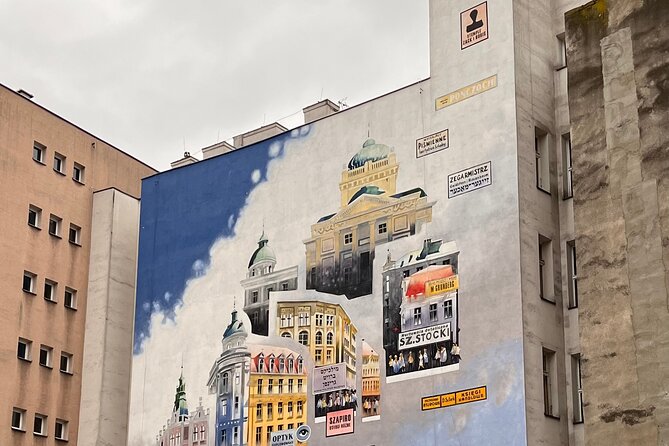
Before the war, Nalewki was one of the most active streets in the northern Jewish quarter. Shops, small manufactories, and market stalls filled the area. The description of this street helps correct a common mistake: thinking of Jewish Warsaw only through the lens of the ghetto and the Holocaust.
Here, the guide turns your attention to everyday city life. Streets were places of work and trade, not merely routes to memorials. That detail can make the later stops more affecting because you begin to picture the people and communities that once shaped this part of Warsaw.
Do not expect the same kind of intact historic street you might find in another European city. Warsaw was heavily destroyed and rebuilt, and the experience relies on explanation to reveal what is no longer visible. That is one reason the guide matters so much.
Krasinski Garden and a pause outside the ghetto
The 20-minute stop at Krasinski Garden brings a change of mood. This park was a place of rest for Warsaw residents and remained outside the ghetto during World War II.
The park’s role is historically important because it helps you understand that the ghetto was not the whole city. It was a forced, controlled space set within a larger urban area. The fact that Krasinski Garden was excluded from the ghetto gives the guide a chance to explain how boundaries affected movement, separation, and daily life.
This is also likely to be one of the more restful sections of the walk. After the first historical sites, a green public space offers room to pause and absorb what you have heard. I like that the route does not rush from one monument to another. Even a short stop in a park can help keep the experience human rather than purely chronological.
The trade-off is that a park may seem less immediately connected to the story than Mila 18 or Umschlagplatz. Its importance depends on the explanation of what it represented during the war. Listen for the geography. The point is not only the garden itself, but the line between the ghetto and the city outside it.
A completely different kind of day out in Warsaw:
- Warsaw: Chopin Concert in the Old Town
★ 4.8 · 2,287 reviews - Warsaw: Traditional Galar Cruise on The Vistula River
★ 4.6 · 1,640 reviews - Warsaw: Old Town Highlights Walking Tour in English
★ 4.7 · 1,516 reviews - Warsaw Concert: Chopin – Painted by Candlelights with Wine
★ 4.8 · 1,442 reviews
POLIN Museum Square and the Ghetto Heroes Monument
The tour then reaches the square beside the POLIN Museum, home of the Monument to the Ghetto Heroes. The scheduled stop lasts around 30 minutes.
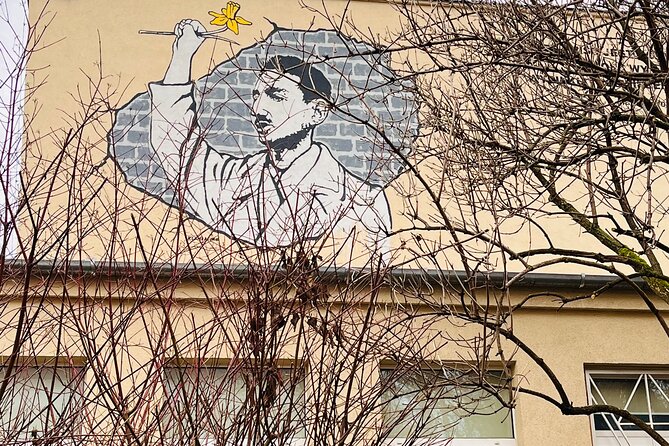
This is one of the key places of remembrance in Warsaw. The monument honors the Jewish resistance fighters of the Warsaw Ghetto Uprising and has become a central site for public commemoration. Each anniversary, people place daffodils here in memory of those who fought and died.
The daffodils add a simple, personal ritual to a monumental setting. They also connect the annual act of remembrance with the continuing life of the city. This is not history sealed behind glass. It is marked and revisited in public.
The nearby POLIN Museum is important context, but admission is not included in the walk. You should not assume the tour includes entry or a museum visit. If you have extra time in Warsaw, a separate visit may pair well with this experience, but the walking route itself remains outdoors and does not charge admission at the listed stops.
The 30-minute pause allows more room for questions and reflection than the earlier street stops. This is a good point to ask about the uprising, how it is remembered, and how the monument fits into modern Warsaw.
Mila 18 and Anielewicz Mound
At Mordechaja Anielewicza Street, the route reaches the Anielewicz Mound at Mila 18. The stop lasts about 30 minutes.
Mila 18 is associated with Mordechai Anielewicz, a leader of the Warsaw Ghetto Uprising. The mound commemorates the deaths of the uprising’s leaders. It is one of the most solemn points on the route because the site connects a physical place with the final moments of organized resistance.
This stop rewards a slower pace. You are not simply looking at an old building or a surviving wall. The mound marks loss, leadership, and the decision to resist despite the odds. The guide’s role is crucial here, since the meaning of the place comes through the story attached to it.
The personal account of Mona’s guiding style is especially relevant at this point. Her gentle approach is well suited to a stop that can feel heavy. The experience has been described as both heartbreaking and enlightening, with attention to the struggle of human survival rather than only military events.
The site also shows why a walking tour can add value even when no ticketed attraction is involved. You can visit a mound on your own, but a guide helps connect the location to the people, decisions, and wider events it represents.
Umschlagplatz and the road to Treblinka
The 15-minute stop at Umschlagplatz is among the most painful parts of the route. The monument marks the departure point for Jews transported to Treblinka extermination camp. Approximately 300,000 Jewish people died there.
This is not a place for rushed sightseeing. The name and function of Umschlagplatz point to the machinery of deportation: people were gathered, held, and sent away by train. The monument gives that process a location in the city, allowing you to understand that deportation happened through ordinary streets and rail connections, not in some distant, abstract setting.
Because the stop is relatively short, the guide must present the facts with care. You may want to ask questions, but you should also allow time for silence. The subject does not need dramatic treatment. Its force comes from the numbers, the place, and the human reality behind them.
This part of the tour makes clear why the route is not recommended for people seeking a casual city walk. The experience is educational, but it is also emotionally serious from beginning to end.
Willy Brandt Square and a reflective finish
The final stop is the Willy Brandt Monument at Willy Brandt Square. The memorial recalls Brandt’s tribute to the murdered Jews of Warsaw and to all victims of World War II.
Ending here gives the tour a different note. The route has moved through Jewish life, forced separation, resistance, deportation, and remembrance. The Willy Brandt memorial adds a later act of recognition and public responsibility.
The tour ends at Skwer Willy’ego Brandta near Mordechaja Anielewicza, rather than returning to Bankowy Square. That is useful for planning the rest of your day. You receive recommendations for a nearby coffee stop, though coffee and tea are not included in the price.
I like this ending because it gives you a practical way to come down from the subject. You can continue talking with the guide or your companions over coffee, or use the suggestions to plan your next stop in the neighborhood. The experience does not simply finish at the last monument and leave you to work out where to go.
Is $112.43 a fair price?
At $112.43 per person, this is not a budget walking tour. All seven listed stops are free, and coffee or tea is not included. The fee covers the certified guide, the route, and the interpretation.
So the value depends on what you want. If you only need directions to the monuments, the price will seem steep. If you want a small group, a structured route, and a guide who can explain the connection between Jewish life, the ghetto, the uprising, deportation, and modern remembrance, the cost becomes easier to justify.
The small group is a real advantage. A maximum of 10 people is much more manageable than a large crowd at memorials where sound carries poorly and questions can be awkward. The private-tour feedback also suggests that Mona can make the walk feel personal, even when the subject is broad and historically complex.
Group discounts are available, though the exact reduction is not specified. The tour is offered in English and uses a mobile ticket. Confirmation arrives within 48 hours of booking, subject to availability, so you should not treat the reservation as final until confirmation comes through.
Who will get the most from this walk?
I would recommend this experience if you want a focused introduction to Warsaw’s Jewish past and the Warsaw Ghetto Uprising. It suits people who prefer places and explanations over a long indoor program.
It is especially useful for:
- You are visiting Warsaw for a short time and want a concentrated historical walk.
- You want to ask questions in a small group.
- You are interested in both prewar Jewish life and wartime history.
- You value a guide who can handle painful subjects with care.
- You want to see several memorials in one connected route.
- You can manage about 2.5 hours of walking.
I would think twice if you have serious walking or mobility problems. The experience is not recommended for people with walking difficulties, and no alternative transport is described. You should also allow emotional space afterward rather than scheduling a rushed activity immediately after the final stop.
Service animals are allowed, and the meeting point is near public transportation. Most people can participate, but the walking requirement remains the main practical concern.
Booking and cancellation details worth noting
The experience offers free cancellation if you cancel at least 24 hours before the local start time. If you cancel later, the amount paid is not refunded, and changes made within that 24-hour period are not accepted.
The operator is Mona_be_your_guide. The tour is offered in English, and you should receive confirmation within 48 hours, subject to availability. Since the tour begins at Bankowy Square and ends at Willy Brandt Square, plan your route home from the final stop rather than assuming you will return to the start.
Should you book Past Meets Present in Warsaw’s Jewish Ghetto?
I would book it if you want a serious, carefully guided introduction to this part of Warsaw and are willing to pay for interpretation rather than admissions. The strongest reasons are the small group, the seven-stop route, and Mona’s warm, thoughtful way of handling difficult material.
I would skip it if you want a cheap, casual walk or if long periods on foot are difficult. For everyone else, this is a purposeful way to understand Warsaw through the places where Jewish life, persecution, resistance, and public memory meet. Give yourself time afterward for coffee and quiet thought. You will need both.
FAQ
How long does the Warsaw Jewish Ghetto tour last?
The tour lasts approximately 2 hours and 30 minutes.
What language is the tour offered in?
The tour is offered in English.
What is included in the price?
A certified guide is included. Coffee and tea are not included.
Is admission to the stops included?
All listed stops have no admission charge as part of the experience. Entry to the nearby POLIN Museum is not listed as included.
How large is the tour group?
The experience has a maximum of 10 participants. Group discounts are available.
Where does the tour begin and end?
The tour begins at the Monument of Słowacki near Bankowy Square in Warsaw. It ends at Willy Brandt Square, where you receive recommendations for a nearby coffee stop.
Just added around Warsaw
- Jewish heritage in Warsaw★ 4.5 · 3 reviews
- Warsaw Outdoor Paintball with Transfers (all year round)★ 5.0 · 3 reviews
- World War II Warsaw Old Town, Military Cemetery Walking Tour★ 4.7 · 3 reviews
- Warsaw: Wolf’s Lair & Swieta Lipka Small-Group Tour + Lunch★ 5.0 · 3 reviews
- Sunset Boat Tour with Unlimited Drinks in Warsaw★ 3.5 · 3 reviews
- Majdanek – German camp from II World War – Private Tour – 1 DAY TRIP FROM WARSAW★ 5.0 · 3 reviews
- From Warsaw: Guided Tour to Wieliczka Salt Mine and Krakow★ 4.5 · 3 reviews
- Warsaw Sightseeing with NEW Mercedes Sclass !!!★ 5.0 · 3 reviews
Jewish Quarter & Ghetto Tours, compared.


Bike Tour of Old Town, Jewish Quarter and the Ghetto
Read our review →
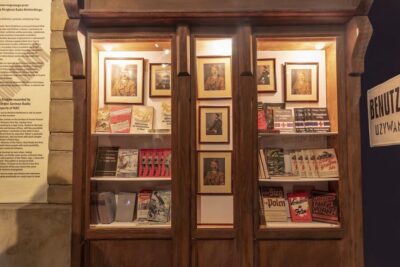
Kazimierz, Schindler’s Factory & Ghetto Guided Tour
Read our review →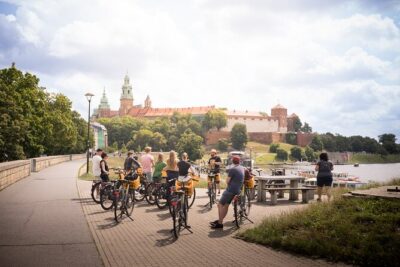
Full Bike Tour – the Old Town, Jewish Qtr & the Ghetto NEW BIKES
Read our review →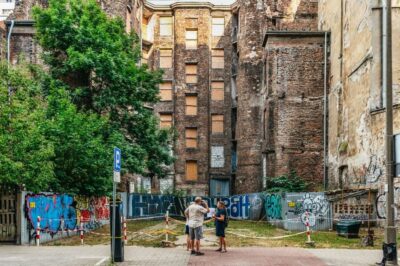
Warsaw Ghetto Private Walking Tour with Hotel Pickup
Read our review →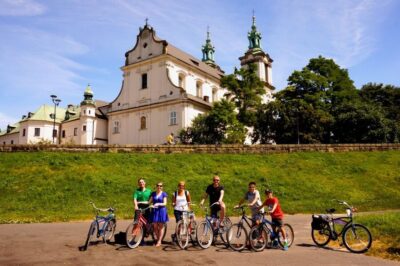
Bike Tour of the Old Town, Kazimierz, and the Ghetto
Read our review →Browse the lists this tour appears in